Category Archives: Tasmania

Tasmanian Writers Festival in Hobart

Through last Friday, Saturday and Sunday I participated in workshops and attended discussion sessions presented by individual and groups of local, national and international writers.  Three wonderful days. The venue was perfect, the scheduling of sessions was well timed, the selection of guest speakers provided a rich cross-section of approaches and ideas, and the administration each day by the staff and volunteers associated with the Tasmanian Writers Centre was seamless and seemingly trouble-free.

In particular, I was alert for approaches by which I might turn my walk from the mouth to the source of the Derwent River into a fictional account once the walk is over. Throughout the weekend, I was reminded that the clichés of real life have no place on the page of a novel, that I must stop emphasizing the factual and place emphasis on the underlying emotional and troubling aspects of the story, and that links between the events of the walks could be made on the basis of association rather than chronology. Overall, it seems I should write to bind a reader to the experience not the facts, and that it is best to do so by following a chain of emotional connections. Easier said than done, however these ideas give me a basis on which to start thinking about how the story might unfold.

Memorable sentences from the Festival include:

  • Stand back from your real/true story and view it as a reproduction; as a photo or video made by someone else.
  • What is in memory is not necessarily real.
  • By assigning characters to aspects of the bush / the landscape we shape our own characters and beliefs.
  • Where you stand influences what you see.
  • Real experience is not necessarily a personal experience.
  • The unexpected makes the invisible visible.
  • Use secondary characters to make main character more plausible.
  • If you have a lot of backstory then you have started too late in the story.
  • It is better to write about something you are apprehensive about.

In one session, internationally renowned author Robert Dessaix remarked that he ‘liked himself in India’ and Paris but not in Rome. I liked myself at the Festival venue Hadleys Orient Hotel Hobart for the duration of the Festival.  I believe I will like myself even more in the vicinity of the Derwent River when I walk the edge during the coming days, on the first stage since April.  Spring has arrived!

Maps

The Derwent River will always be your guide if you choose to walk along its length, but sometimes it is difficult to walk directly next to the river; for example structures may be built to the edge, steep drop down cliffs may raise you many metres above the water, and gates and fences may make access impossibly impassable.  In addition, when the terrain forces you away from the river, the vegetation may be sufficiently dense so that you can get lost (without map and compass – and GPS if your technology allows).

If you choose to walk the entire length of Tasmania’s Derwent River you might consult one or more of the 17 maps which cover the territory. One value is that you learn the name and shape of landmarks. Have a look at the list below:

Maps

The Derwent River at night

Tasmania’s bush, its coast and urban areas offer a photographer’s paradise at all times of day and night across the four seasons.

This Amazing Planet  is one of many blogs that show spectacular photographs of Tasmania’s flora, fauna and landscape. Go to Nightscape-Hobart for a stunning visual treat. Enjoy looking at part of the glorious Greater Hobart Area, at night, photographed from on top of Mount Wellington. Between the two sides of the city, the rich blue Derwent River passes on its way to Stormy Bay and then the sea. The brightly lit Tasman Bridge can be seen to join the two shore lines.

From the sea to the source; stories of a river on the other side of the globe

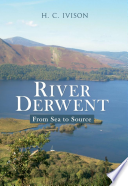
Two years ago, Helen Ivison published River Derwent: From Sea to Source (Amberley Publishing).

 Ivison River Derwent

 The promotional puff declares this book ‘brings to light tales and stories of fascinating events, landmarks and people. River Derwent: From Sea to Source is essential reading for anyone who knows this river well, and also for those who are visiting the River Derwent for the first time.’  But what is the author referring to?

Hers is the Derwent River in the Cumbrian region of England which flows from the mountainous Lakes District in two strands, one of which starts near Styhead Tarn. The two strands meet at Grains Gill, and continue in a north easterly direction as a single river towards an expanse known as Derwent Water. The river passes through this ‘lake’ then eases into a north westerly direction across country before flowing onwards through Bassenthwaite Lake. Finally, the English Derwent River turns westwards and empties into the Irish Sea.

By contrast Tasmania’s Derwent River flows generally in a south easterly direction from Lake St Clair, through steep narrow gorges, curving around farmlands, before passing between the two sides of the Greater Hobart Area into Storm Bay. The man-made lakes of Lake King William, Wayatinah Lagoon, Lake Catagunya, Lake Repulse, Cluny Lagoon and Meadowbank Lake all disrupt the progress of the River. These lakes have resulted from dam building as part of hydro-electricity generating projects over the past century.

Internet records of measurements may be dodgy

Since my last post, some readers found Google has revealed the length of the Derwent River.  It gives the number of 249km without any indication of where that number was found or how it was calculated. Immediately below this information box are two listings both giving alternative conflicting distances.

My measurement of 214kms was from an arbitrary line between Cape Direction and Pearsons Point to mark the mouth of the Derwent River, and I stopped at the point where the river starts from the southern end of the Lake St Clair Lagoon.

I have noticed that one source indicates the measurement ought to be taken from the point where Lake St Clair meets the Lake St Clair Lagoon.  I have found another source which seems to indicate the mouth might be where Storm Bay meets the sea.  Even if the length of the Lagoon and the width of Storm Bay were added to my 214km, the Google number would not be reached.  I have asked Google to identify its sources because I cannot believe their number can be accurate. Unfortunately, I have not received any feedback.

STOP PRESS – JUST DISCOVERED THE AUTHORITATIVE LENGTH IS 215KMS.  Read my new November 2015 post.

The length of the Derwent River

Past readers of Frequently Asked Questions know that I have not been able to discover the ‘real’ length of the Derwent River.  In conversation recently with blog follower Yo, I was reminded of the challenges involved with determining river lengths.

If a river empties into a sea by more than one waterflow, then which is the ‘real’ river? Do we say there are two river lengths for the same river in such a circumstance?

If a river enters into a bay which opens onto a sea, where does the river end?

If the mouth of a river is a complex delta receiving silt flows and forever changing, can we pinpoint the location of the river mouth? At which time could a reliable measurement be made? No and never, are the answers to these questions.

At the source, rivers sometimes start with a dribble of water oozing from the ground. Is that enough to be able to define the water source as a river?  Some rivers pour from Lakes. Is the middle of the lake the start of the river or is that bank over which the water leaves the Lake, the official starting point? If a dam has been built at the junction of the lake and river, then the starting point may be the water at the top of the dam or at the bottom of the dam – leading to a different final river length.

What about rivers such as the Nile River which have at least two waterflows starting inland and which then meet to form one river?  Which waterflow counts towards the measurement of the river’s length? Or does the river start where the two or more waterflows merge?

Rivers do not travel in neat straight lines so should we measure the distance along the riverbank? If so, which bank?  The shape of the shoreline on either side of a river can be markedly different from each other and one side is usually longer than the other.

How about measuring the length of the river taking a centre line? Will that give the most accurate measurement?  This is the preferred method, however many of our measuring devices are straight – think ruler, think tape – so how can we make a reliable measurement?

On the first day in December 1873, the Commissioner of Patents for Inventions under England’s Patent Law Act 1852 recorded Edward Russell Morris’s invention of a pocket instrument which could measure distances on curved lines.  Since the 19th century, various variations have been developed.

If you check on EBay online, many historical versions of Opisometer Curvimeter Meilograph Map Measurers have been photographed, and are offered for sale. Opisometers have a tiny wheel at one end which, when rolled on a map along a road or river, connects with a graded scale in either a straight or circular format to read a distance. The unit markings refer either to kilometres or miles. You can watch a demonstration of one of these measuring tools on You Tube .

A bushwalking friend purchased an Opisometer many years ago and lent it to me so I could ascertain the length of the Derwent River more closely.  Today I used the Opisometer by rolling it on my maps, along an arbitrary ‘line’ in the centre of the river.

20150828_125903

After using the Opisometer on all seventeen 1:25,000 maps that cover the Derwent River, it seems the length is 214 Kilometres (refer to Frequently Asked Questions for a table showing the breakdown per map).

Based on my measurements today, so far I have walked against 61 kilometres of that length.  I can see that any previous measurements reported in my blog, have been wildly inaccurate – generally too low.

Religious wildernesses

I remember childhood Bible stories referred to the Wilderness. These days I find it interesting to consider most if not all religions link with the concept of the wilderness. Laura Feldt covered this topic in “Wilderness in Mythology and Religion”: ‘Wilderness is one of the most abiding creations in the history of religions.’ Her book ‘addresses the need for cross-cultural anthropological and history of religions analyses by offering in-depth case studies of the use and functions of wilderness spaces in a diverse range of contexts including, but not limited to, ancient Greece, early Christian asceticism, Old Norse religion, the shamanism-Buddhism encounter in Mongolia, contemporary paganism, and wilderness spirituality in the US.’

In her 2014 article ‘Religions need wilderness’, Kathleen Braden wrote “The three monotheistic religions based on a common root – Judaism, Christianity, and Islam – have an expression of nature and wilderness as places that allow perception of God’s sovereignty. … Wilderness is a territory (both on land and sea) where one encounters God, and it is not always an easy geography. For the ancient Israelites, it may be a place of repentance coupled with renewal. When the Israelites leave Egypt and displease God, they must wander in hostile lands before reaching a promised place. Abraham casts the slave woman, Hagar, into the wilderness, but she is saved by God, who renews her spirit and gives her a vision that she will build a great nation. Similarly, in the New Testament, the gospel of Mark begins with John the Baptist proclaiming God in the wilderness, foretelling the Christ who is to come, and calling for, again, repentance. Jesus has his own time in the wilderness being tested and honed for his ministry. For believing Muslims, creation is a gift from God and a sign of God’s grace. Similar to Judaic and Christian traditions, in Islam, nature reflects the dominion of God, not the hubris of human control. For these three monotheistic faiths that began in the Middle East, groups of believers through history have set themselves apart in monastic communities, often seeking out the wild places in self-imposed exile to allow the voice of God to be understood more clearly.

In other religions, nature and the sacred helps bring humanity into a right relationship with creation. Baha’i traditions hold that nature reflects the perfection of God and thus, sacred spaces help create a sense of harmony, transformation, and wholeness. In Hinduism and Jainism, nature reflects the abundance that the earth provides and also reminds us of the wholeness of humanity with all other life forms: there should be no barriers or separation.

Likewise, Buddhism suggests that nothing that exists is in isolation, but the sacred can lead us to understand the interdependence of all living things and help us express compassion for creation. Some sects of Buddhism also have, like the desert Christian communities, an ascetic tradition, adherents who must be removed from the material world. Their spiritual quests may be best realized in wilderness.

Religions or traditions with cultural hearths further east in Asia – Shintoism, Confucianism, Daoism – also have expressions of harmony and continuity with nature, but perhaps more in a cosmological view, although places, such as sacred stands of trees with shrines in Shintoism, may be manifest of the need to have a holy place of contemplation and refreshment.

Finally, Indigenous religious traditions are so varied and numerous that outlining them in a short essay might risk stereotyping these faiths. But in many regions, Indigenous spiritual traditions connect the wild with a worldview that interweaves humanity with nature in an unbroken relationship. Whether the shamanistic traditions of Central Asia, Native American religions of North and South America, pre-Christian European practices, animistic faiths of the African continent, or contemporary paganism, none are devoid of practices and stories related to the human relationship with nature. 

While the sacred does not have to be wilderness, wild places must be sacred. Religion needs wilderness. Whether we call this hunger an expression of God’s sovereignty or evidence of the union of all living things or connection with ancestors and a world of spirits, religion requires the wild – the not-us – to show a crucial interrelationship. The threats to wilderness, therefore, also pose a danger to the heart of humanity’s most treasured faith doctrines.”

As an atheist I don’t believe a God or other deities exist, whatever name is given by any religion. However, I am happy to be playful with one ancient Greek god who came out of retirement to meet me. A recent comment by my sister about the danger of snakes when I walk in the Tasmanian bush (all Tasmanian snakes inject their venom poisonously), reminded me of my meeting with Zeus last year. While walking in the visitor-less grounds of one of his temples located in Dion, northern eastern Greece, he and I surprised each other. Zeus has the ability to transform himself and appear as a snake. There he was basking in the sun near the end of the path I was following. Having welcomed me, he slipped away quickly.  I felt very safe then, as I will do when walking along the Derwent River. Besides, Tasmania’s Mt Olympus overlooks Lake St Clair on its western flank, and we all know Zeus’s home is Mt Olympus, albeit the one in Greece. I suspect Zeus will look out for me in some form, and make sure I reach Lake St Clair.

Despite not believing in a God, I do believe in the personally transformative power of the bush, wilderness, forests, whatever you may call those bunches of trees and natural collections of flora and fauna.

When with friends I have talked about walking, particularly in the bush, as a meditative practice. Sometimes the impact of the bush and its flora and fauna is so great that a well of great happiness is tapped – as evidenced, for example, by my bursting into song as described in an earlier post . At the end of any walk, words such as reinvigorated, revitalised, relaxed, uplifted, satisfied and at peace always come to mind. In addition, the power of the bush allows me to put the rest of life and living into perspective. Nature and its forces are so much stronger and more beautiful than any one of us, and it is a delight to be reminded of this in such profound ways. The rich rare world out there, rather than any religious connection, draws me to our wilderness.

Wilderness – what is it?

The word ‘wilderness’ has different meanings depending on context. Dictionaries offer a range of similar meanings:

  • An uncultivated, uninhabited, and inhospitable region. Neglected or abandoned.  A large area of land that has never been developed or used for growing crops because it is difficult to live there. (Oxford)
  • An unsettled, uncultivated region, especially a large tract of land that has not been significantly affected by human activities. A barren or desolate area; a wasteland. Something characterised by bewildering vastness, perilousness, or unchecked profusion. (The Free Dictionary)
  • A wild, uncultivated region, usually where humans do not live. Any desolate tract or area. (WordReference.com)
  • A tract or region uncultivated and uninhabited by human beings. An area essentially undisturbed by human activity together with its naturally developed life community. An empty or pathless area or region. (Mirriam Webster dictionary)

From Old English used in the 13th century, the word ‘wilderness’ is derived from wild dēor ‘wild deer’, wilddēoren ‘wild beasts’, and from wildēornes, ‘land inhabited only by wild animals’. From Middle English, wildern is ‘wild’.

Reflecting on these varying definitions, I realise some of the meanings ring true particularly in relation to the land along the Derwent River between Lake Catagunya and Derwent Bridge (I anticipate this part of the River will take at least 8 days to walk, over three stages).

Lake Catagunya to Derwent Bridge

The sides of the River will be uncultivated and uninhabited. Its dense forest, littered with generations of massive tree falls, will make some sections relatively inhospitable.  The only markers of human kind will be parts where old growth logging has or is occurring, and where the infrastructure associated with dam construction across the Derwent River has occurred and is being maintained.  The area will not be barren, desolate (although I might feel desolate when penetrating some of the denser bush hour after hour), and it is not neglected, abandoned nor a wasteland.  This wilderness will be rich with flourishing flora and fauna, have profound connections with the original indigenous population pre-European settlement of Van Diemen’s Land, hold a social history with the settlers who moved inland in the 1800s and 1900s, and include an occasional contemporary history with photographers, tourists and fishermen.

The United States of America has proclaimed special legislation. ‘The Wilderness Act bans all kinds of motors, roads, and permanent structures from large tracts of American territory. It provides a legal definition of wilderness, as land that’s “untrammelled by man” with a “primeval character and influence”.’  You can read more at this site.  What is the Australian situation?

The Wilderness Society of Aus logo

The Wilderness Society of Australia summarises our state-based rather than national legislation in relation to the wilderness. ‘Dedicated wilderness legislation exists in NSW and SA, which allows the nomination, assessment, declaration and management of wilderness. In other States, such as Victoria, Queensland, WA and the ACT, management of wilderness is provided for under general nature conservation legislation, with varying degrees of usefulness in terms of actually ensuring identification and appropriate protection.’

In Tasmania we have a range of legislation including the most recent Tasmanian Forest Agreement Act that was negotiated to include the requirements of the Tasmanian Wilderness World Heritage Area (TWWHA) – that is, those parts of Tasmania which have been recognised with World Heritage listing for their natural and cultural heritage that is important to the world community.  Tasmania’s Nature Conservation Act talks about biological and geological diversity, and historic sites and provides regulation for our fauna (and strangely it also covers animals which do not live in Tasmania such as dingos and wolves) and flora. The word ‘wilderness’ does not appear.

stock-photo-64271807-walking-boot-and-bike-tread-marks-on-muddy-trail(Image is a free iStock photo)

The land on which I will walk has been walked for thousands of years originally by our indigenous ancestors and more recently by their descendants and European settlers. However, there will be parts on my trek which will not have had many footfalls because of the isolation and the forest density.  Unless there was a purpose such as surveying the Derwent River as part of planning to build dams, sensible people would travel from Lake St Clair towards the coast  via the region around the township of Ouse, or by more hospitable routes. With or without the word ‘wilderness’ being written into our state legislation, much of the inland edges of the Derwent River edge are undoubtedly genuine wilderness.

Another Special Anniversary

Implementation Milestone remembered:

22 August 2014 was the date when I made the first walk and commenced my long journey from the mouth of the Derwent River on the northern side, in the South Arm area.

On that first walking stage I recorded the weather as: “The sky was blue and cloudless but I was rugged up and beanied to avoid the early morning chill.” At the start of stage 2 on the 5th September the blog recorded:  “The sun is shining. Air is crisp.”  I recall that on both occasions the day warmed so the walking was very comfortable.

Derwent Valley Gazette

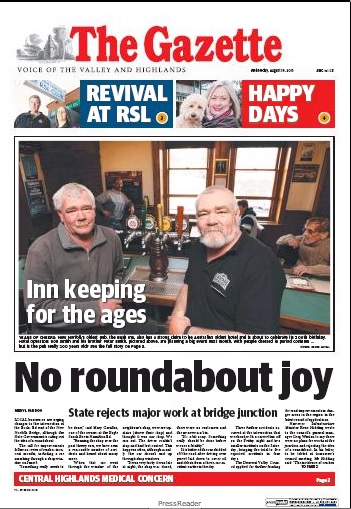
Despite the Derwent River emptying into the sea approximately 60Kms east from New Norfolk, reference to the Derwent Valley usually centres on New Norfolk and further west then north west. The reach of the Derwent Valley’s newspaper extends further to the highlands around the hundreds of lakes in central Tasmania. The Gazette (http://www.pressreader.com/australia/the-gazette-derwent-valley/textview)  is the ‘voice of the valley’.

The Gazette front page Aug 2015

I expect this regular newspaper will provide insights into local conditions and activities which might impact on my future walks.  For example, I have discovered there will be an Ouse & Highlands Festival on Saturday the 17th October. An entry on the Facebook site https://www.facebook.com/Ouse.festival) gives an indication of progress: ‘As part of the Children”s entertainment at the Festival we now have The Balloon Lady booked in as well as a Face Painter. It’s looking good.’ Another future activity will be the first stage of a trout fishing contest, the Tasmanian Trout Classic scheduled for the 29 and 30th August somewhere near New Norfolk.  Subsequent stages will be held at Arthurs Lake and the Great Lake.  Apparently last year’s contest attracted ‘huge interest from around the Valley, with a great crowd at daily weigh-in.’ It is a different world in the Valley: recent players at the New Norfolk Golf Club found ‘the entire course was frozen, but that didn’t stop some red-hot scoring.’

I look forward to reading more snippets of information about that new world inland from Hobart.

The weather in southern Tasmania

The early non-indigenous settlers in Van Diemen’s Land (now Tasmania), almost all of whom were formerly residents of the typically rainswept and cool British Isles or had lived in hot India, documented their thoughts on the weather.

Their descriptions of our weather were usually based on comparisons with the situation from which they had relocated. Generally the impression given is that the weather on this island is temperate, irritatingly variable, and considerably easier to live with compared to that experienced in the settlers’ original homelands. For example, in James Bischoff’s “Sketch of the History of Van Diemen’s Land” written in 1832, there are many references to the climate and its relationship to agriculture and animal husbandry. More generally he says: ‘To one accustomed to the moist climate and plentifully watered countries of England, Scotland, and Ireland, Van Diemen’s Land, at first sight, may present a dry and unproductive appearance; but upon a nearer acquaintance, it will put on a more inviting aspect.’  It was ‘the regularity and salubrity of its climate’ which Bischoff found attractive.  The author also claims that ‘A book was published at Calcutta, in 1830, giving an account of Van Diemen’s Land, principally intended for the use of persons residing in India, and shewing the advantages it holds out to them for their residence; the following is extracted from that work: Its climate seems so well adapted to the renovating of the constitution of those who have suffered from their residence in India, that it only requires to be pointed out, and the easiest manner of getting there made known, as also the cheapness and comfort of living, when there, to turn the tide of visitors to the Cape and the Isle of France, towards its shores.’

Godwins Guide to Emigrants to VDL

Godwin’s “Emigrants Guide to Van Diemen’s Land more properly called Tasmania held in the collection of the State Library of Victoria, written in 1823, offers the following: ‘This island has to boast of perhaps the most salubrious and congenial climate of any in the known world, for our European constitution: It has been ascertained by the thermometer to be similar to that of the south of France; the general temperature being about 60 degrees Fahrenheit, and the extremes from 43 to 80 degrees. The spring commences early in August, the summer in November, the autumn in March, and the winter in May. The winter, therefore, is not of more than three months’ duration, and the severest part only six weeks.’

Ros Haynes writes on a University of Tasmania site in 2006 ‘In most areas there was adequate rainfall, the climate was more conducive to growing the crops they were used to …. The temperature was also considered more invigorating than the heat and humidity that enervated settlers in the other Australian colonies. Van Diemen’s Land was soon marketing itself as the ‘Sanatorium of the South’, famous for its flowers, fruit and healthy inhabitants.’

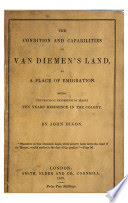
Dixons cover

John Dixon, in his 1839 book (available as an E-book) “The Condition and Capabilities of Van Diemen’s Land, as a Place of Emigration: Being the Practical Experience of Nearly Ten Year’s Residence in the Colony“, explained, ‘Lingering illness is seldom heard of in Van Diemen’s Land: and, in consequence, the deaths always seem to be sudden.  These seeming sudden deaths may contribute to praise of the climate: for they may improve its salutary influence, by sustaining the body in health longer there, than in the climate of another country.

These days we would describe our climate as being cool temperate with four distinct seasons. However, across the island, our temperature and rainfall ratings vary according to topography, nearness to the coast and time of the year.  Despite Tasmania’s capital city Hobart being the Australian capital city located closest to South Pole, it is known as the nation’s driest capital city.  By contrast, parts of the west coast of Tasmania expects rain for more than 300 days each year – I lived in Queenstown once and it rained for three weeks straight leaving me feeling very sun deprived.

Helpful tip

When you visit Tasmania for the first time, you will find any and everyone will be happy to talk with you about the weather – for many minutes at a time.  Such conversations may help you to make new friends.  However, please avoid some pitfalls. If you normally live in a super cold climate it may not be appropriate to say our weather is so mild and lovely here, when powder snow tops our mountains in the distance and light drizzle saturates the ground – because we may not think highly of the weather under those circumstances.  Similarly if you come from a very hot climate it may not be appropriate to say the weather is so gorgeously moderate here when we have a 35 Celsius degree day, because it is likely we will consider that to be a hot day. I guess we all have our peculiarities.

Walking again – not yet

Regular blog readers know I am eager to restart my walk inland along the Derwent River, and that my next travel date is dependent on the weather being suitable.

Despite unexpected occasional snow flurries in the higher areas, Hobart’s rising temperature and minimal rainfall has become more agreeable by the day, so recently I decided that it was time to tackle the walk west from New Norfolk to Gretna at the end of this week.

Unfortunately, the long range weather forecasts in the Bushy Park area, where I will be camping overnight before passing through, indicate the mornings will be -3 degrees and the days only rising to 14 degrees maximum (I cannot see any pleasure in breaking the ice in the morning to make a cup of tea).  In addition, a few splashes of rain are forecast. In reading these projections, I am reminded that the climatic situation in Hobart is not the same as in areas located many kilometres inland.  So, regrettably I must let a few more weeks pass before continuing on.

For me the perfect walking environment includes a temperature of between 15 and 21 degrees Celsius, a sunny day preferably without a cloud in the sky, and almost no breeze (definitely no wind). Before each walk I hope rain has cleaned the air so that all the green vegetation sparkles – but that everything I stroll through is no longer wet. During the early walking stages, I had quite a few of such lucky days – and I am hoping for more.

Best Bester Bestest Good Gooder Goodest

Did I attract your attention? Did I make you cringe? Perhaps I need to improve my writing or some other feature.

Blogger and follower of my blog, Ma, recently forwarded me a connection to Karen Andrew’s ‘10 Tips to Improve Your Blogging’. If you subscribe to Andrew’s newsletter she forwards the e-book to you for free: go to her site  if interested. The intention of today’s post today is to try out one of her suggestions. Andrews recommends bloggers ask their readership for ideas for improvement.

If you read the Frequently Asked Questions section on my blogsite you can see a list of my intentions for this walking project. Do you think I can achieve some of these goals in a better way? If so, what should I do?  Should the content be different?  If so, what ideas do you have? How about the format of the blog – should that be different?  If so, what suggestions can you make?

A big thankyou

I have been delighted with the engagement of many of my blog’s followers – those who give me gifts of links and connections to information and ideas are truly valued. Thank you. And an additional special thank you to all the writers of those wonderful blogs that excite and motivate me, and for those that make me rethink my conditioned and tired old ways of thinking. Blogging has opened new worlds for me.

Tasmania’s native purple berries

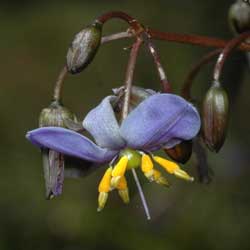
Blog reader Ma reminded me of the Flax Lily, a native plant well known to indigenous Australians – the Tasmanian Flax Lily is the Dianella tasmanica.  The purple flower petals spread around glowing yellow stamens and are very distinctive when you come across them in the bush. The resulting fruit are glossy purple berries.  The photos below come from https://www.anbg.gov.au/gnp/interns-2009/dianella-tasmanica.html

dianella-tasmanica-flower dianella-tasmanica-berries

Apparently the berries of mainland Australia’s varieties are edible and taste something like grapes, and can be made into jam.  When walking, I have simply admired their colourful occasional presence in native bushland whenever I have seen them.

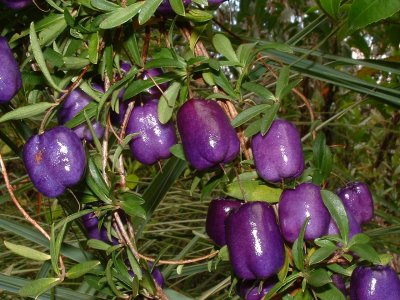
Tasmania has an additional plant with brilliant purple berries.  It is the Billardiera Longiflora otherwise known as the Mountain Blue Berry or Mountain Berry. The photo below is taken from http://www.wildseedtasmania.com.au/climber.php

 Mountain Blue Berry

The same site indicates these berries are edible. I have passed these berries many times when walking in the bush but I have never picked or eaten any.  I rather like the idea of leaving the bush as I find it.

The Outlaw Gardener at http://outlawgarden.blogspot.com.au/2013/08/billardiera-longiflora-my-favorite.html presents a range of stunning photos of the Mountain Berry.

Yam Daisies

Thanks to information and photographs supplied by blog follower, Ma from Melbourne, I will be more alert for the plant and flower Microseris scapigera or Microseris lanceolata known by indigenous Australians as Yam daisy or Murnong. Ma told me these plants would provide nourishment as I walked.

Yam daisy Microseris-scapigera-2-226x226

The photo above is located on http://www.victoriannativeseed.com.au/?product=yam-daisy . As the flower continues to open, the similarity with our common dandelion becomes obvious, and a number of websites suggest the dandelion head is similar to the seed head of the Yam Daisy.  It seems perfectly understandable that this plant may be referred to as the native dandelion and it explains why, when walking in our bushland affected by the intrusion of exotic plants, the possibility of misidentification exists. From Wikipedia I have learned that ‘the Tasmanian form is markedly smaller than the mainland Australian form’.

According to http://www.anbg.gov.au/gardens/visiting/exploring/aboriginal-trail  ‘This small perennial plant … has a radish-shaped tuber, which is renewed each year. In the spring the plant forms a yellow flower-head like a dandelion, and in the summer the leaves die off and the tuber becomes dormant. The tubers were cooked in baskets in an earth oven, producing a dark sweet juice which was much liked.’

The Yam Daisy has offered a traditional source of food for indigenous Australians. Wikipedia claims the tubers were ‘prepared by roasting or pit baking; the taste is described as “sweet with a flavour of coconut’.  Sounds yummy to me! The website http://www.parksaustralia.gov.au/botanic-gardens/pubs/aboriginal-plantuse.pdf tells us that the ‘Yam Daisy was a most important staple food. Women dug the roots with digging sticks and then roasted them in baskets in an earth oven. Digging for roots turned over the soil and thinned out the root clumps, two ways of encouraging plant production. Aboriginal people didn’t take the lot or there’d be none left for next time! Aboriginal people believed that the roots of ‘murnong’ should not be collected before the plants flowered. This was probably because during the drier winter period before springtime flowering, the roots would not be fully developed.’

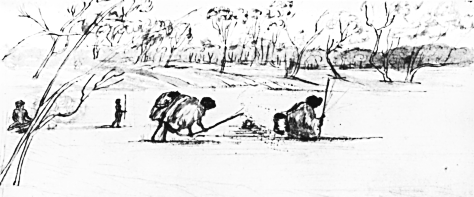
Women digging roots of yam daist State LIb of Vic

The drawing above by J.H. Wedge (1835), showing women digging roots of the Yam Daisy, is held in the collection of the State Library of Victoria. You can see a detailed drawing of a digging stick at https://www.anbg.gov.au/aborig.s.e.aust/roots.bulbs.html.

According to https://tasmanica.wordpress.com/tag/yam-daisy/ ‘… the Yam Daisy (Microseris lanceolata) or ‘Murnong’ as it is known by tuber hunting aborigines on the mainland, has a convoluted history. This makes it a subject of ecological and evolutionary interest to biologists. Its closest relatives are found in western North America. Based on morphological and chromosome studies, the Yam Daisy probably came about by the hybridization of two American species followed by long distance dispersal – quite a distance I might add. So it goes that aborigines were eating foods of American origin way back. This marvellous feat of intercontinental dispersal has been confirmed more recently by studies using DNA extracted from the chloroplasts (cpDNA) of American and the Australian/New Zealand species of Microseris (Vijverberg et al. 1999).’

In my walks along the Derwent River, I have seen these Yam Daisy flowers from time to time. Of course, next time I will look at the plants more closely.