Category Archives: Walking

The crustacean that walks – and only in Tasmania

My last post introduced a giraffe who took a long walk. Since giraffes typically walk as part of their locomotion, the surprise of that story cannot be as great as the fact of the shrimp (prawn if you like) which walks around the high creeks and streams which flow down into the Derwent River in Tasmania.
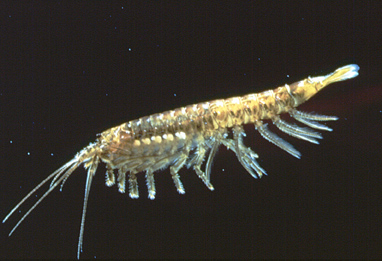
Anaspides tasmaniae from Parks&Wildlife Service

(Photo courtesy of Parks & Wildlife Service Tasmania – http://www.parks.tas.gov.au/indeX.aspX?base=11244)

Geoffrey Smith, in his book A Naturalist in Tasmania (Oxford, 1909), describes the Anaspides tasmaniae. “A number of streams rise in the plateau of Mount Wellington, some of them attaining a considerable size before joining the estuary of the Derwent, and all of them characterised by the beautiful clearness of their water, owing to their beds being formed entirely of hard greenstone boulders.

In the pools of the upper reaches of these streams near the top of the mountain, a very peculiar shrimp-like animal is found.  It is now recognised as one of those survivals of a bygone age of which the Australian continent has furnished so many and such interesting examples. The nearest allies of this animal appear to be some marine shrimps which come down to us as fairly common fossils in the sand deposited round the Permian and Carboniferous seas of Europe and North America: subsequent to this very remote period they do not seem to have existed in the seas, at any rate in the northern hemisphere, so that an enormous passage of the earth’s history has occurred between their peopling the northern seas and their survival on the mountain tops of Tasmania.

The Tasmanian Mountain Shrimp (Anaspides tasmaniae) is sometimes as much as two inches in length, of a brown colour, and walks about on the stones and among the weeds at the bottom of the pools, browsing on the mosses and liver-worts and any small creatures it can catch; it very rarely swims, but when frightened it darts forward by flicking its tail and takes cover under a stone.

In other parts of the world no trace of the animal’s survival has been discovered.

Goethe somewhere remarks that the most insignificant natural object is, as it were, a window through which we can look into infinity. And certainly when I first saw the Mountain Shrimp walking quietly about its crystal-clear habitation, as if nothing of any great consequence had happened since its ancestors walked in a sea peopled with great reptiles … time for me was annihilated and the imposing kingdom of man shrunk indeed to a little measure.”

The website http://www.anaspides.net/other/website_name_why.html believes “Anaspides tasmaniae has remained unchanged for 250 million years (Triassic Period): it is a living fossil. The first published record of Anaspides tasmaniae was made in 1893 from alpine pools on Mt. Wellington behind Hobart.”  More details about this discovery, and about the later involvement of the author of the book excerpt above, Geoffrey Smith, can be read at http://www.tasfieldnats.org.au/TasNaturalist/Articles/1967/TasNat_1967_No8_Feb_pp1-2_Hewer_AnaspidesTasmaniae.pdf

On a camel, then on two different sailing boats, followed by a 900 mile walk

Here is a little light relief with a piece of history which has nothing to do with my walk along the Derwent River. Blog follower Jo alerted me to the story of Zarafa. Have you heard the story of Zarafa?

In the early 1800s exotic animals from Africa and beyond were still sensational to the inhabitants of Europe so, over time, various animals were transported thousands of miles from their home territory to amaze strangers and for political purposes.

The giraffe Zarafa, when gifted to King Charles X of France in 1826 in 1826, became an international sensation in consequence of the challenges faced in her travels.  Zarafa’s journey started in the country of the Masai when she was loaded onto the back of a camel. On reaching the Nile River, she boarded a sailing vessel and travelled northwards to Alexandria. From here she was moved onto a larger boat, with a hole cut in the deck so her head could lift up and out, and sailed for 32 days across the Mediterranean to France. Finally she led by a man in a long walk from Marseilles to Paris over 41 days, and by all accounts she became healthier and more robust with each step.  Fed with the milk of three accompanying cows, Zarafa was considerably taller at the end of her journey.

You can read more at:

Apparently, Zarafa’s stuffed remains can be viewed in France at the La Rochelle museum. I would be interested to hear comments from any blog follower or other reader who has visited this museum and the remains of this giraffe.

Fashion progressed (or suffered) as a result of Zarafa’s arrival.  Apparently Parisienne woman piled their hair so high they needed to sit on the floor of their carriages, and men wore elongated hats and ties as the new trend of ‘a la girafe’ emerged.

Film: The Way Back

The Way Back, an epic dramatic film directed by Australia’s Peter Weir, was released in 2010. The film was inspired by The Long Walk (1956), a memoir by a former Polish Prisoner of War, who escaped from a Soviet Gulag and walked 4,000 miles (yes miles not kilometres) to freedom during World War 11.

What was it about the film that absorbed me?  Firstly, the story is so improbable considering the extreme climate and environment over which the walk took place – yet it happened.  Secondly, the acting was first class, made the story plausible so that I believed every bit of each challenge faced in the Gulag and then on the long southward trek through wilderness and deserts.  I knew previous work of some of the actors, but others were completely unknown to me: Jim Sturgess, Colin Farrell, Ed Harris, Saoirse Ronan, Alexandru Potocean, Sebastian Urzendowsky, Gustaf Skarsgard, Drago Bucur and Mark Strong.

Overall, the details of and the panoramic views of landscape were enthralling and breathtaking in their scope and richness. I found myself using Google maps to understand the route past Lake Baikal, into Mongolia and across to Tibet, then over the Himalayas into India. Extraordinary achievement.

If you watch the trailer at http://www.imdb.com/title/tt1023114/, I believe the sensational music and the movie excerpts are not in the spirit of the big spaces and the big decisions faced by the walkers.  The power of the dialogue and its pacing is lost.  Seeing the whole movie gives a completely different perspective. What I have been left with after seeing the movie, is an unshakeable faith that there are people who have an important goal and will do anything to achieve it. Quite wonderful!

Trees co-operating with themselves to create completely connected and supportive communication systems

I will be heading out into the wilds of the Tasmanian bush later this year when I walk near the more inhospitable edges of the Derwent River through old-growth forests; I will be walking away from any tracks and be remote from civilisation.

On this basis, it was with interest I read the article at http://www.abc.net.au/science/articles/2015/05/20/4236600.htm. New research about underground communication has extended 30 year old research which introduced the practice of above ground communication between plants in forests.  There is talk of ‘mother’ trees.

Some readers might consider this is a crack pot viewpoint that has come out of the inclinations of green politics with which they don’t agree.  So I checked who the researchers were, their affiliations were and whether any funding might be seen to skew their research findings.

Leading this research is an academic at the University of British Colombia, Professor/Dr Suzanne Simard who works in the Faculty of Forestry.  Her research is grant funded by a neutral body, the Natural Sciences and Engineering Research Council of Canada – so that the research findings are not created to support any organisation which wants a particular outcome.  At her university, Simard leads Terre WEB (the Terrestrial Research on Ecosystem & World-wide Education and Broadcast project) a Masters and PhD degree level training program that focuses on effective communication of global change research.

You can watch and listen to Suzanne talking in a video as she walks in a forest: go to http://www.ecology.com/2012/10/08/trees-communicate/.  She offers a simple but extraordinary explanation of the process.  Takes less than 5 minutes to watch.

Walking from Australia to London

I blinked and blinked again.  Walking from my home to London? How would this be possible?  Yes it will be possible … but in 100 – 200 million years’ time when continents reconnect with each other, according to a recent news story: http://www.news.com.au/technology/science/australia-on-path-to-join-uk-as-part-of-supercontinent-amasia/story-fnjwl2dr-1227331780435?sv=1e2848859e5b4afa30b76819882202f0&

I reflected that the Derwent River might no longer exist and its beautiful ribbon-like pathway through our landscape might only be remembered in the fault lines of rearranged rocks.

Considering the geological and weather upheavals likely during those intervening years, I imagine the footsteps of human kind will not even be a distant memory.  My guess is that the ant and cockroach populations will have mutated strangely and may be the only lively fauna roaming the planet. If water remains on the Earth then possibly some creatures who can survive in highly acid waters may be in the ascendancy in some regions.

It is rather strange to sit here tapping on my computer and to consider that not only do I expect the human race to become extinct, but all the artefacts of mankind will be obliterated over the millennia.  Having held a career in the museology industry for much of my professional life, I retain the urge to collect and conserve the artefacts of our histories. Nevertheless, these collections and preservations will probably only be valued for a few more hundreds or thousands of years.

On this basis it seems that walking and discovering what we have around us is a much more worthwhile thing to do – at least at the personal level. In an earlier posting I referred followers to the blogsite of a man who took 11 years to walk around the world. Even if I should set myself a similarly outlandish goal, it won’t be possible now to walk from home to London in my lifetime except by using some water or air based technology to move from land to land. What a small dream this is in relation to the expanse of the history of the universe.  But then, humans are not so great when compared to the scale of the universe.

Blog written by Chris Linton: Inspirational Tasmanian walker

I have been alerted to Chris Linton’s blog containing lots more information and a button to make donations to the Black Dog Institute.  Go to: http://www.earthwalkcommunity.com/

1400km walk around Tasmania concluded yesterday: congratulations Chris Linton

A few weeks ago I read that a Tasmanian father and son (Chris and Kelvyn Linton) were planning an unsupported long-distance charity walk around the perimeter of Tasmania. This huge ambition filled me with excitement, and I hoped they would be able to achieve their goal.

While his son walked 20 of the 46 days it took for the walk, Chris Linton battled around every metre of the coast line.  Chris is reported as saying ‘Out of Queenstown, that hill is unforgiveable. The weather through that mountain pass was quite extreme – lots of snow and constant rain for two weeks.’ Refer to http://www.themercury.com.au/news/tasmania/epic-blues-beater-puts-dad-on-the-map/story-fnj4f7k1-1227357590621 for the arrival story, at Salamanca on the edge of the Derwent River.

I believe his walk is a significant achievement in one of the most challenging environments in the world. I am in awe of what has been done, and even more so because much of the walk was undertaken during one of Tasmania’s most bitterly cold and stormy periods.

More information about this trek, to raise funds for the Black Dog Institute, can be read at http://www.blackdoginstitute.org.au/docs/TasmanianresidentsChristopherandKelvynLinton.pdf

You can read more about an earlier stage of the walk at: http://www.themercury.com.au/news/tasmania/chris-linton-nears-end-of-walk-around-tasmanias-perimeter/story-fnj4f7k1-1227351866303

As a war veteran suffering from post-traumatic stress disorder, I hope the soothing effect of Tasmania’s wilderness environment and the flood of positive endorphins encouraged by the continuous activity, have been healing forces for Chris. An amazing personal achievement! Congratulations Chris Linton!

More natural beauties stages 11 -14

As some followers remarked on earlier postings, my selection of past photos on different walk stages has given me a chance to ‘relive’ the experiences. Here are some favourites from the last 4 stages of my walk along the Derwent River.

20150119_071956

I love the Hobart wharf area with its crab and other fishing vessels.

20150119_072334

I love the pretty 19th century buildings lining Hunter St, one of the first settled areas in Hobart.

20150119_071536

I love the drama of the Federation Concert Hall where the Tasmanian Symphony Orchestra presents great performances.

20150119_073636

No water is spared. The Parliamentary gardens are always lush and green.

20150119_084657 20150119_101600

I love the juxtaposition of the old and new: at Wrest Point Casino; at Lower Sandy Bay’s Blinking Billy against new modern houses.

20150119_085149 20150119_100336

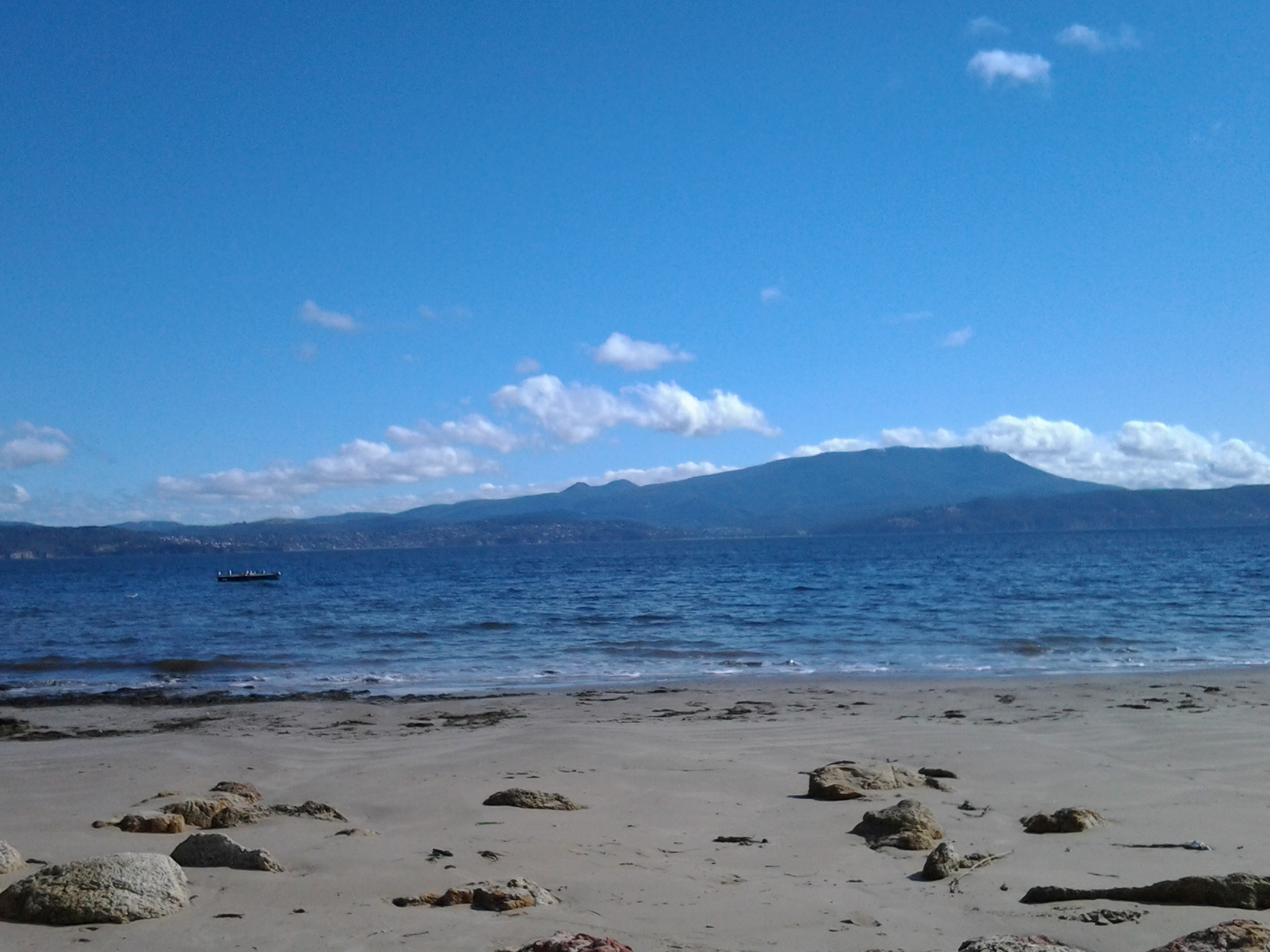
Fresh beaches. Serenity.

20150119_095728 20150119_130442

Public sculpture.

20150119_124053 20150202_142013

Coastal walking tracks.

20150224_075230

Great signage

20150202_095936

The heritage listed Shot Tower near Taroona

20150202_112545

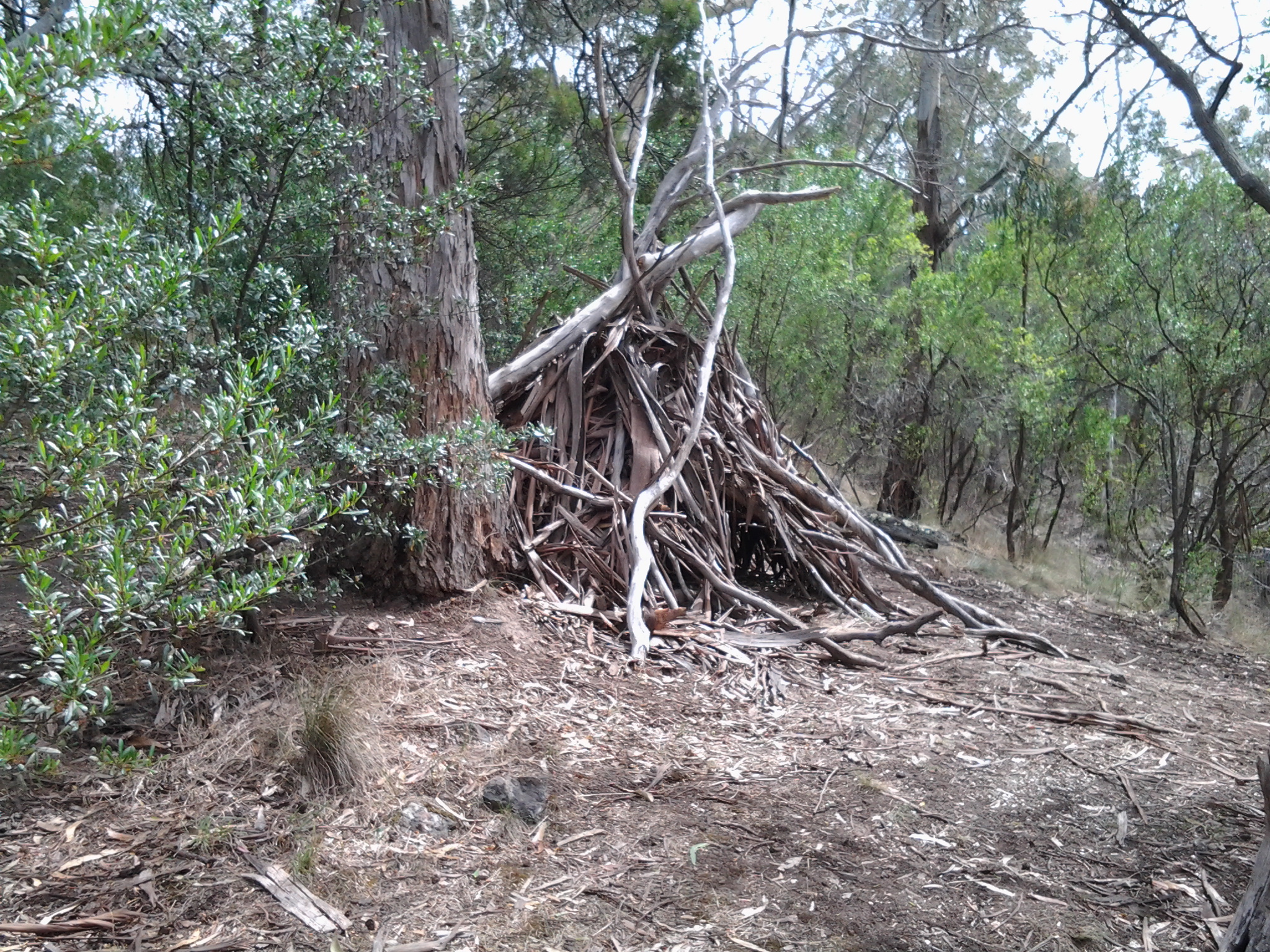
A rough bark and branch ‘hut’ near a track. Shelter from any rain?

20150202_142352

Natural rock caves

20150224_081151

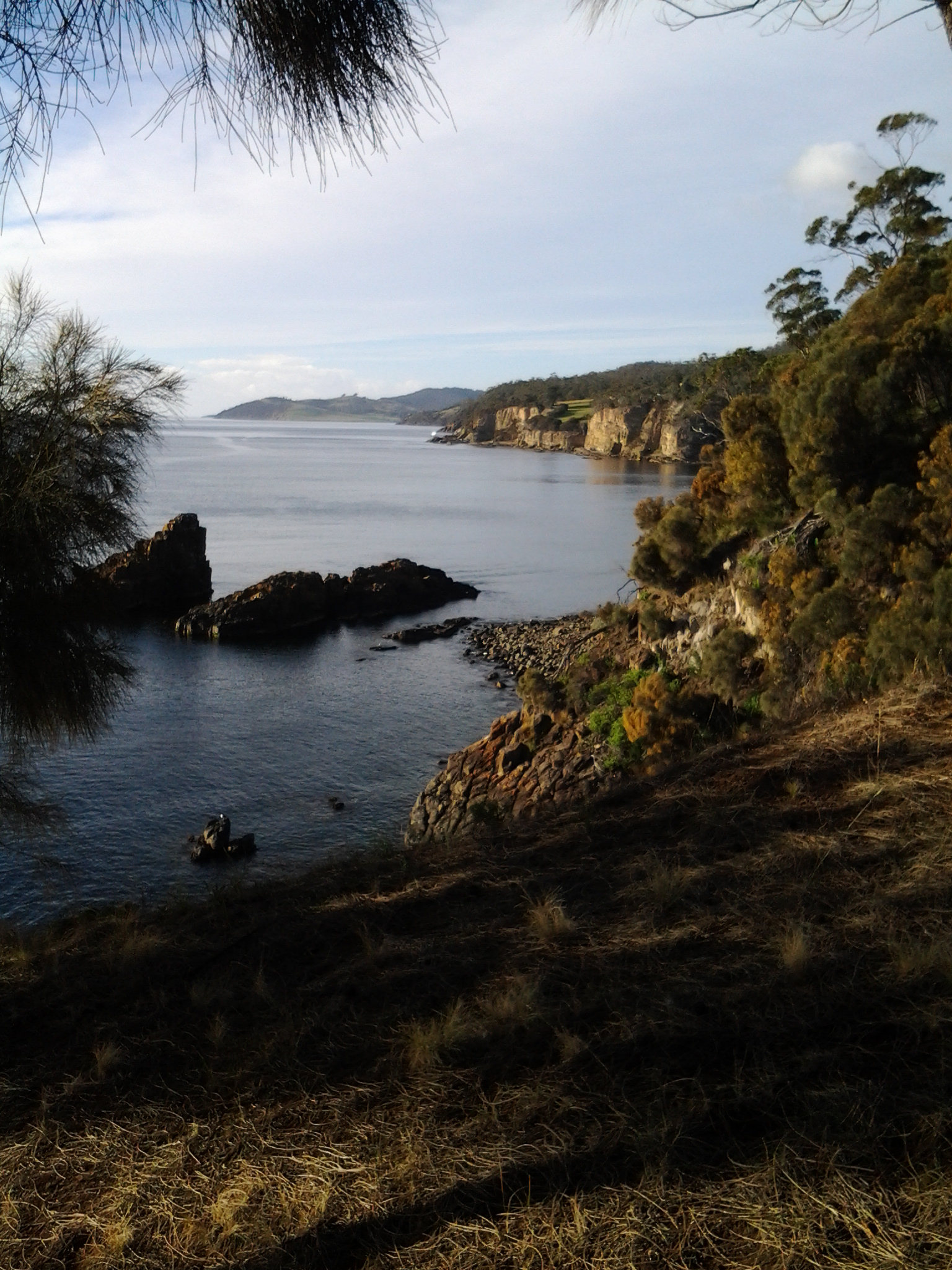
Dramatic viewpoints

20150413_125912

The sun. The reflections.

20150413_131826

Looking at, listening to, smelling the bush.

20150413_140030 2015-04-13 15.11.08

And I appreciate the glories of introduced trees and man-made vistas.

Collectively these images provide a reminder of what sits beside the Derwent River as it flows from New Norfolk to its mouth.

Another revision: naturally therapeutic images from stages 7-10

I can’t help myself. Having reviewed my favourite images from the first half a dozen stages of my walk along the Derwent River, I felt compelled to continue looking through my collection from the subsequent walks.  I have chosen photos showing aspects of both the natural and man-made world and I believe all will prompt thinking about the Derwent River, Hobart and its suburbs, and the natural environment. My selection of the images with the most memorable impact for me, from stages 7-10, are given below.

20141031_094126

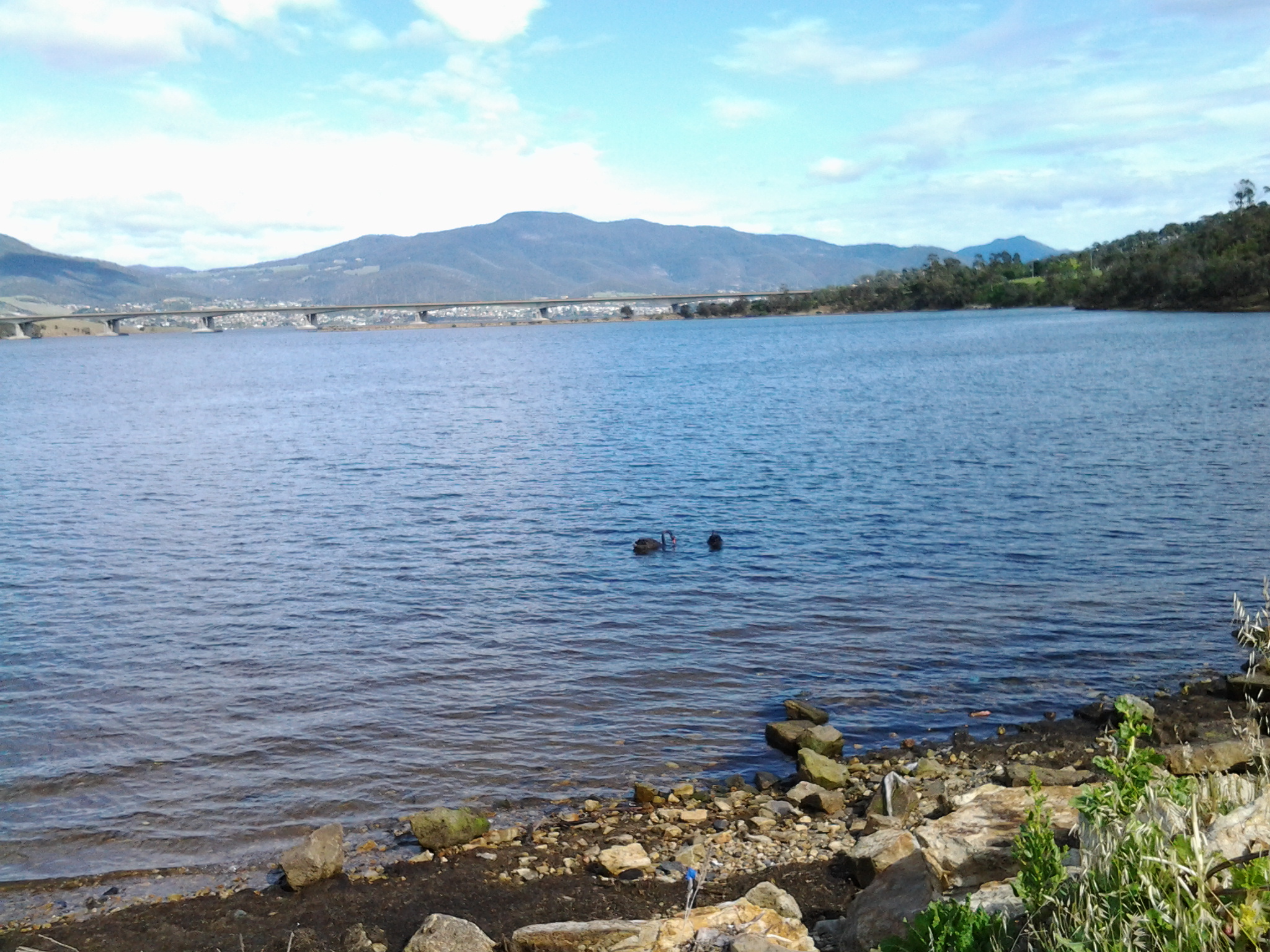
From the eastern shore looking northwards towards the Bowen Bridge, with a couple of black swans on the river.

20141031_100200

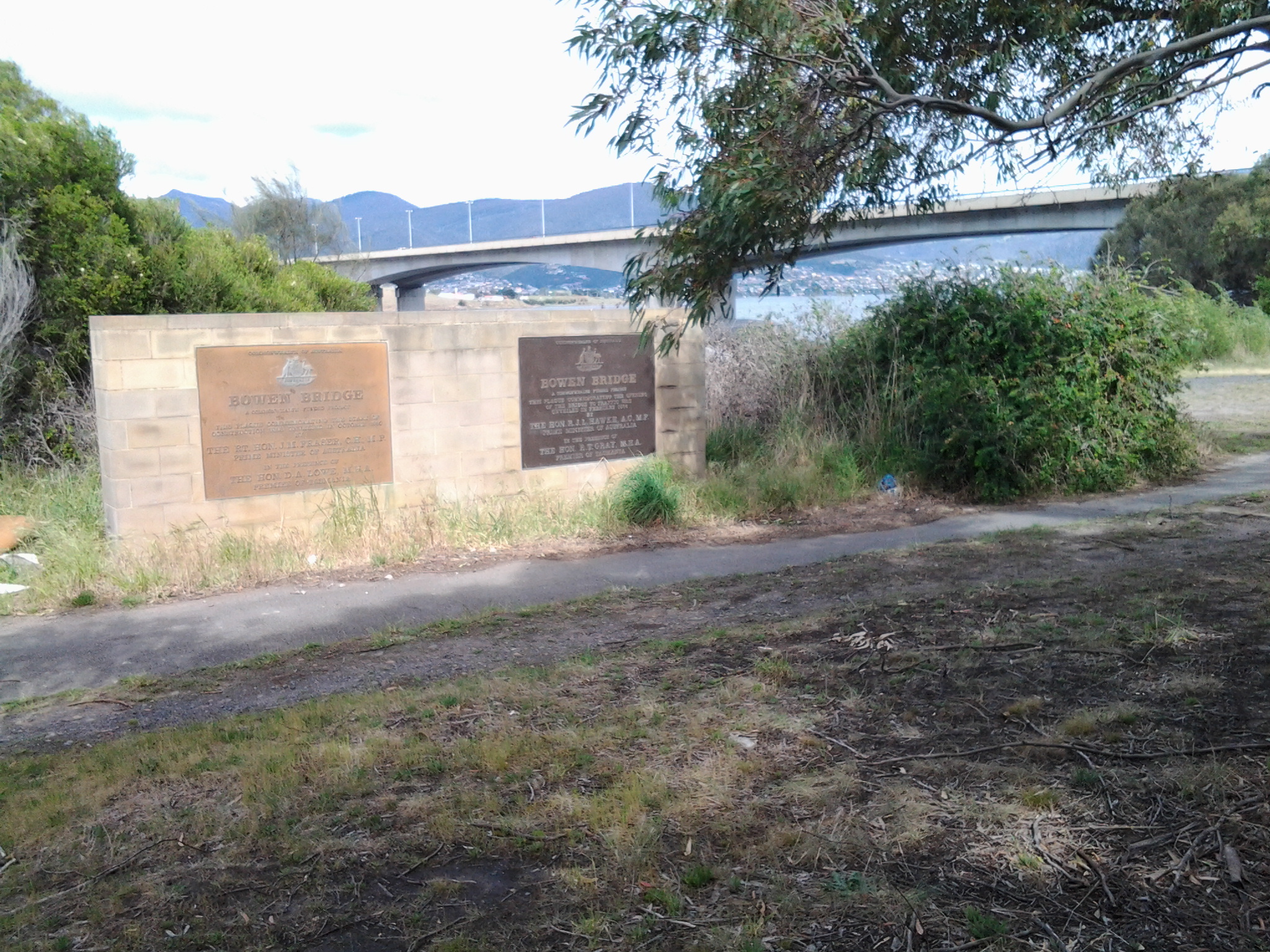
Two plaques ‘opened’ by two great Australian prime ministers near the Bowen Bridge.

20141031_104822

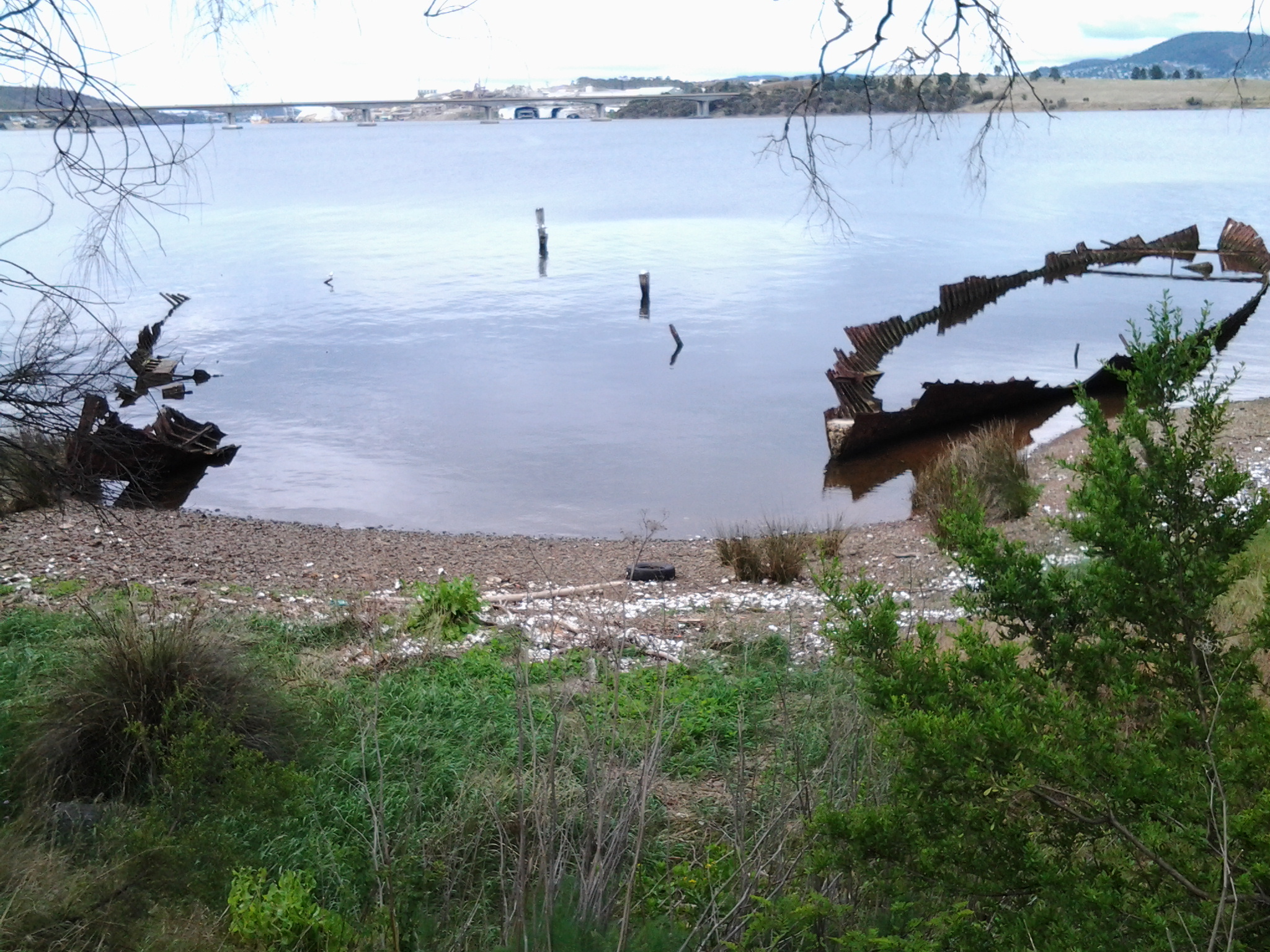
The rusting raw-edged remains of a ship, the Otago, at Otago Bay.

20141031_113132

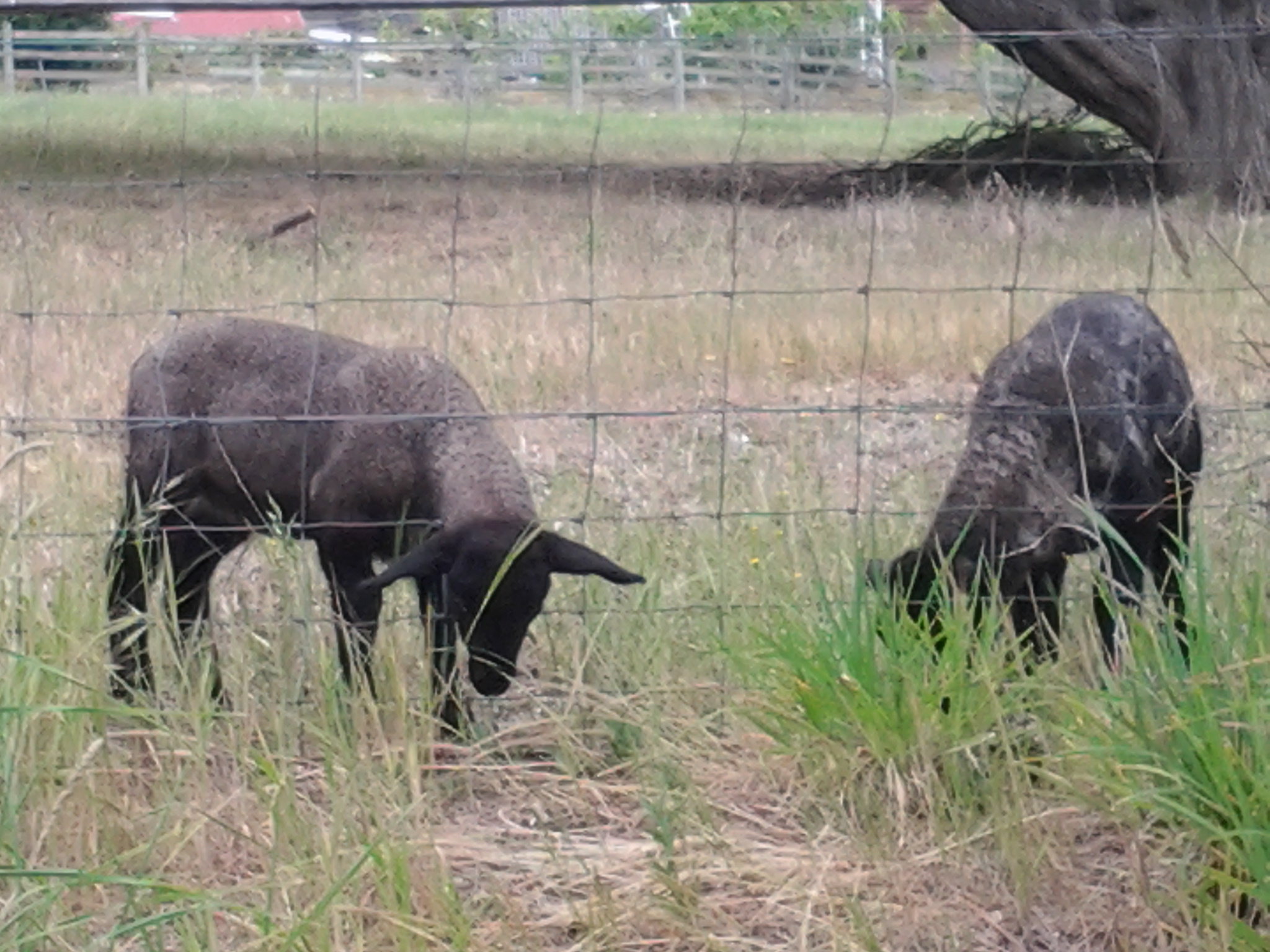
My enjoyment of any family’s black sheep.

20141031_123000

Heading into Old Beach and gradually leaving Mount Wellington behind.

20141031_132519

The gloominess of the approaching storm when I reached Old Beach.

20141111_092342 20141111_092805

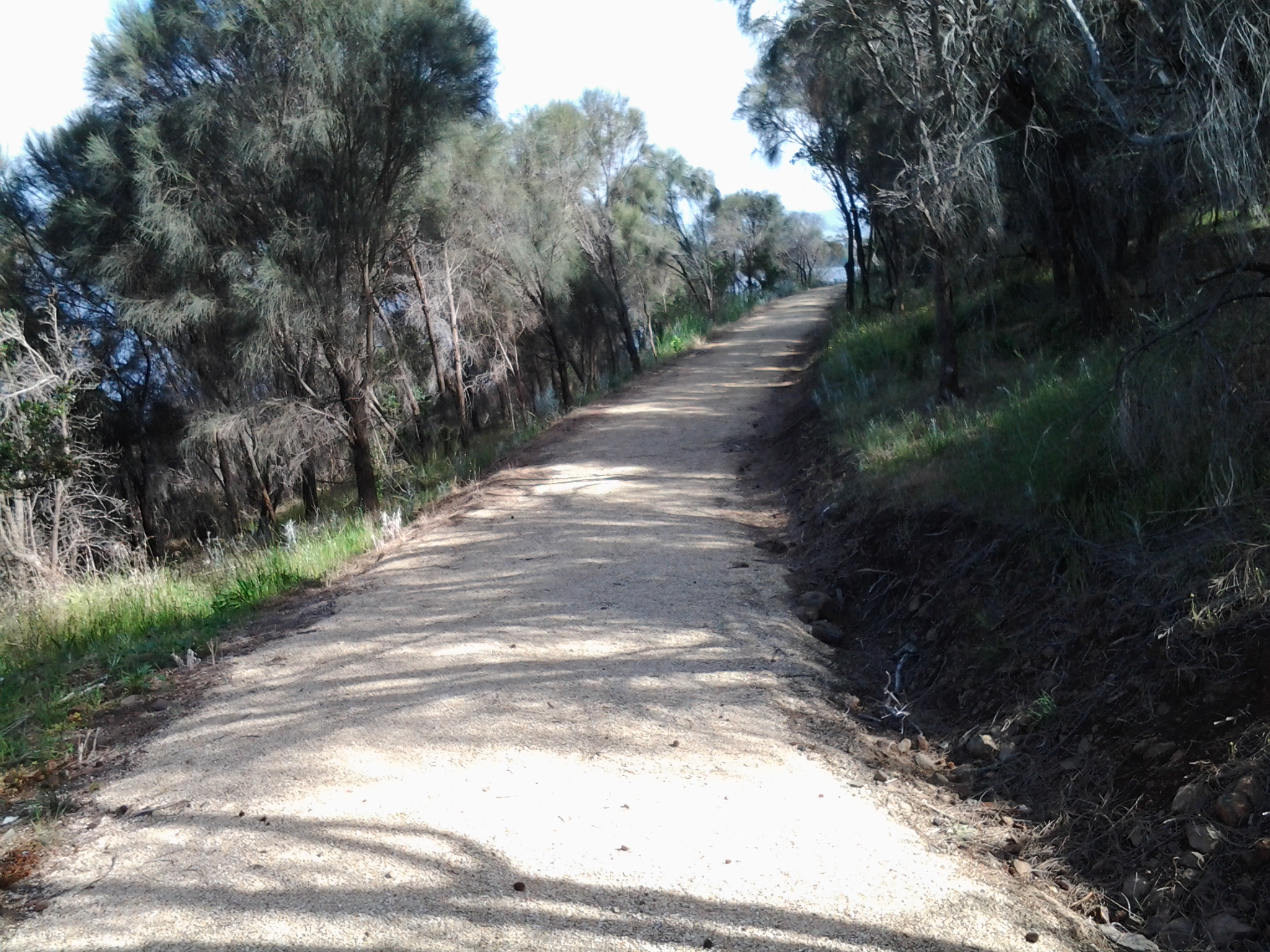
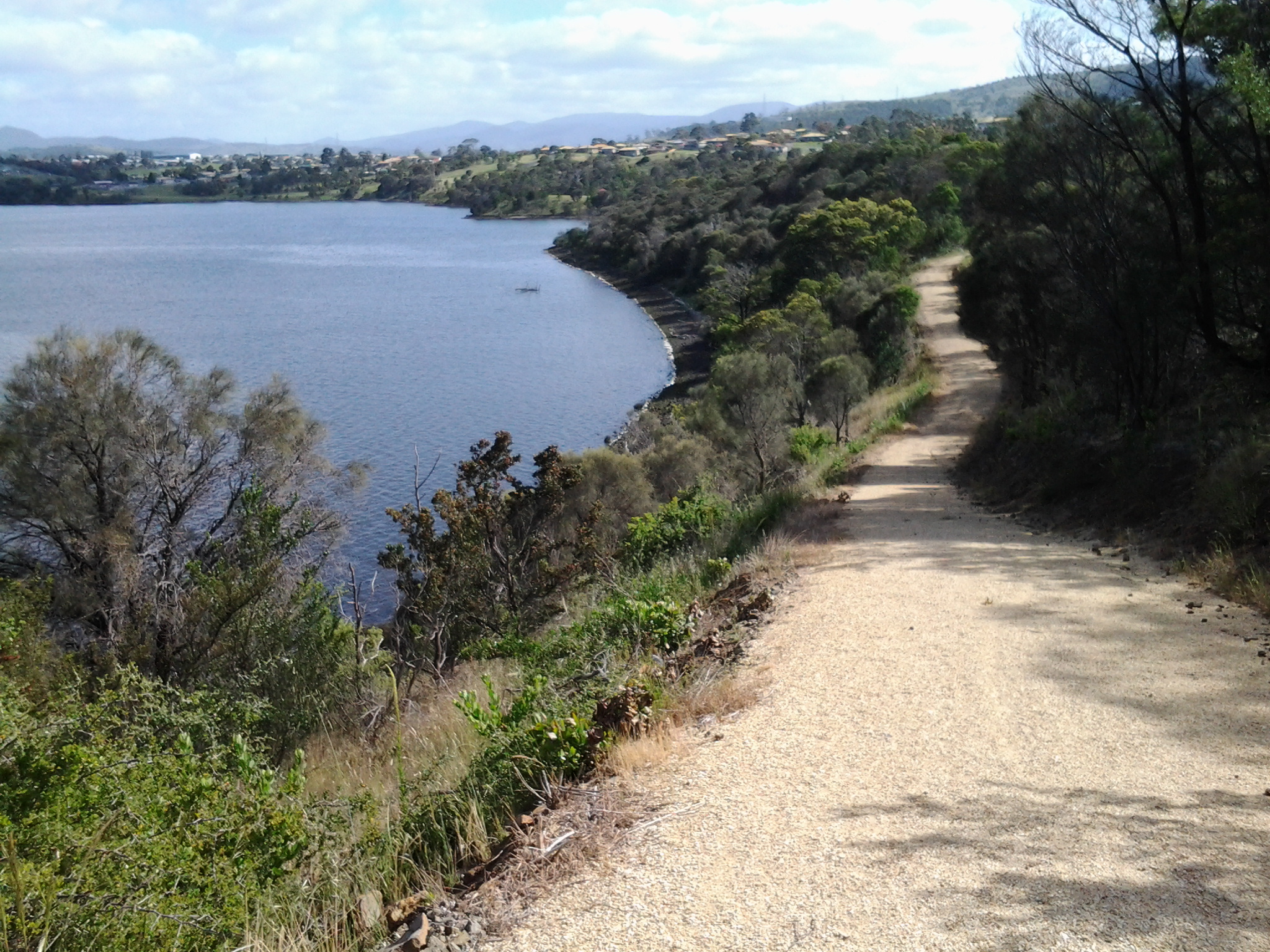
The pleasures of well-made pathways, thanks to local government.

Green Point from new Old Beach

Looking northward across the Jordon River to Greens Point.

20141111_103700 20141111_121906

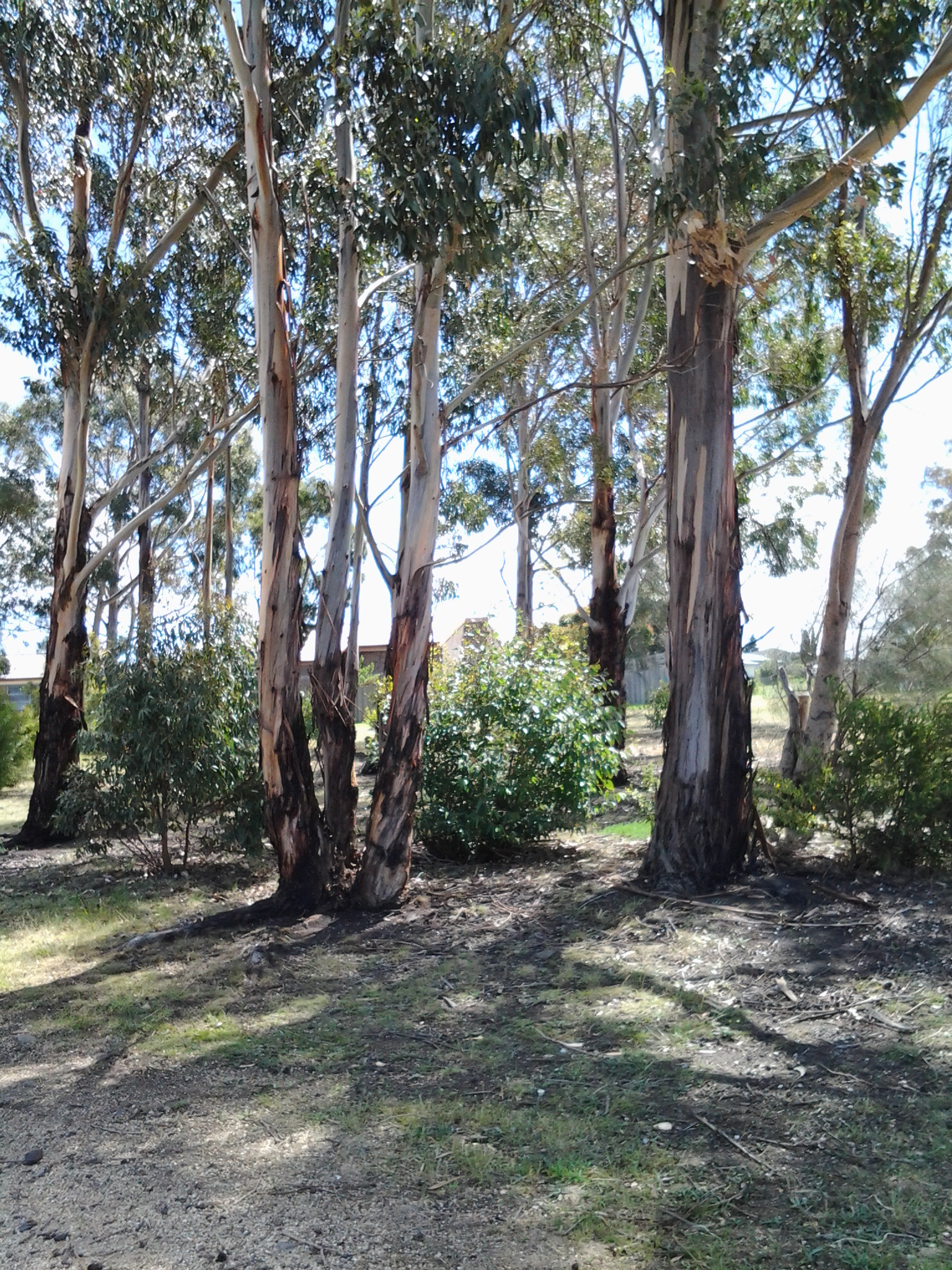
The glories of native flora. In these instances, it was blooming wattle and a spectacular stand of eucalyptus/gum trees which attracted my attention.

20141111_120752

The remains and the signs of a burnt out car on a back track.

20141111_130523

Knowing that it is still possible to have a laugh when walking.

20141111_131133

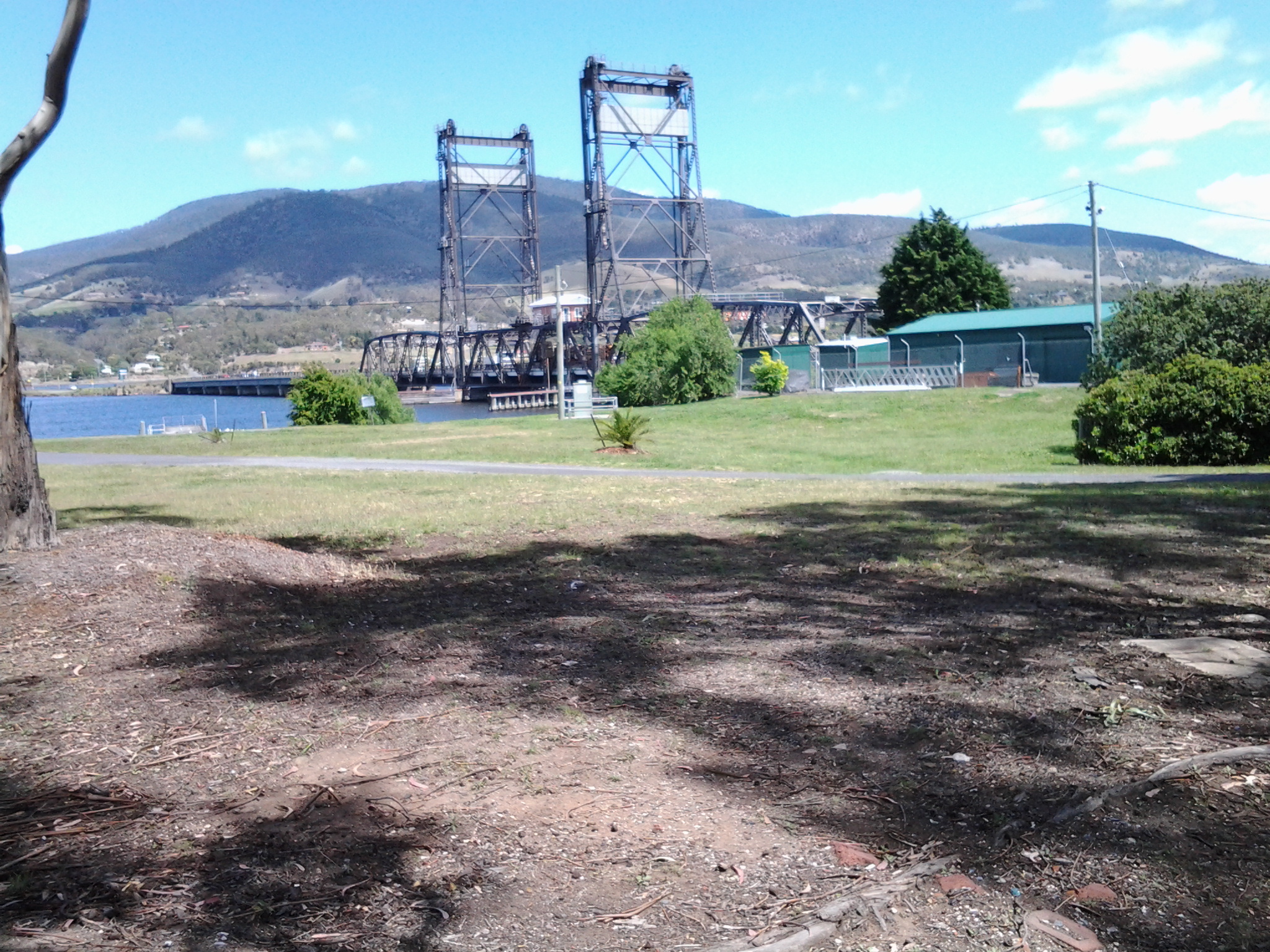
Arriving at the Bridgewater Bridge.

20141111_134311

Walking on the western shore of the Derwent River for the first time during this project.

20141125_095438

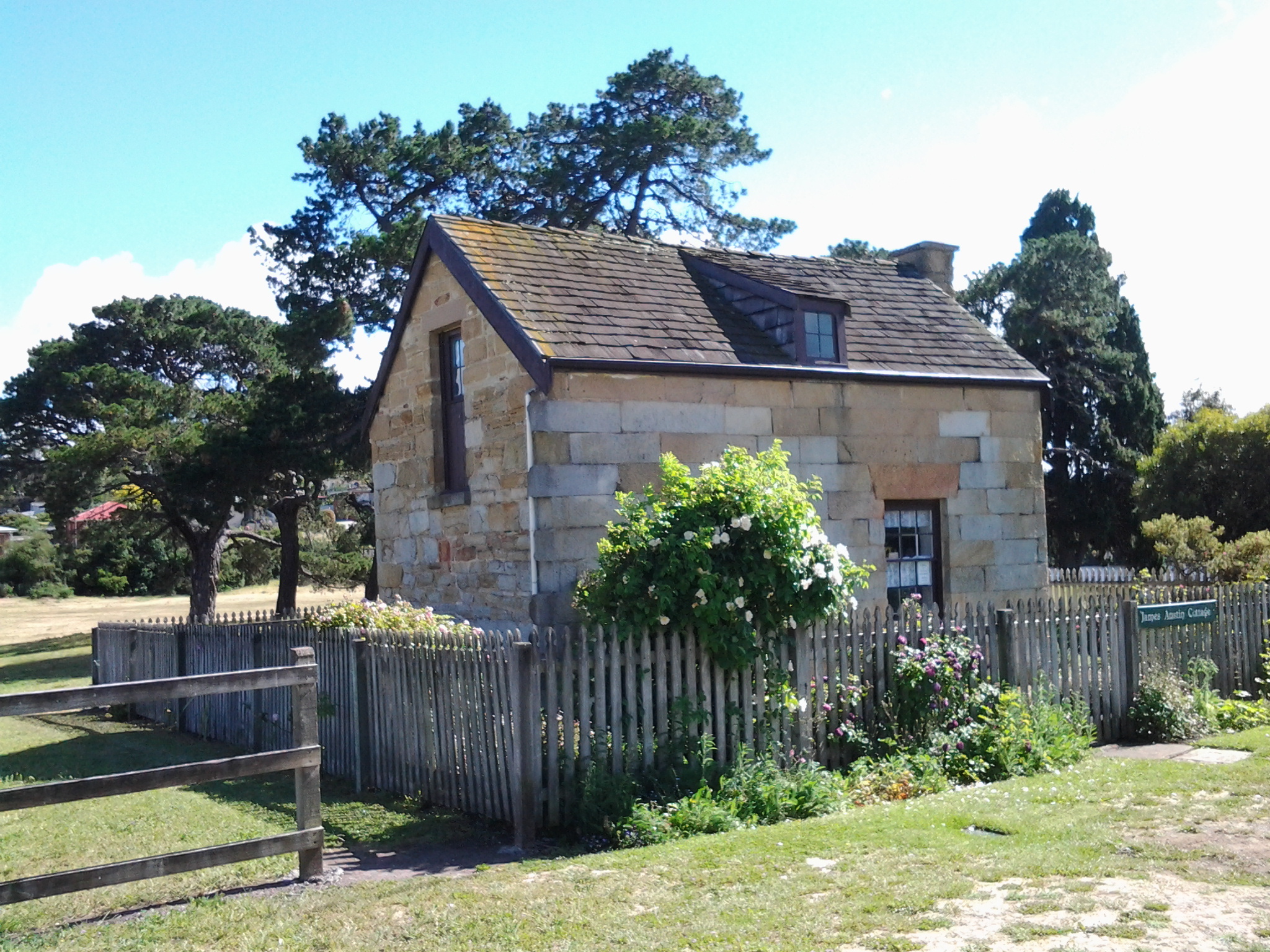
The house of one of first European settlers, James Austin, at Austins Ferry.

20141125_115047

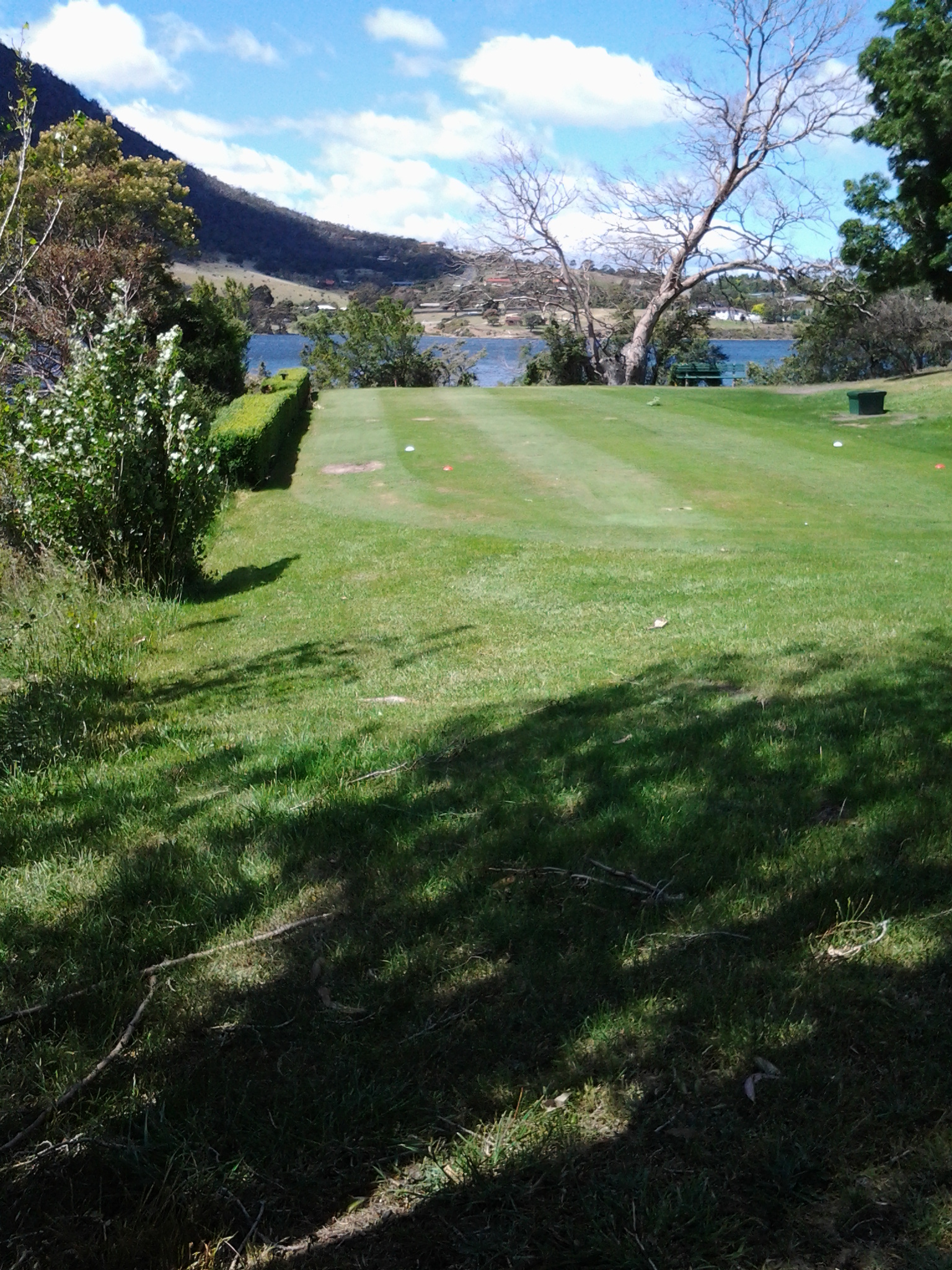
At Dogshear Point, walking around the Claremont golf course, with the thwacking sound of hit balls crossing the greens.

20141125_110906

Reaching Cadbury’s chocolate manufacturing factory in Claremont.

20141125_143454

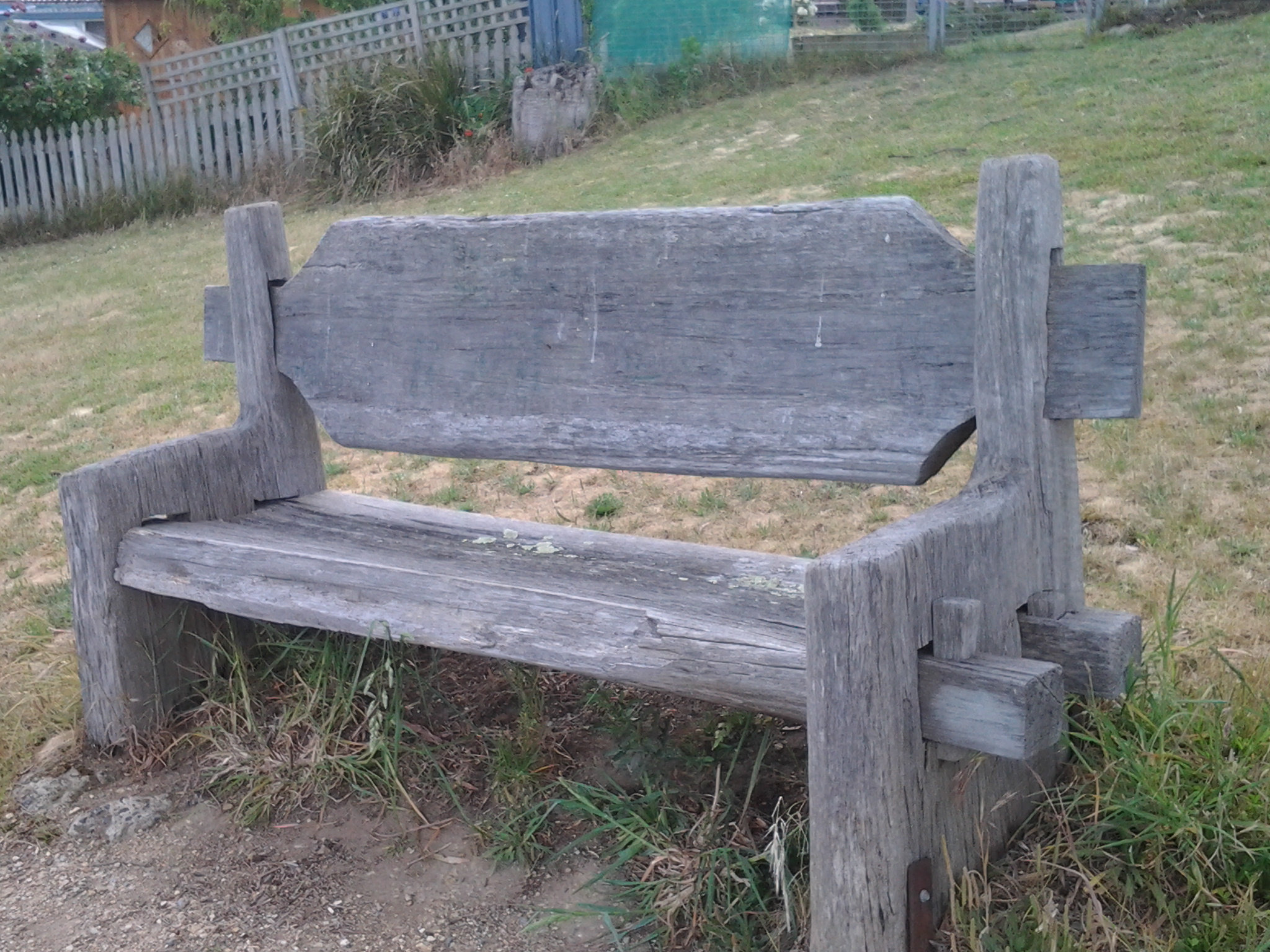
The hand-hewn rustic style seat near Connewarre Bay.

20150109_074126
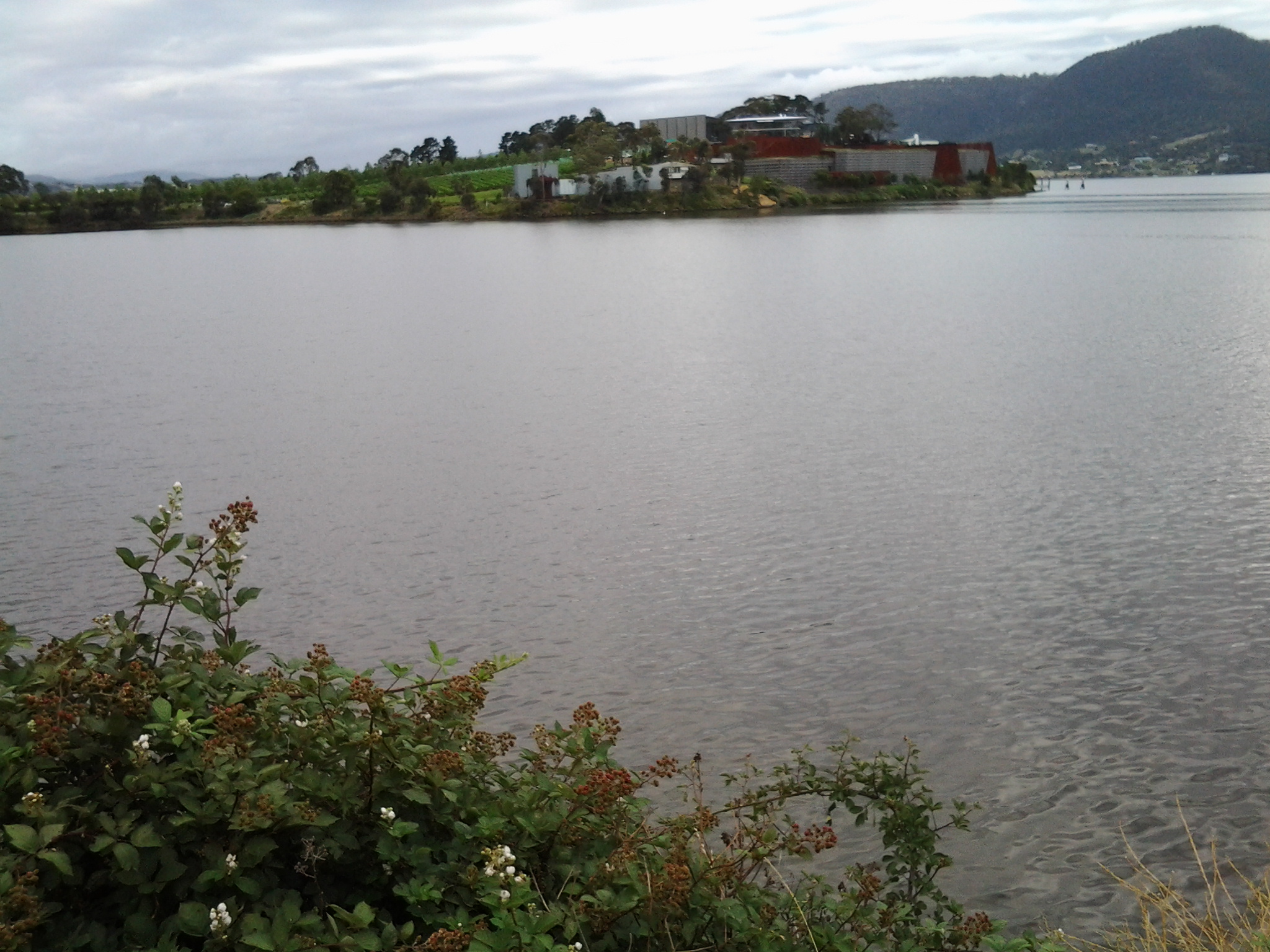
Passing MONA somewhat camouflaged as it nestles into a tiny hill against the Derwent River.

20150109_081644

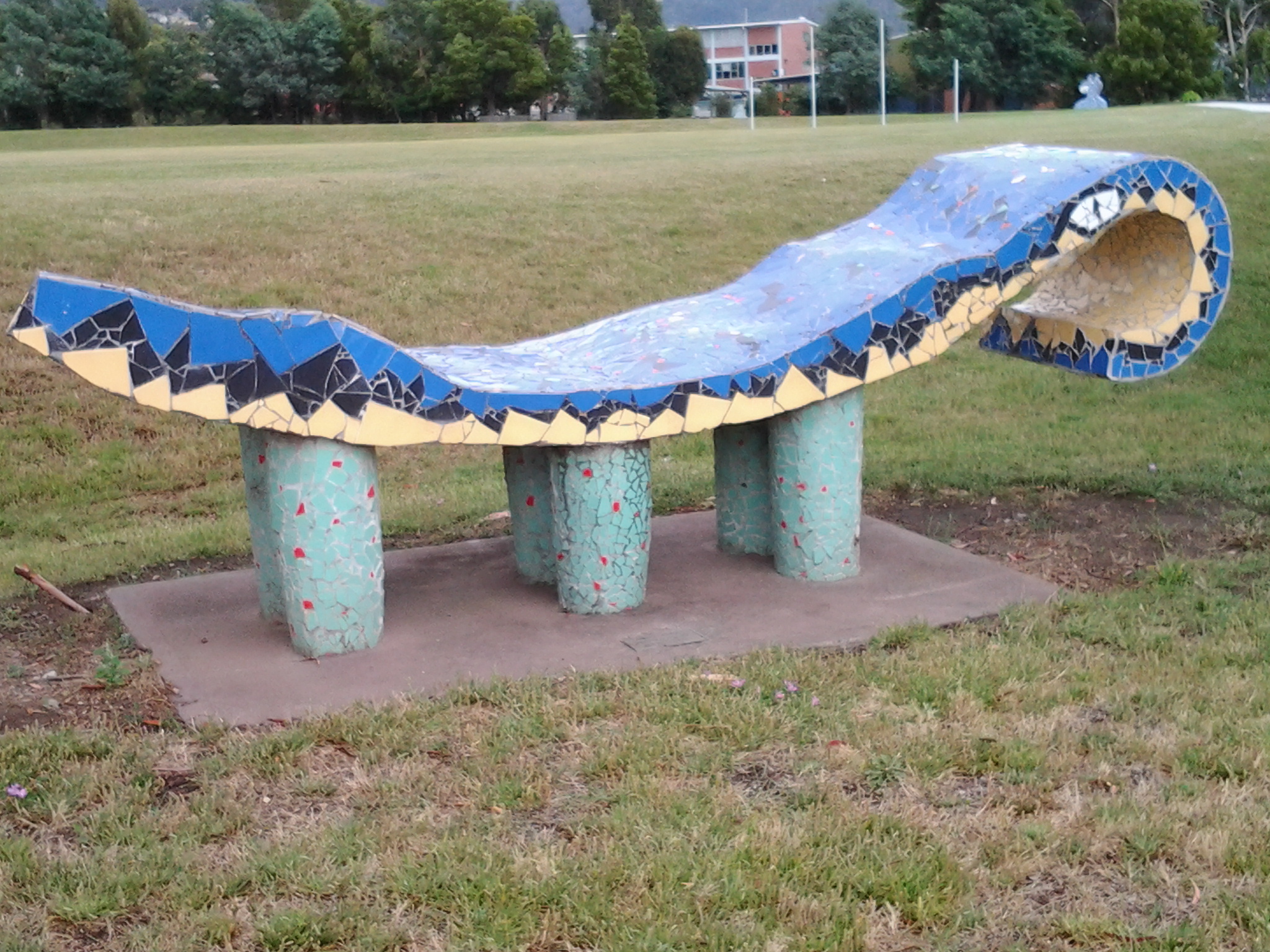
The mosaics along the foreshore.

20150109_101243

The jumble of boats and boat houses at Prince of Wales Bay.

Hoon tyre marks

Road mark making in Lutana.

20150109_132008

Cornelian Bay’s oil tanks up close.

20150109_153103

The Tasman Bridge.

20150109_155515

The circus had come to town.

20150109_161747

The emptiness of an arena of stands waiting to be filled during wood chopping competitions.

20150109_161339

Reaching the ‘end of the line’ on arrival in Hobart city.

Nature is cheaper than therapy

A Californian fiction writer M.P. Zarrella offered the opinion ‘nature is cheaper than therapy’.  Since then, her point of view has spawned posters, cushion covers, and T shirts such as:

Nature cheaper than therapy  and tshirt nature its cheaper than therapy

The use of this comment spread until people couldn’t help themselves …

facebook cheaper than therapy and Beer is cheaper than therapy

Thinking about whether nature is cheaper (with the inference of ‘better’ than therapy), I have been inspired to trawl through my walking-the-derwent photos.

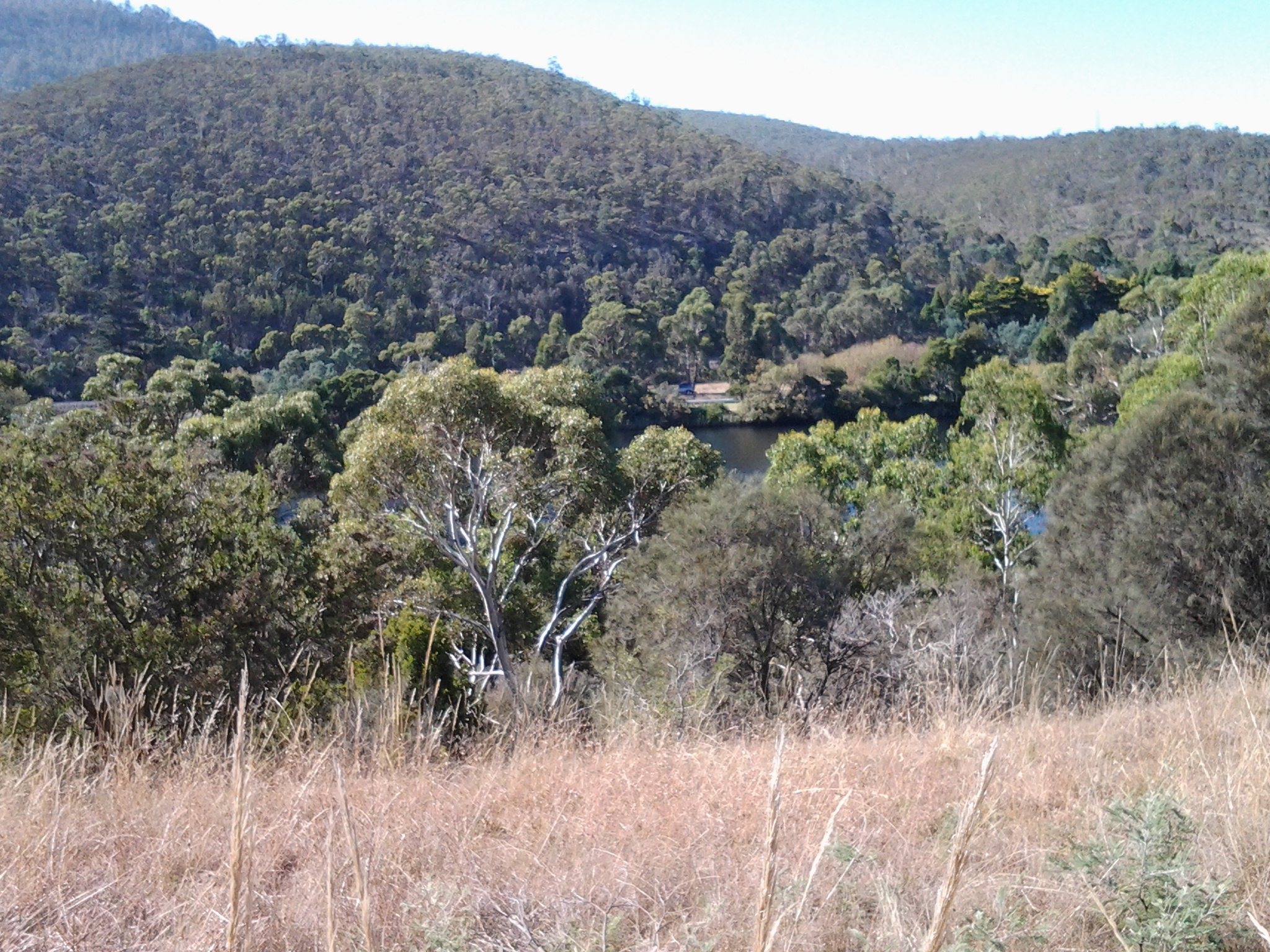
Here are a few favourite natural scenes clicked during Stages 1-6 of my walks along the eastern shore of the Derwent River.  Most of these images spent time as my computer screen background where they lifted my spirits daily.

20140822_100301

Iron Pot off the southern end of South Arm peninsula

20140822_101716

Driftwood beach shack on Pot Bay Beach, South Arm peninsula

20140822_114606

Mount Wellington across the Derwent River from South Arm Beach

20140904_110312

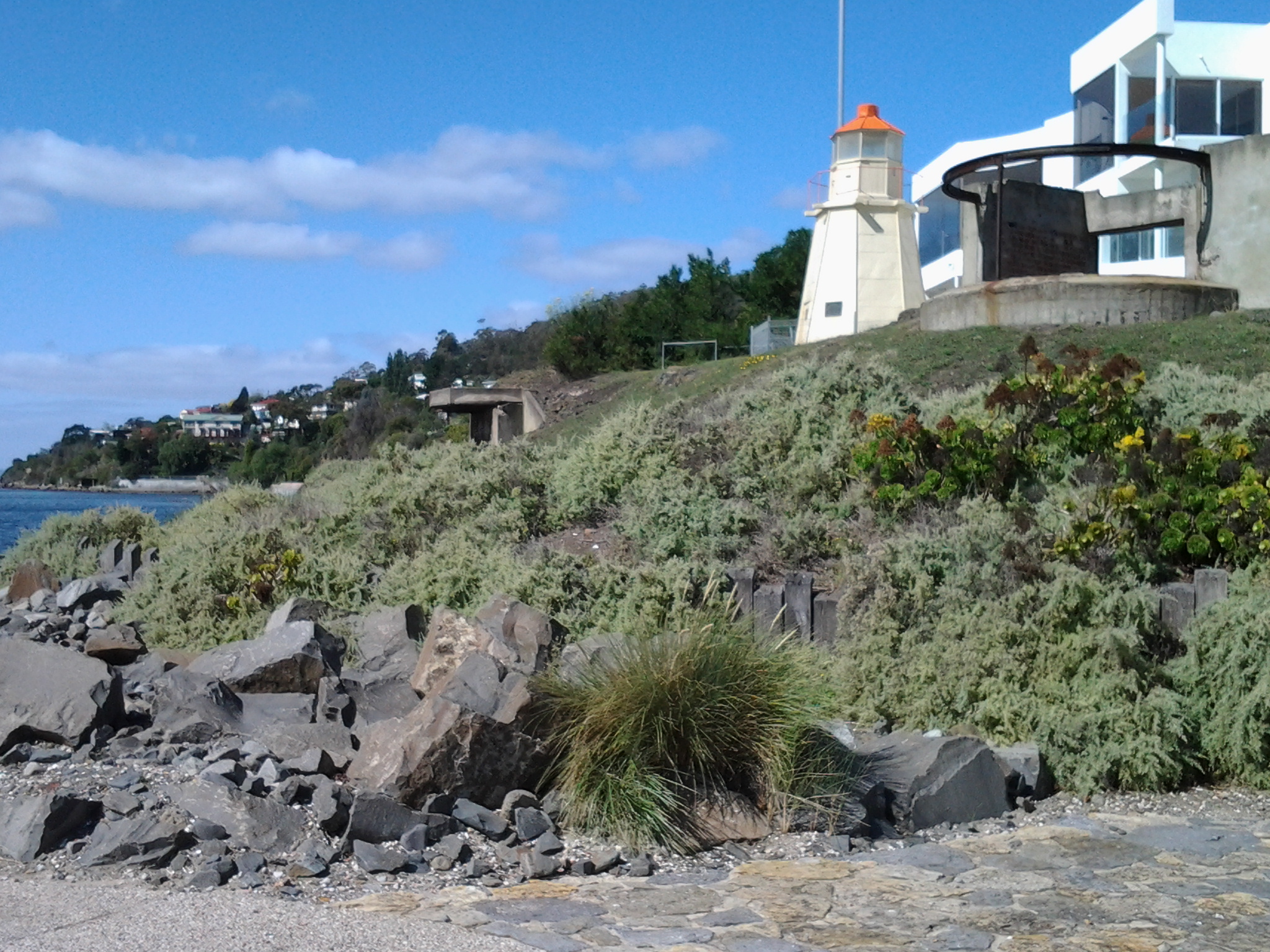
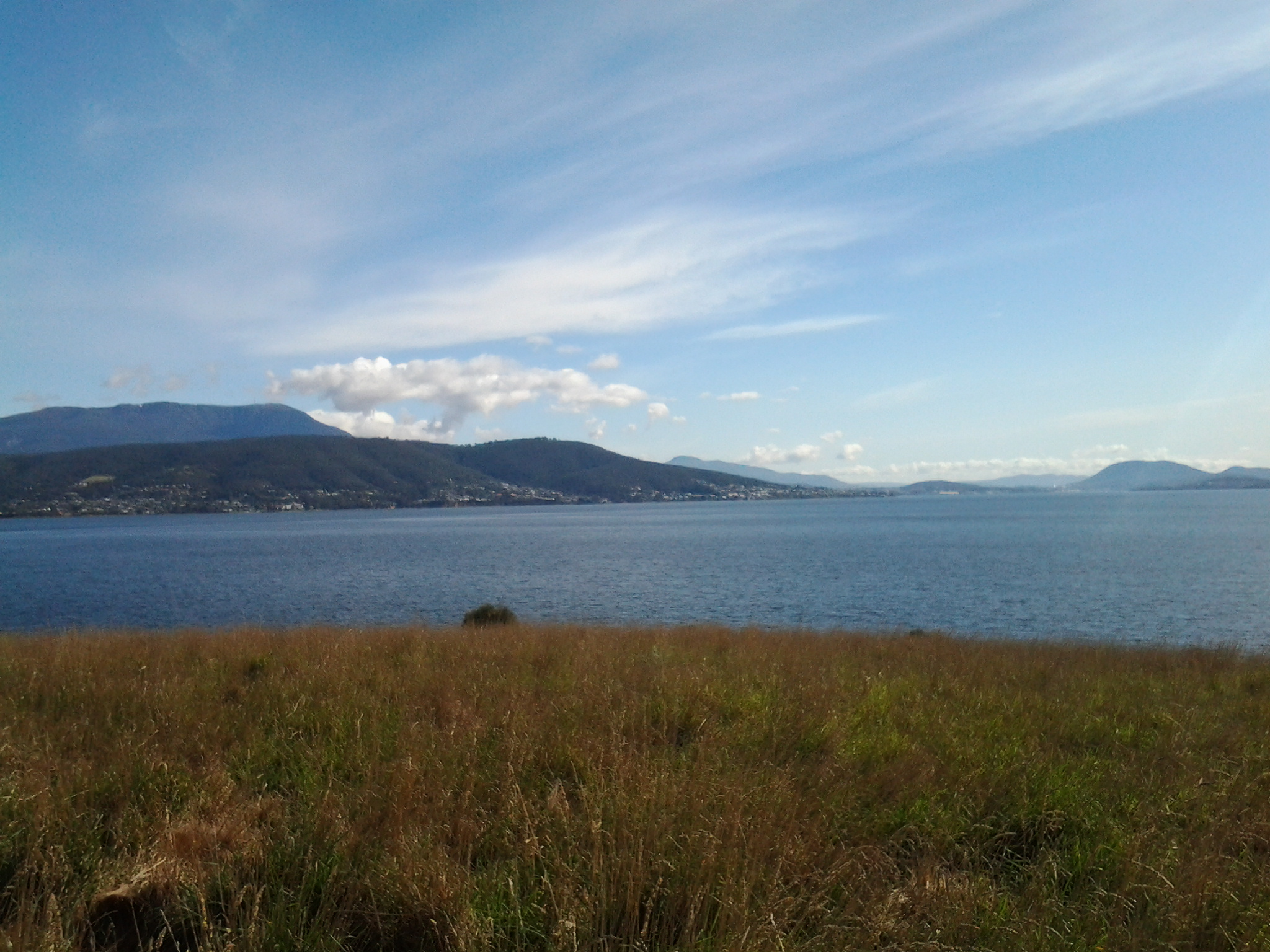
Looking northwards into the gigantic Derwent Harbour from Gellibrand Point at the northern end of the South Arm peninsula.

20140920_102738

Looking uphill from Trywork Point

20140926_095629

Lichen on rocks at Tranmere Point

20140926_104056

Little Howrah Beach

20140926_115158

Looking southwards along Bellerive Beach

20141010_093842

The suburb of Sandy Bay across the Derwent River through the casuarina trees from Rosny Point

20141010_123003

Tranquil Geilston Bay looking toward Mount Wellington

20141015_101248

Bedlam Walls Point

20141015_104855

Shag Bay

20141015_122048

Native flowers in the East Risdon State Reserve

20141015_133435

Tommys Bight

Whenever the weather is deteriorating outside my window, by looking at these photographs from the first 6 of 14 walking stages, I ‘revisit’ the various locations and feel most uplifted. No therapy needed here.

Another Derwent River transport service may be disappearing

A few days after I wrote the post about the end of the water taxi business on the Derwent River indicating my sadness for such short sightedness by the community and government agencies, I have discovered another sad tale. It was with horror I read the story at http://www.news.com.au/national/tasmania/tasmanian-air-adventures-in-liquidation/story-fnn32rbc-1227328240883.

Tasmanian Air Adventures, despite being incredibly popular and forever in the air over the Derwent River, has not been able to recoup its establishment expenses and get into a profit position. The result is the owners have run out of money and the business has gone into liquidation.

The outcome has been immediately clear to me. I had become used to seeing, many times a day, the water planes lifting off from the waters of Salamanca Cove in the centre of Hobart, and flying along the Derwent River.  And now only seagulls fly where once flew entranced tourists and locals.

In a city which has one of the best waterways in the world, Hobart is missing the opportunity which any other city in such a location would be grabbing and making work.  Blog followers keep telling me how much they enjoy my photos and information about what can be seen at the shoreline of the Derwent River.  I feel sure others would feel the pleasure which the river can offer, as well as appreciating its functionality to transport them hither and thither.

Years ago the Tasman Bridge was accidentally knocked down and immediately people became used to ferrying across the Derwent River/Harbour to and from work. The concept that the river is a lifeline and a connector of peoples; one which wants to be used, seems not to be factored into any level of serious government thinking.  Meanwhile valuable resources are used to create more and more city carparks.  Say no to car parks, I say. Say yes to ferry and air travel along the river.

Water Taxi ferry stops operation

Many weeks ago I  joined a group of mad hatters (the Scarlatt O’Hatters local group all decked out in purple clothes and donning elaborate red hats) on a river journey upstream from Sandy Bay to New Norfolk on the Derwent River.

I loved the historical information which the water taxi driver provided about features as we passed the shoreline of the river. He deliberately drove the boat into particular bays with specific and interesting histories. At that time, I had walked both the eastern and western shores of the Derwent River and had researched and seen a great deal, however, during the boat ride I gained new information.  More delightfully I saw the land from a new angle and appreciated the Derwent River quite differently.  It was an experience about which I enthused to friends and encouraged them to try.

So it is not surprising that when, not so long ago and since that memorable trip by water to New Norfolk, the story of the ceasing of this water taxi business became big news, I was stunned.  You can read more at http://www.themercury.com.au/news/tasmania/hobart-water-taxi-operator-rod-howard-winds-up-after-seven-years-of-feast-or-famine/story-fnj4f7k1-1227278029630

I am very sorry that Rod Howard felt he had to pull the plug and close the service.

The Derwent River is an extraordinary resource which should be used frequently by commuters and tourists. The harbour is one of the most picturesque in the world, yet people are have not been patronising services sufficiently for someone to be gainfully employed. Alas, there are no longer any commuter services on the water, and apart from the MONA ferry, the Peppermint Bay cruise and the historic old Cartela, there are few other locals boats plying the waters to carry locals and tourists around.

New Norfolk

New Norfolk is a Tasmanian inland town which sells itself as the Capital of the Derwent Valley. The undulating countryside around and the more majestic peaks in the distance make this town one of the most beautifully set in the region. The town’s social and cultural history is rich and the architectural remnants are everywhere to be seen.

The website at http://www.newnorfolk.org/ contains much interesting information and I particularly like one of the image pages where an early photo of a building or location sits next to a more recent photo in the same spot.  From this website you learn that ‘New Norfolk was the third planned settlement to be undertaken in Tasmania, after Hobart and Launceston.’ 

On the history page, you will learn about the connection between the Norfolk Island penal colony and the settlement of New Norfolk.

‘New Norfolk was at first known as “The Hills” because of its setting among hills, valleys and gentle streams.   In 1811 Governor Macquarie came to visit Van Diemen’s Land.   He mapped out a town site and named the town “Elizabeth Town” (after his wife) in the District of New Norfolk.  The name did not catch on although it was used on and off from 1811 to 1825, but the local settlers, wanting to preserve a link with their old island home, won the day and the town was officially known as “New” Norfolk. The stream called the Thames by the locals, was renamed the “Lachlan” (pronounced Locklon) by Governor Macquarie (in honour of his son). However, although it retains the name to this very day, it is pronounced as “Lacklan” by the locals, much to the confusion of newcomers.’

I strongly recommend this site for its extensive information and superb historical photographs, drawings and reproductions of lithographs.

A second site at http://www.discovertasmania.com.au/about/regions-of-tasmania/hobart-and-south/new-norfolk offers additional information and recommendations for things to look for. when visiting the area. In particular, a convict Betty King/Mrs Elizabeth Thackeray was mentioned as being the first European woman to step onto Australian soil.  You can read more about her at http://monumentaustralia.org.au/themes/people/settlement/display/70623-betty-king and it seems she was buried in a Methodist Church cemetery on Back River Road in New Norfolk (as per the map below). Unfortunately my Stage 15 of the walk, when the weather begins to warm next Spring, will not deviate from the Derwent River to look at this – but if you are visiting, maybe the site will be worth a look.

Map of Betty Kings memorial New Norfolk

My favourite time of the year to visit New Norfolk is autumn when the leaves turn red and gold so that the town almost seems to be on fire in places. Quite wonderful. Notwithstanding this, the other seasons of the year offer their own special characteristics, making the town always interesting to visit. And when the weather fails, you can immerse yourself in the many antique shops.

The last leg to the New Norfolk Bridge on Stage 14

A couple of minutes after passing below the Bush Inn, I enjoyed walking underneath the grandeur of an elderly spreading oak tree.  And then moments later, ahead of me I could see small portion of a massive horizontal girder belonging to the New Norfolk bridge over the Derwent River.

20150413_145236

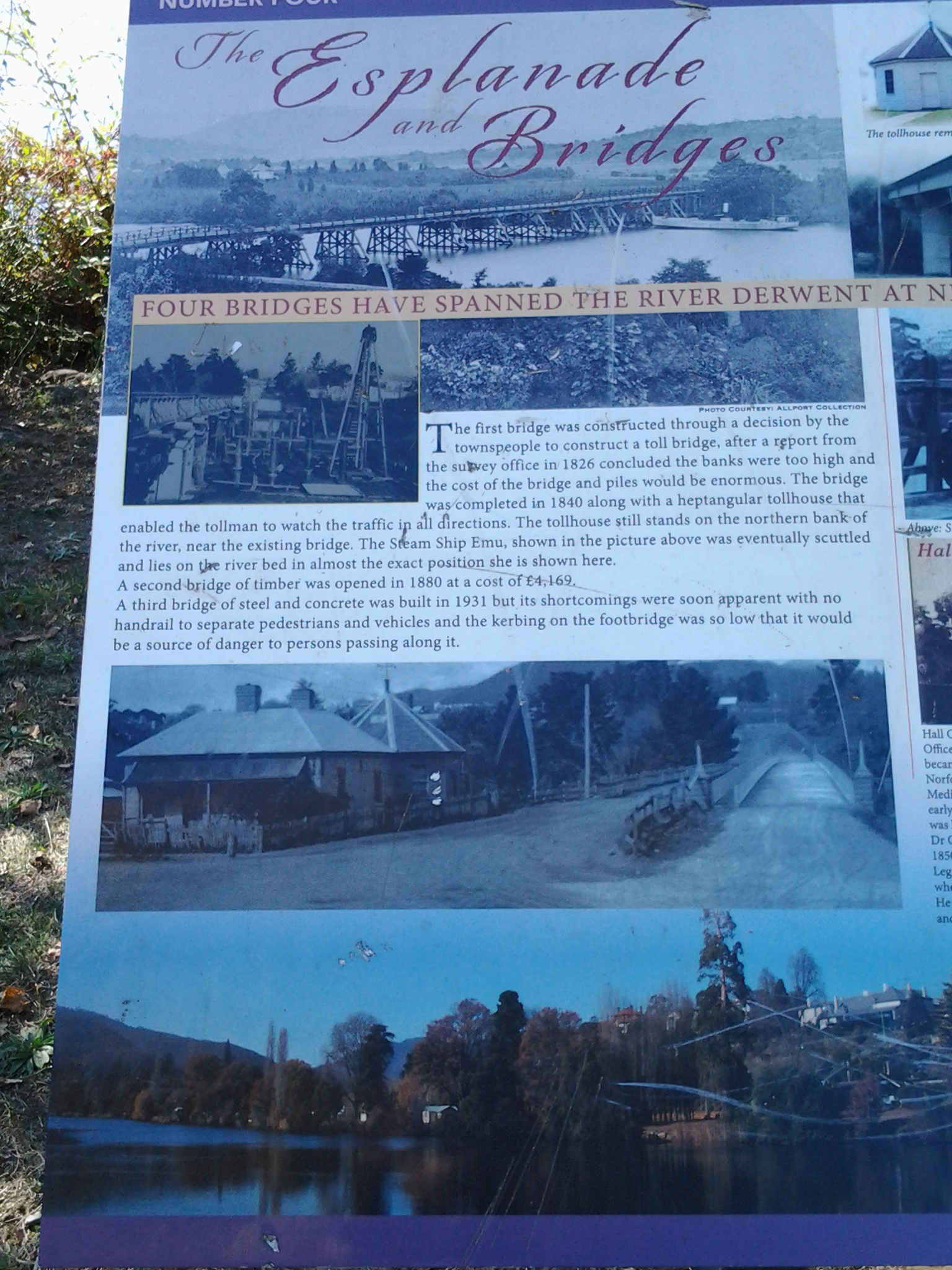
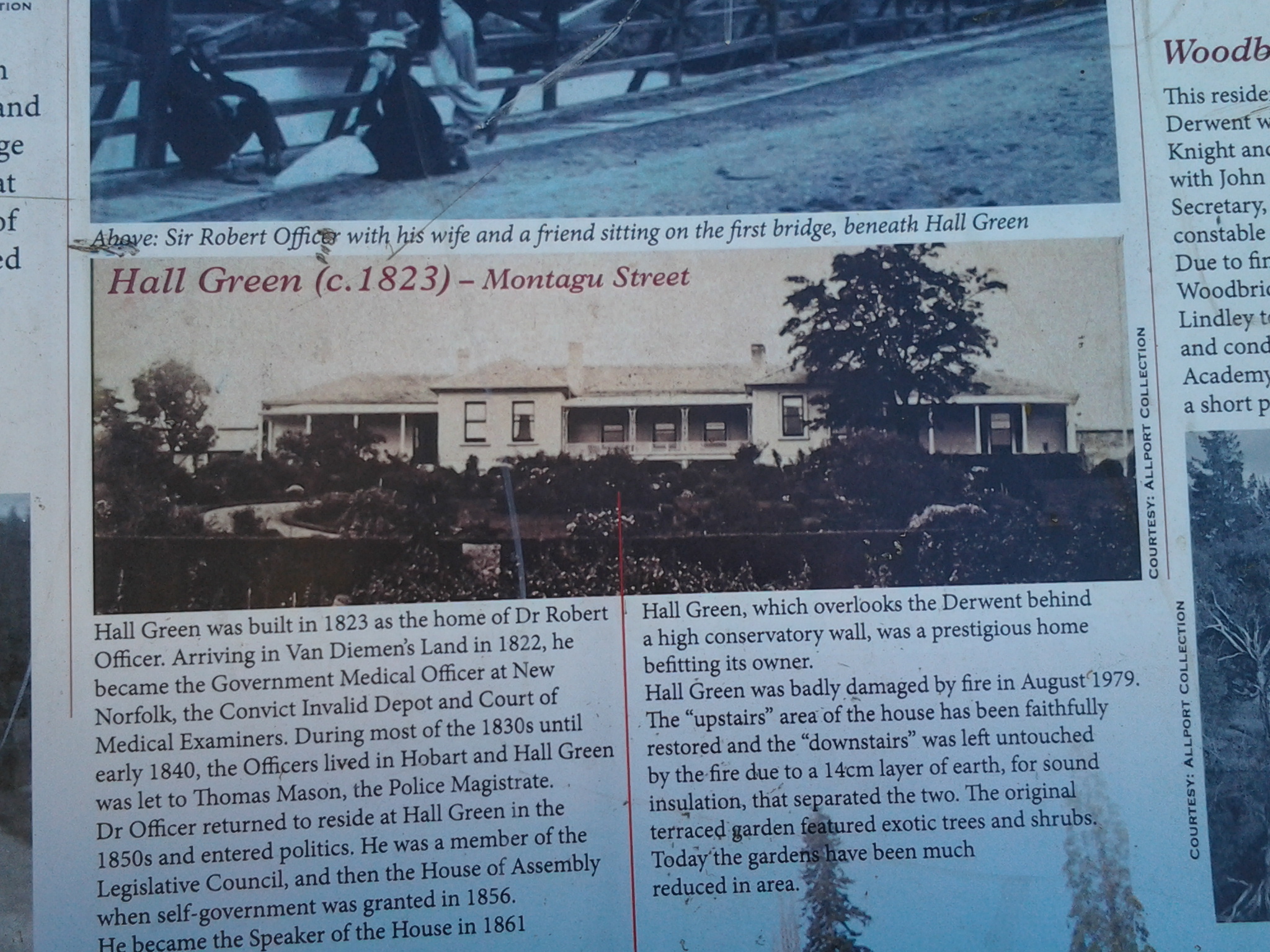
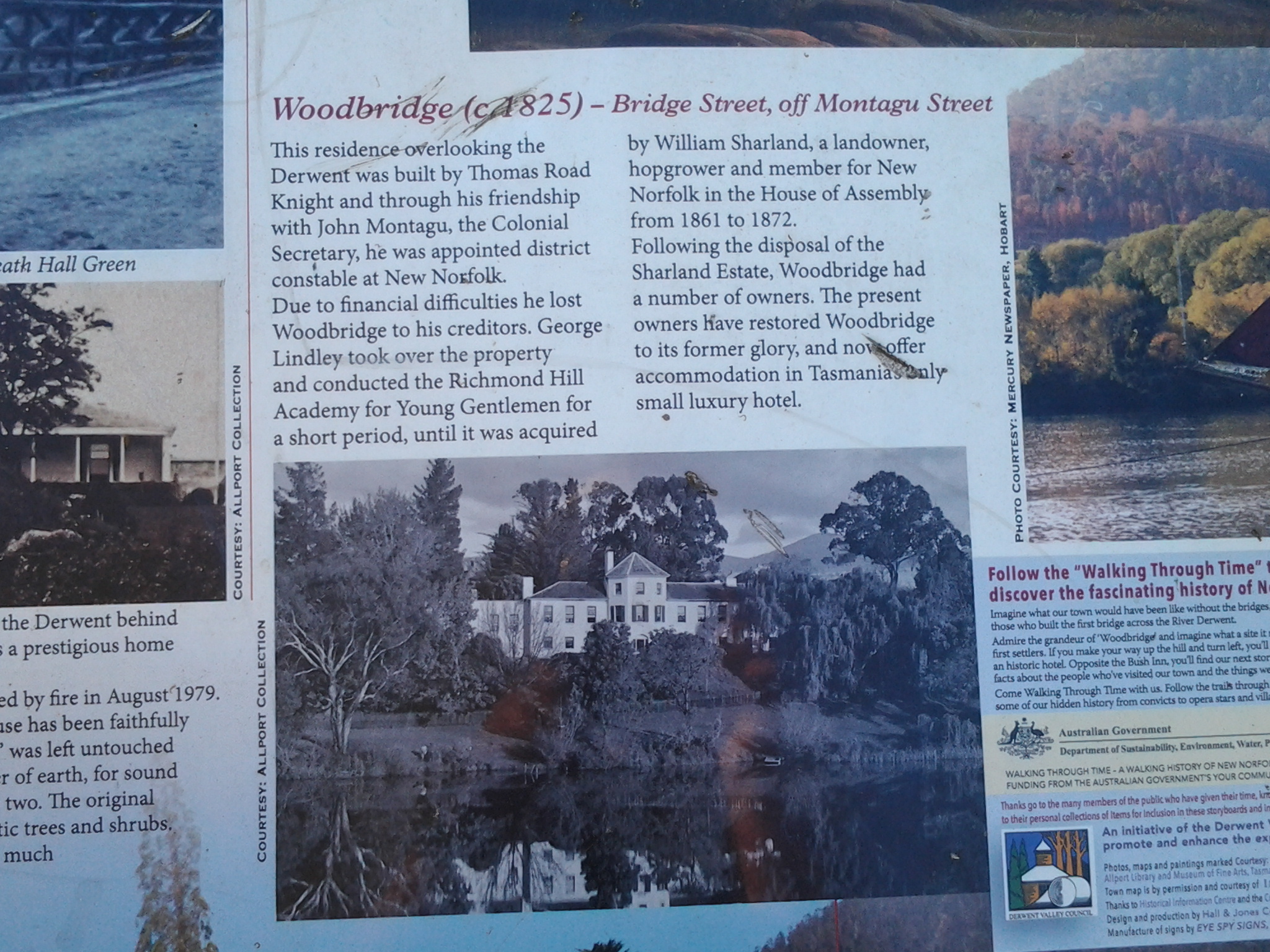
Information panels provided details about earlier bridges across the Derwent, and historic buildings located nearby.

20150413_145250 20150413_145254

20150413_145302

20150413_145328 20150413_145335

The grand and stately houses pictured above, are located near the bridge.

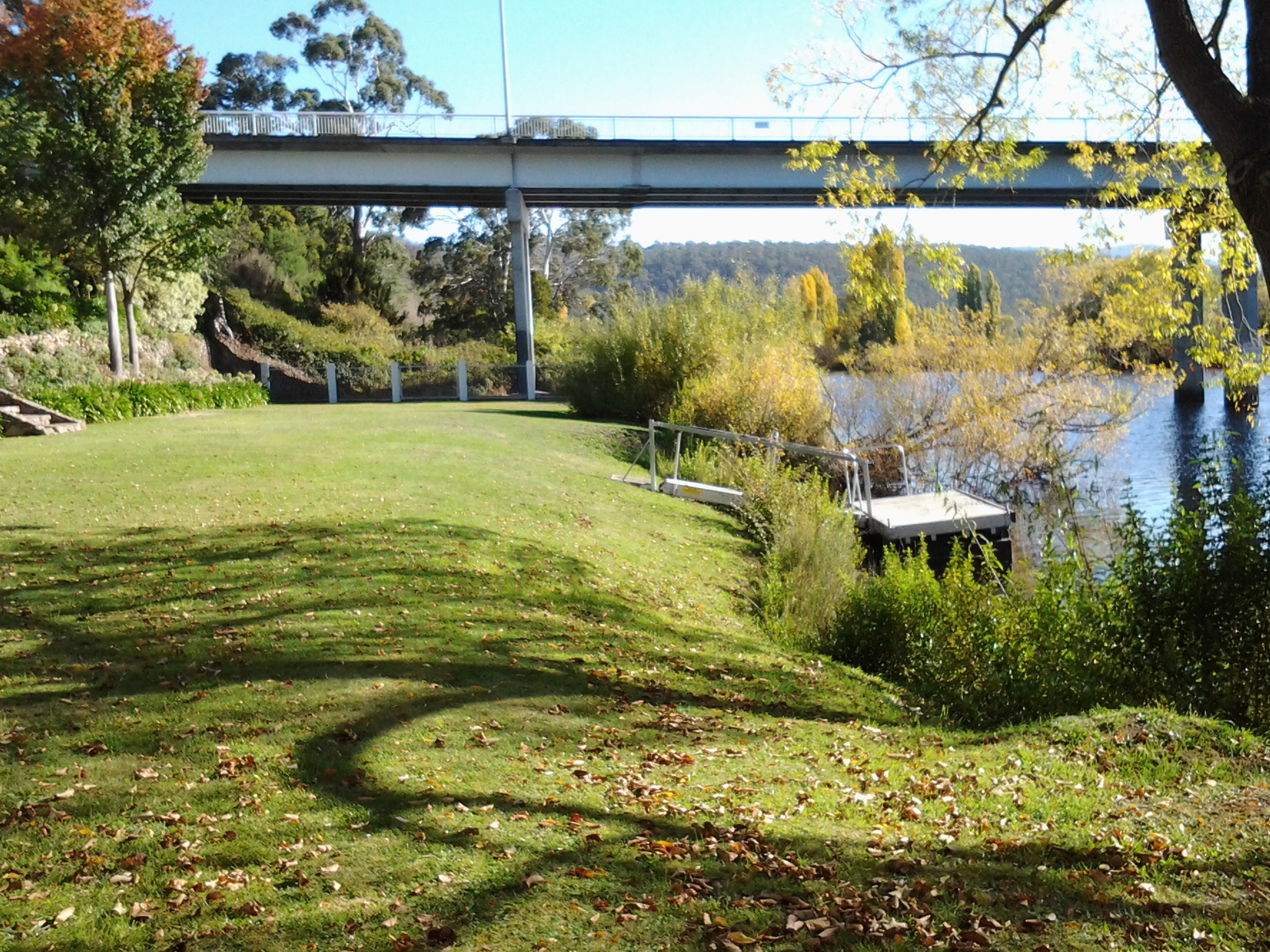
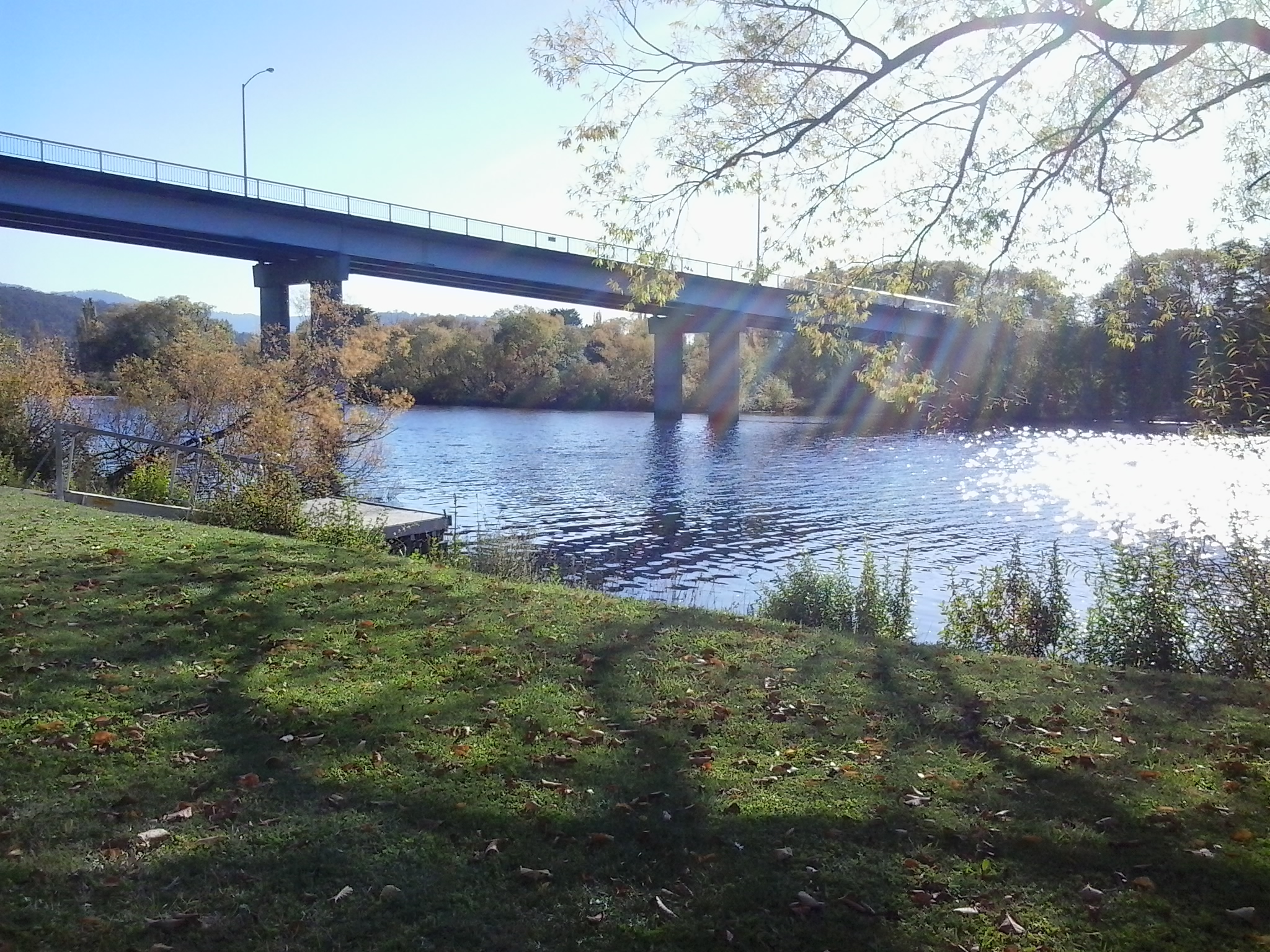
But back to my path to the bridge. In front of me was a gated fence with a sign informing me the gate was locked overnight.  I pushed it open and walked across an impeccably kept mowed lawn. A private sanctuary. Green and lush. The sparkle on the river to my right.  A strongly built bridge ahead.  I reached my destination for Stage 14 at 2.58 pm.

20150413_145518 2015-04-13 15.11.01

2015-04-13 15.11.08 20150413_145514

Instead of charging off up and into the New Norfolk township, and finding a bus to return me to Hobart, I lay down on that green carpet and, soaking in the sun, I felt incredibly fortunate.

My stage 14 day had started with a  5.30 am rise (in the dark) and a Metro bus departure from central Hobart at 7.17 am. The bus left New Norfolk at 4.20 pm and returned me to Hobart. I walked in my front door at 6 pm (as the sun set) feeling quite chuffed because I had seen and experienced many beautiful natural features, the sun had lit up the landscape and the river, and I had talked with interesting people. A wonderful day!

The scenic walk and something for people living with a disability

My walking pathway along the scenic edge of the Derwent River on Stage 14, passed between the New Norfolk Caravan Park and the glistening river water, so I continued unhindered to amble amidst the glow of autumn gold leaves.

By 2.40pm a new jetty presented on my right, public toilets and a Bowling Club were on my left and, in the air, wild geese honked. I could hear quacking ducks on the river.  I watched squalling seagulls fighting over nothing or so it seemed. A No Through Road sign was set only to control vehicular traffic and it was clear pedestrians were welcome to continue onwards.

20150413_145020

As I approached a large flat platform, at 2.45pm, I couldn’t work out what its reason for existence was.  What I saw was:

20150413_144516

When I read the sign its intended use was clear.

20150413_144505

This is the first time I have seen equipment or structures set out in a community/public space for a person who has a disability so s/he can continue their sport.  I was very impressed.

By 2.50 pm I had looked up onto the top of the hill to my left to see the still functioning 1825 heritage Bush Inn (the Inn was built in 1815). Apparently this is the oldest continuously licensed pub in Australia. You can read more information at http://www.australianbeers.com/pubs/bushin/bush.htm

20150413_144852