Category Archives: Hobart

Starting out from Hinsby Beach and walking south to Wandella Avenue – Stage 12

I left home in Bellerive on the eastern shore of the Derwent River before 7am while the morning was cool and the light was soft grey. By the time my bus into Hobart city was travelling over the Tasman Bridge, the sun had hit the top of Mount Wellington, the sky was blue, and the day promised to be sensational.   The dramatic circus tent on the Queens Domain was being dismantled. People on the bus seemed to be dozing. Yet outside the bus, I wondered at the stunning crispness of shadows and sunlight causing windows to sparkle.  The look of the day made me feel like I was sparkling.  But my eyes were wide open.  Waiting at the bus stop at Franklin Square for a bus headed towards Kingston but passing through Taroona,  all I could think was ‘glorious, glorious, glorious’.

With few people on board, the trip to bus stop 30 in Taroona (the one where I finished in Stage 11) only took 22 minutes and then I was out in the fresh air on the Channel Highway at 7.52am. Gulls calling. Gardens were flush with sunflowers, roses, agapanthus, wandering pumpkin plants, lavenders of all types, and flowering gum trees.  All overlaid by the sounds of bush birds flitting here and there.

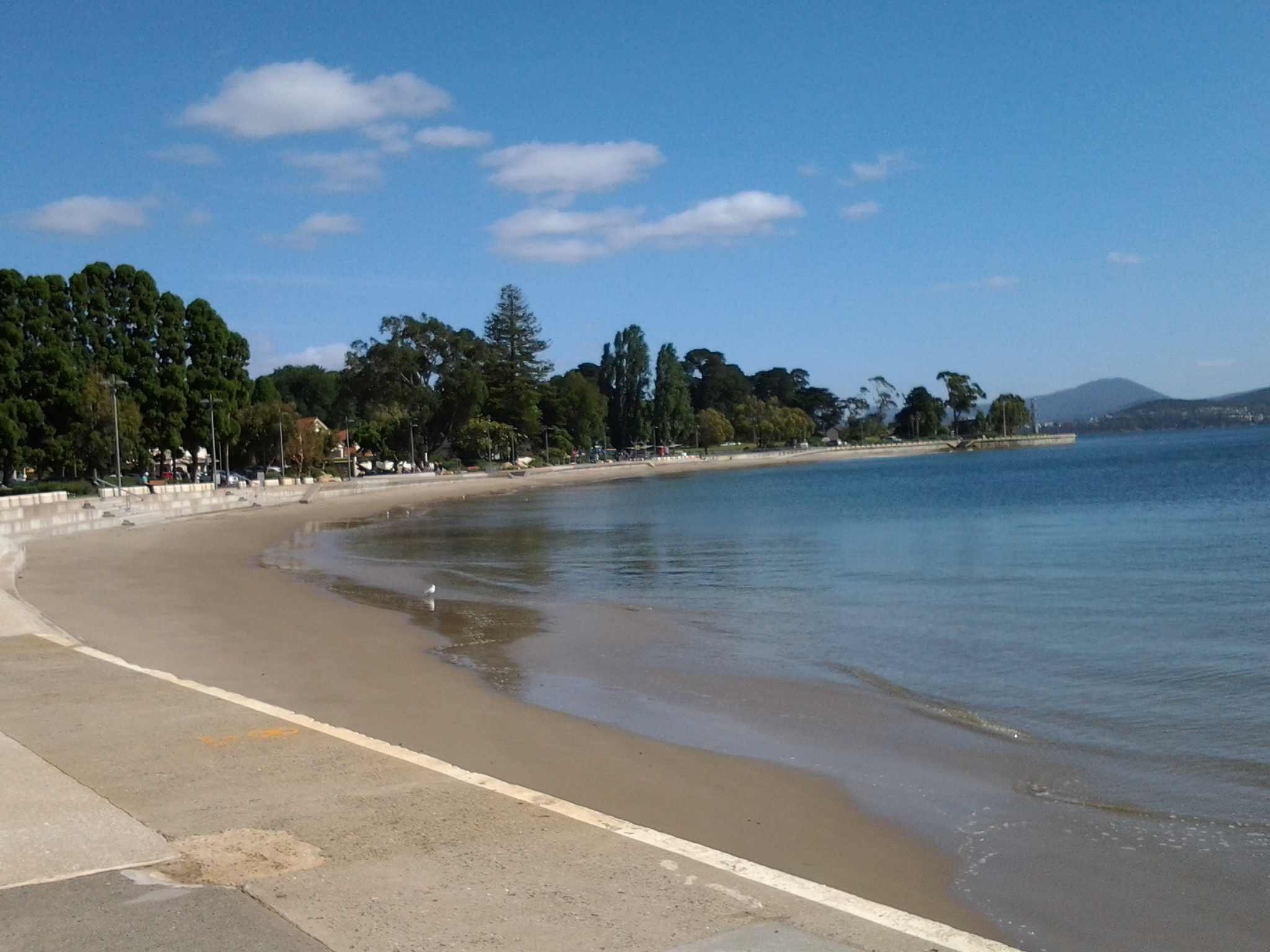
By 7.58am I had walked down Hinsby Street and reached the top of the walkway leading to the Hinsby Beach.  I could hear the shushing of the soft waves along the beach and glimpse a tiny bit of water at the end of the shady path.

20150202_075819

I could see the Alum Cliffs through the trees.

20150202_075858

A swimmer was leaving the water as I clicked a photograph. When I registered his angry body language, I realised I had been feeling the place without really seeing.  Of course my finger on the tablet’s camera clicked mechanically without seeing or feeling – but featuring photographs with him was not to his liking. I immediately claimed to be photographing the Alum Cliffs at the end of the beach and promised not to blog his picture.
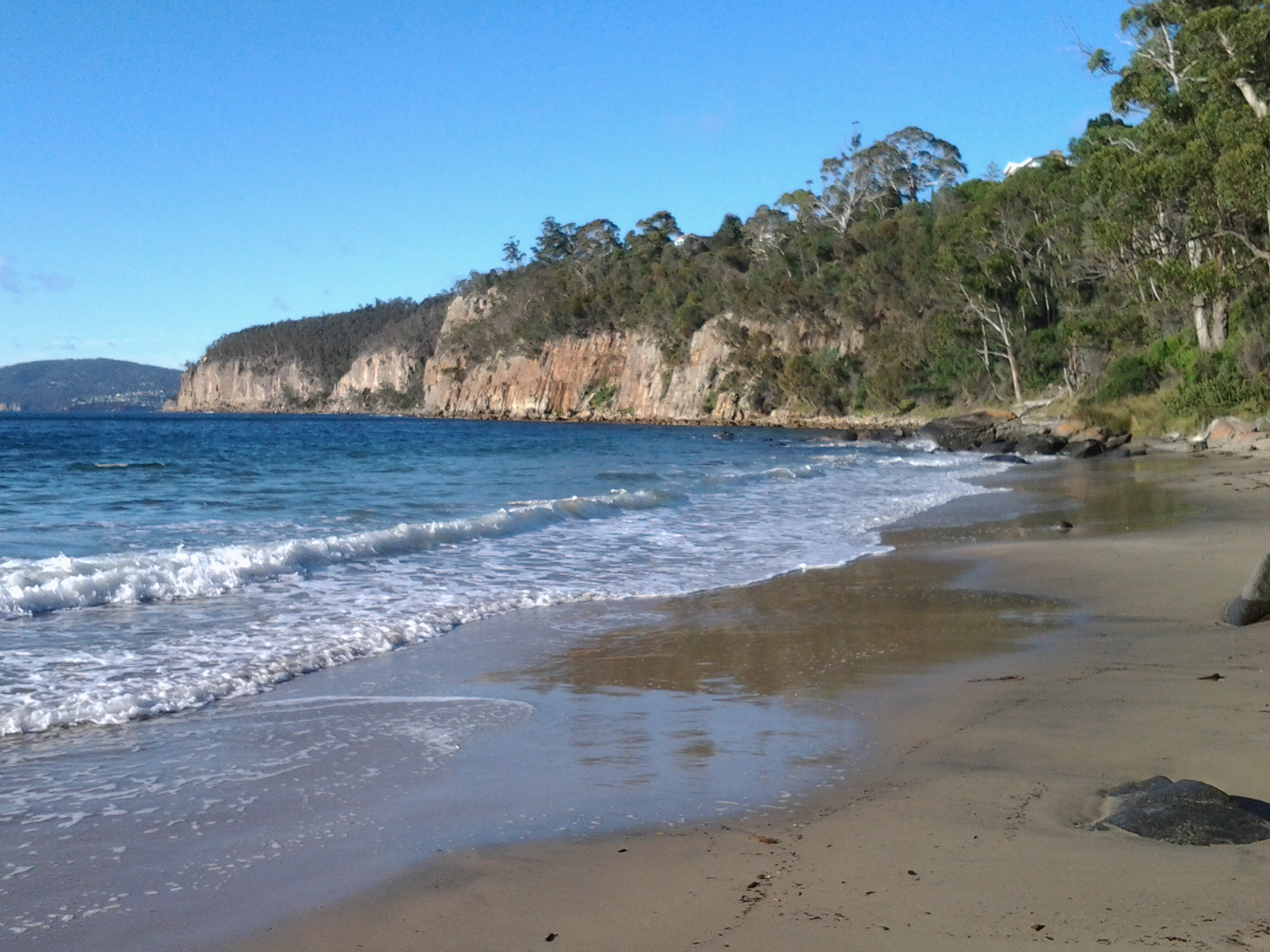
20150202_080143

I guess the swimmer was not used to sharing the beach with anybody else that early and could only repeat rather manically, ‘you must come in’, ‘you must come in’ as he gesticulated towards the water.  I was thickly dressed from neck to toe and already wearing my sun hat.  ‘Going in’ was not in my plan.  I continued along the beach. A little later on a path, I took the following photo – I hope you can understand that getting undressed would never have been an option.
20150202_080640

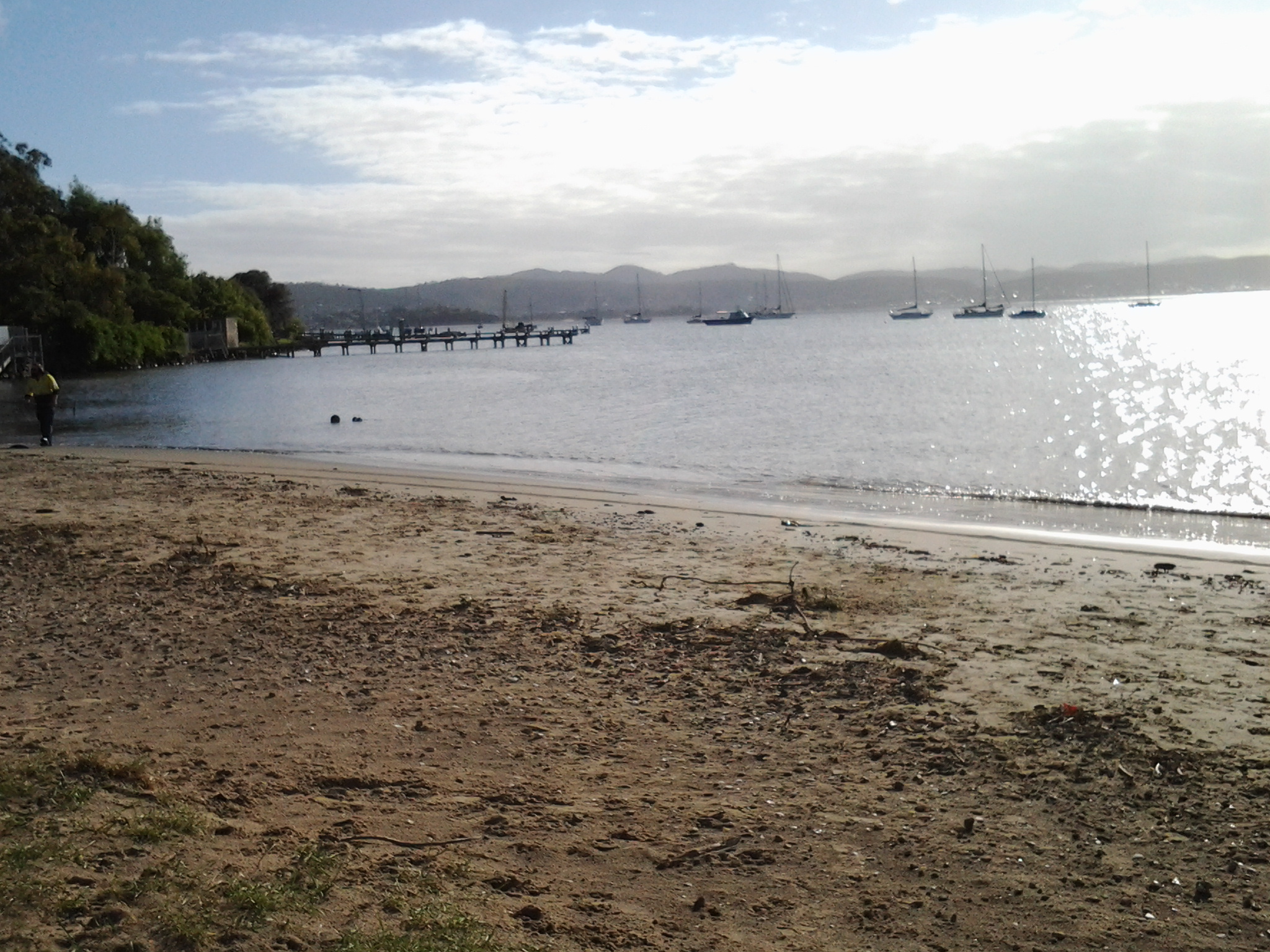
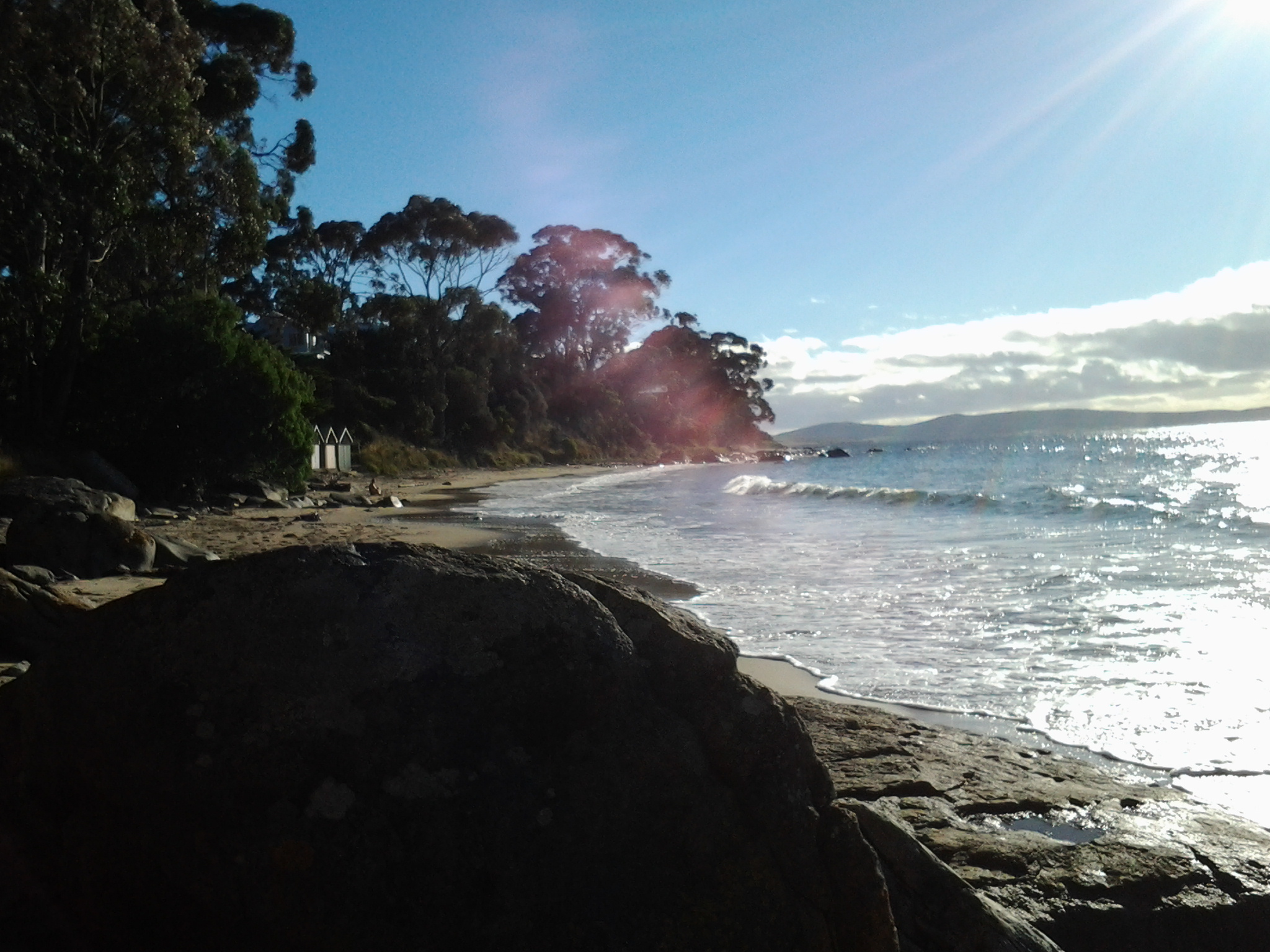
At 8.05am, at the end of Hinsby Beach, I looked back for one last sea-level view of Hinsby Beach.
20150202_080405

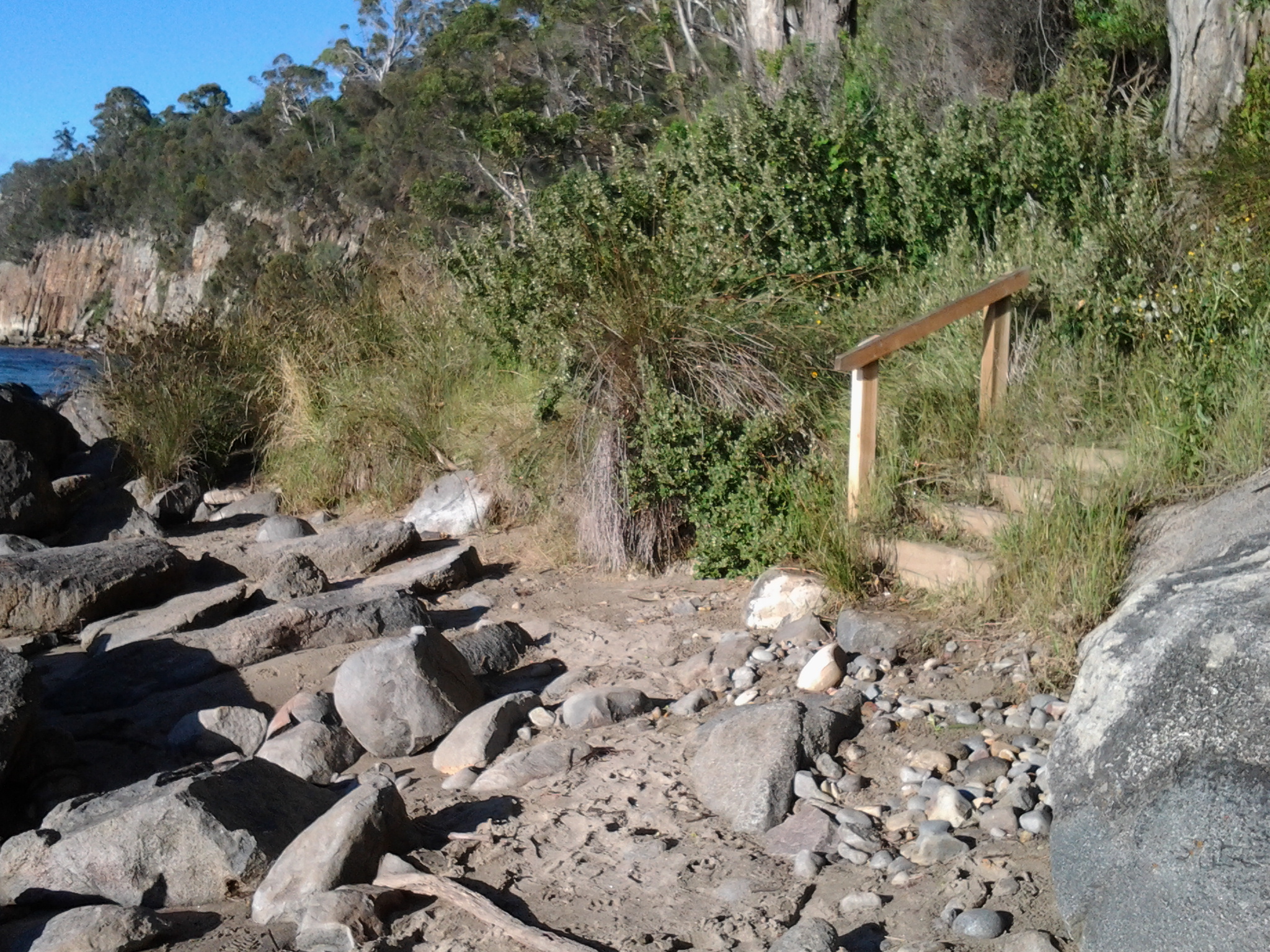
I reached a stairway with rails and walked uphill until I seemed not to be on a clear track.
20150202_080359

When you read further below you will realise the photo above does not show the start of the track which I should have taken.

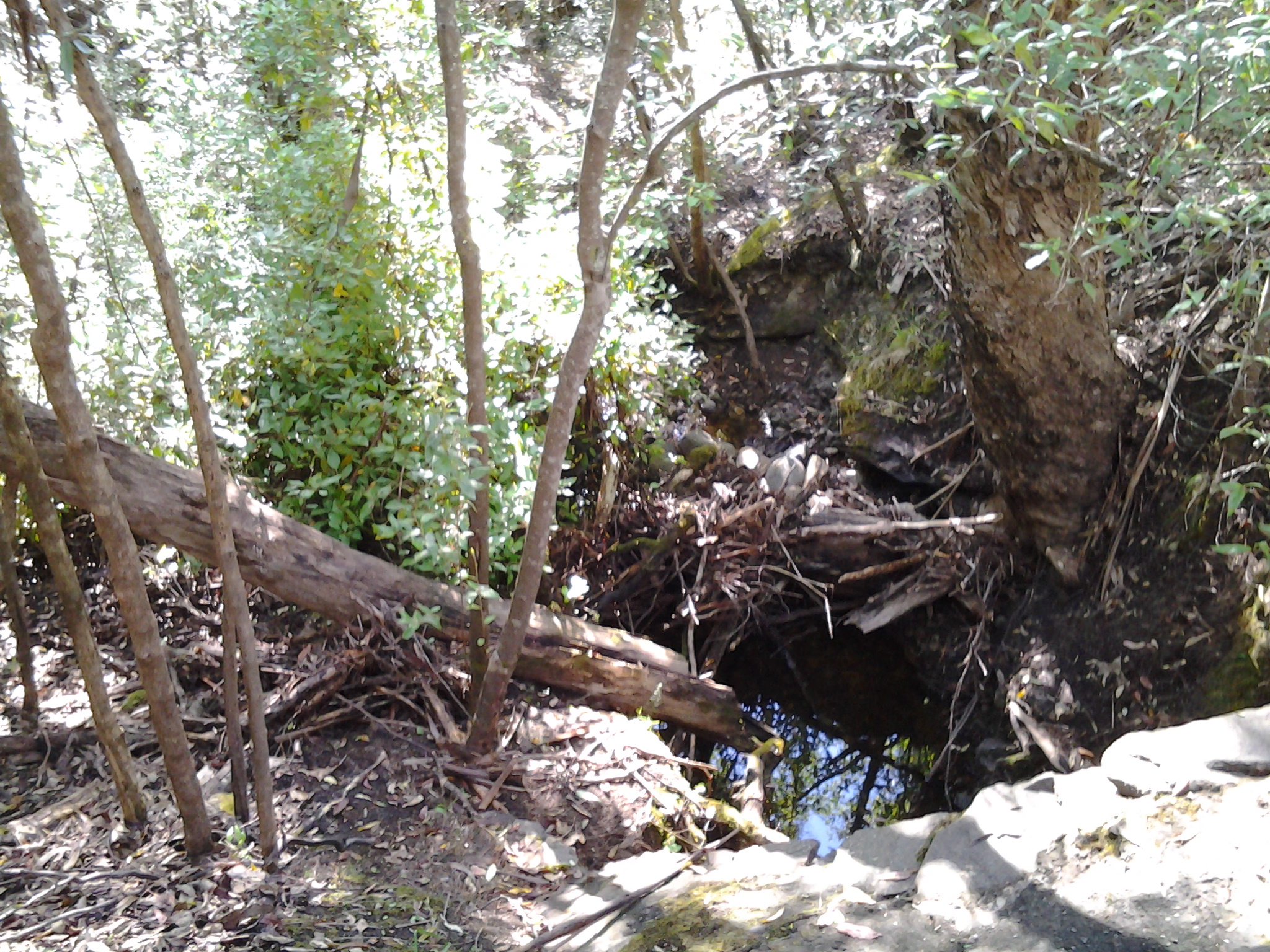
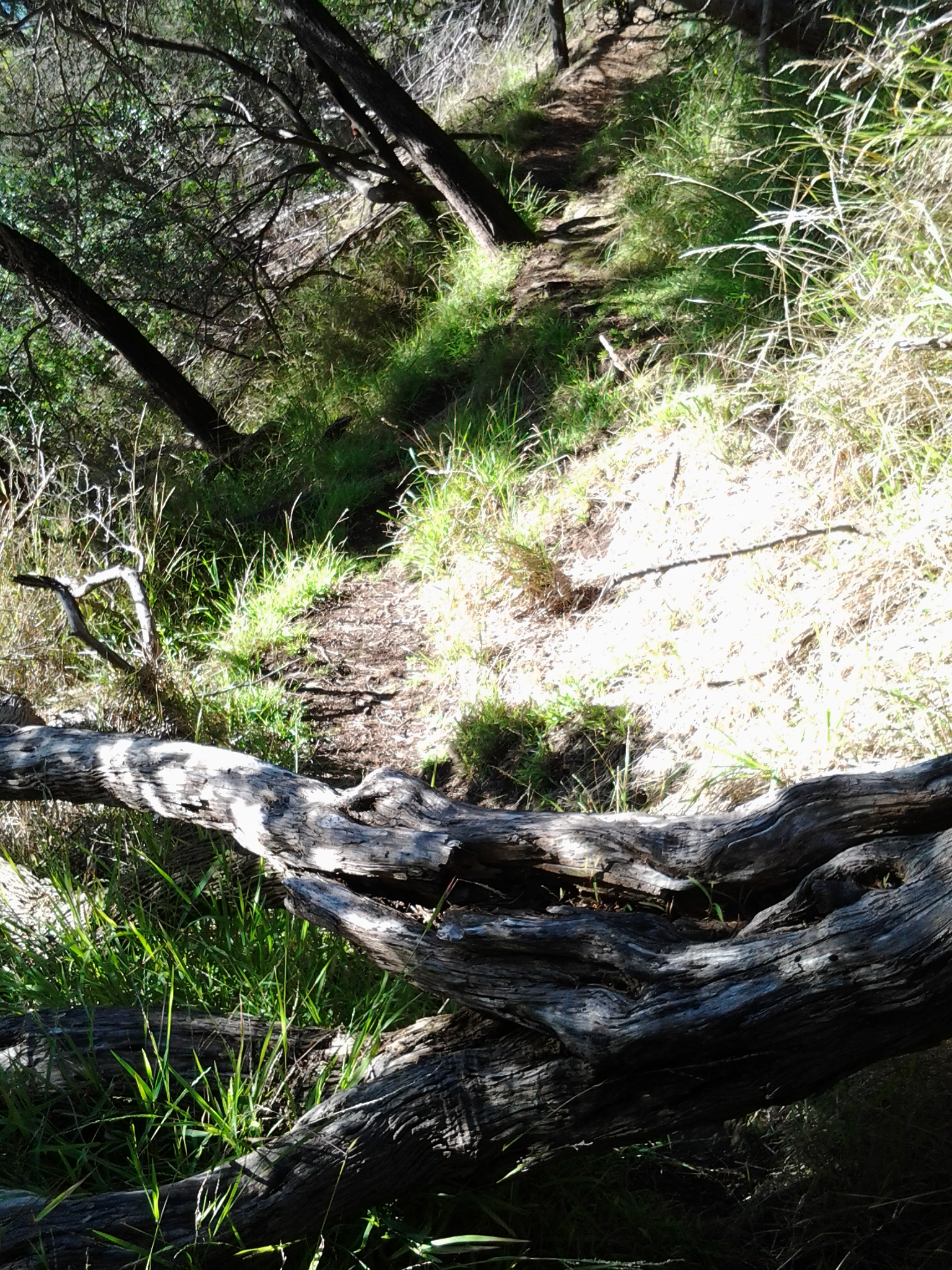
Very soon I arrived at a gully with a small trickle of water passing downhill. I chose not to cross by balancing as a gymnast on the dead tree trunks that criss-crossed it. Instead I simply walked easily down, stepped across a few rocks and walked up the other side.  Before long it was clear I was fenced in and that a proper dirt track passed on the other side of the fence. The fence was elastic so I swayed over it rather dramatically without falling off and down the cliff on the other side of the track. When I righted myself and looked back along the track which I hadn’t known existed, three women and a dog stood very still, their mouths agape. ‘Are you alright?’ they chorused. ‘Yes’, I assured them as I smiled.  Some moments I wonder if I am losing my once good judgement.  ‘But where have you come from?’ I asked with a puzzled wrinkling of my forehead. ‘Where did you find this track?’  Apparently, if I had bypassed the stairs and track I had chosen and walked around over the rocks of Hinsby Beach a little further, the real track started there.  Time for the installation of a few signs!

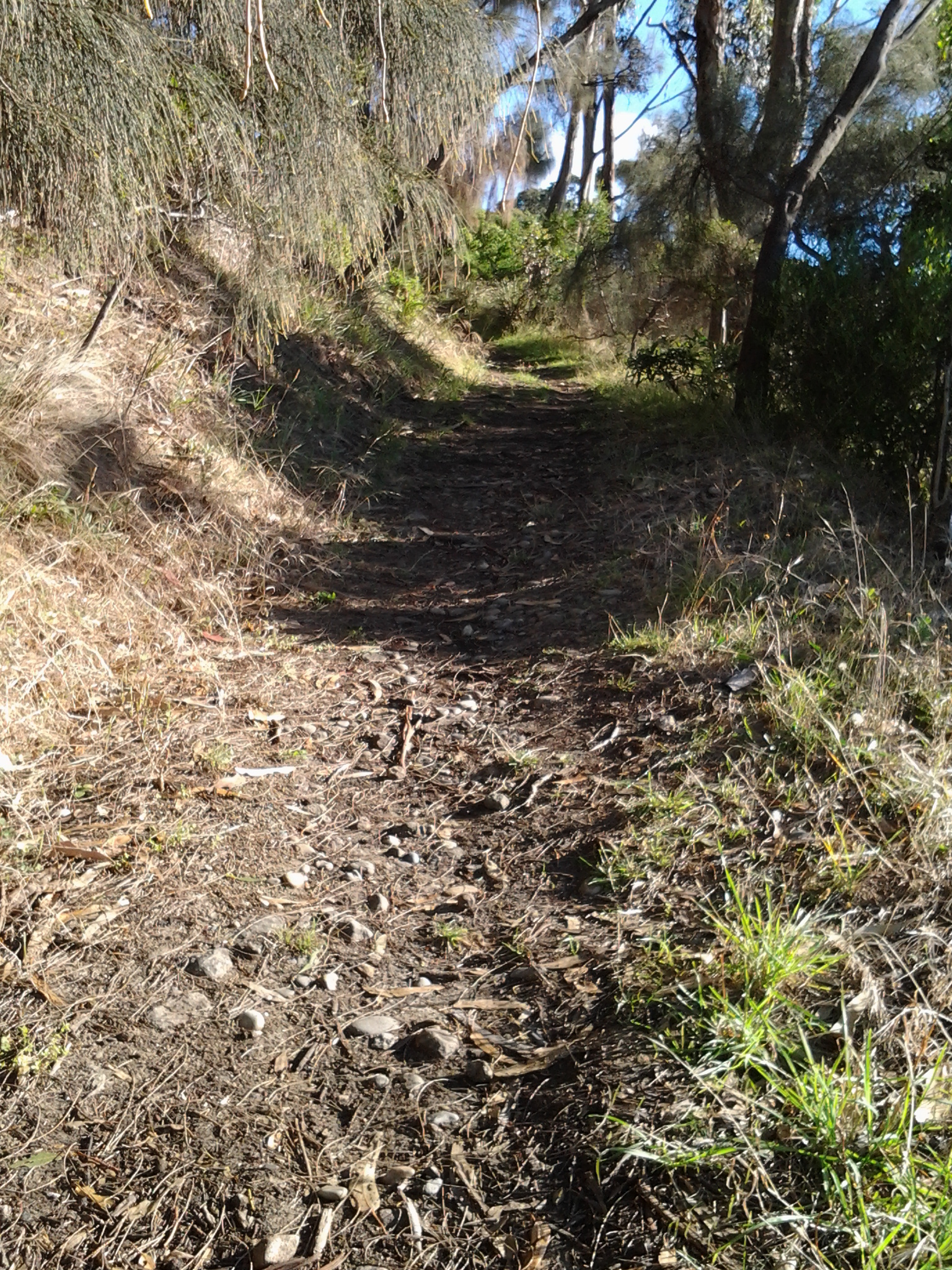
This ‘new’ track was fine.
20150202_080456

Although there were occasional diversions across the track.
20150202_084019

The view back towards Hinsby Beach was clear.

20150202_082252

The time was 8.22am as I offloaded my jacket, smeared sunscreen across exposed parts of my body and continued walking along the track until it extended up into a suburban street.  At 8.25am I turned left into Wandella Ave, wandered along past houses for a while, could not see any further tracks back to the Alum Cliffs, talked to a local who did not think there was one and recommended that I should walk up to the Channel Highway and continue southwards on that road.

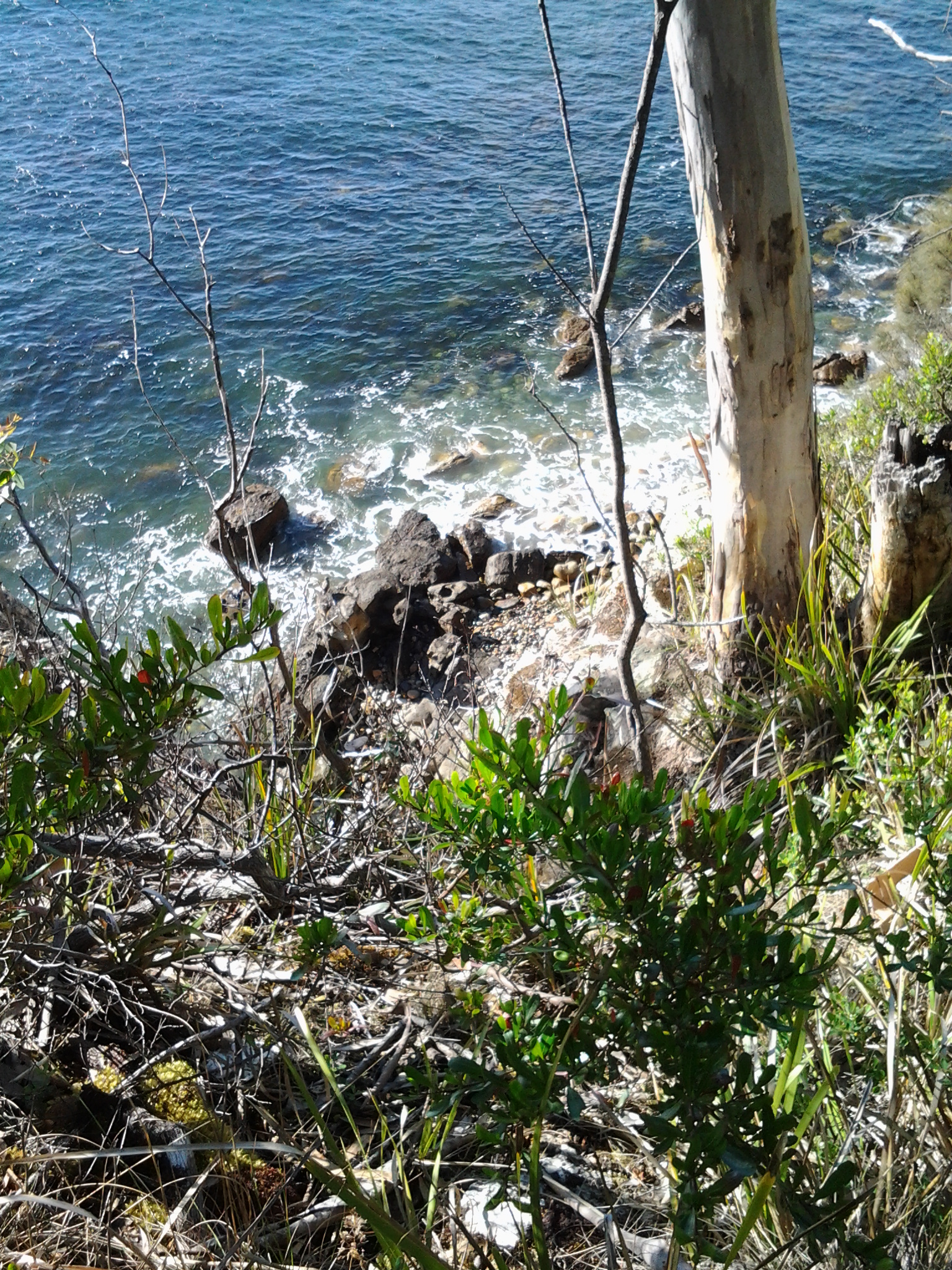
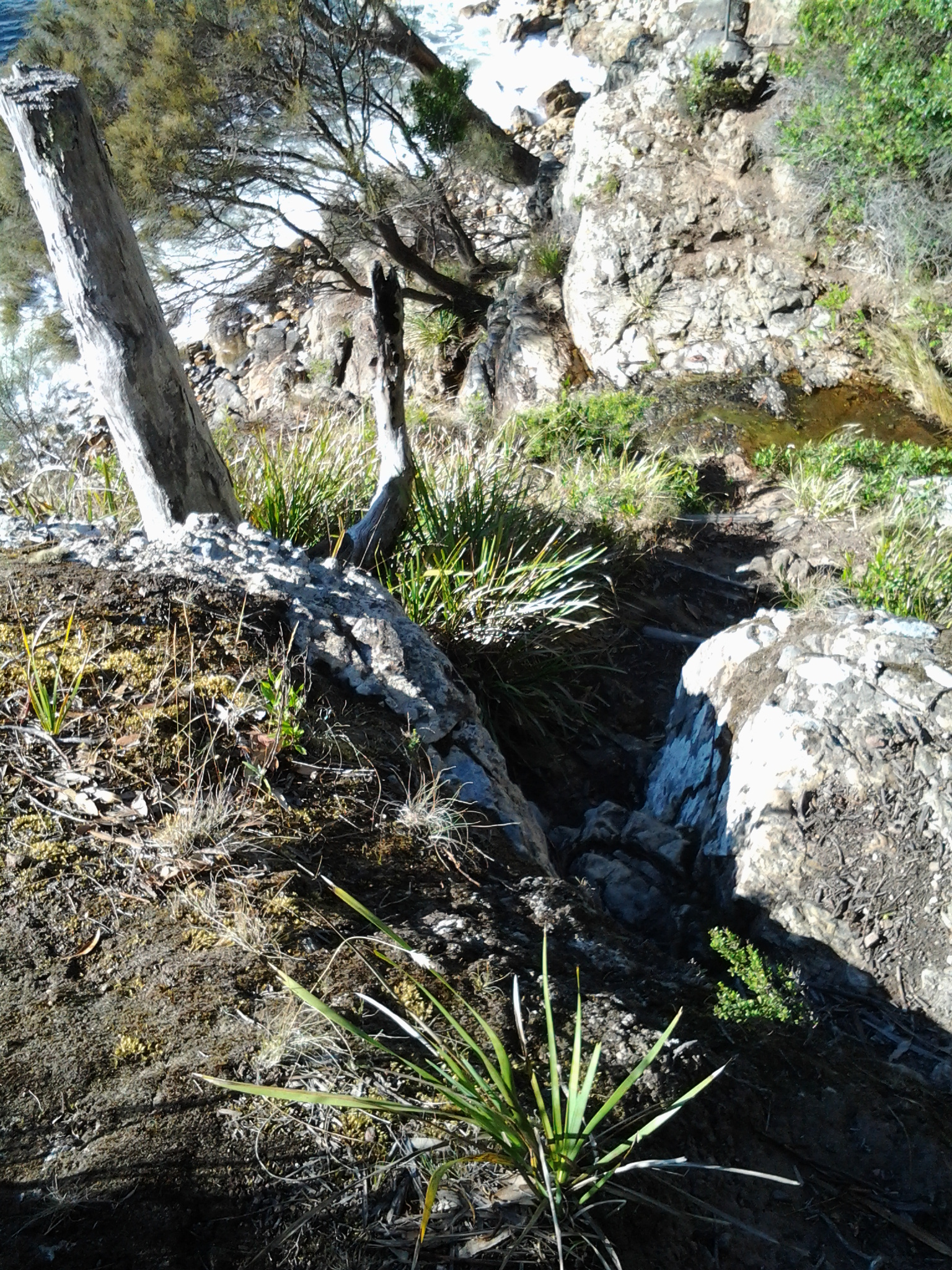
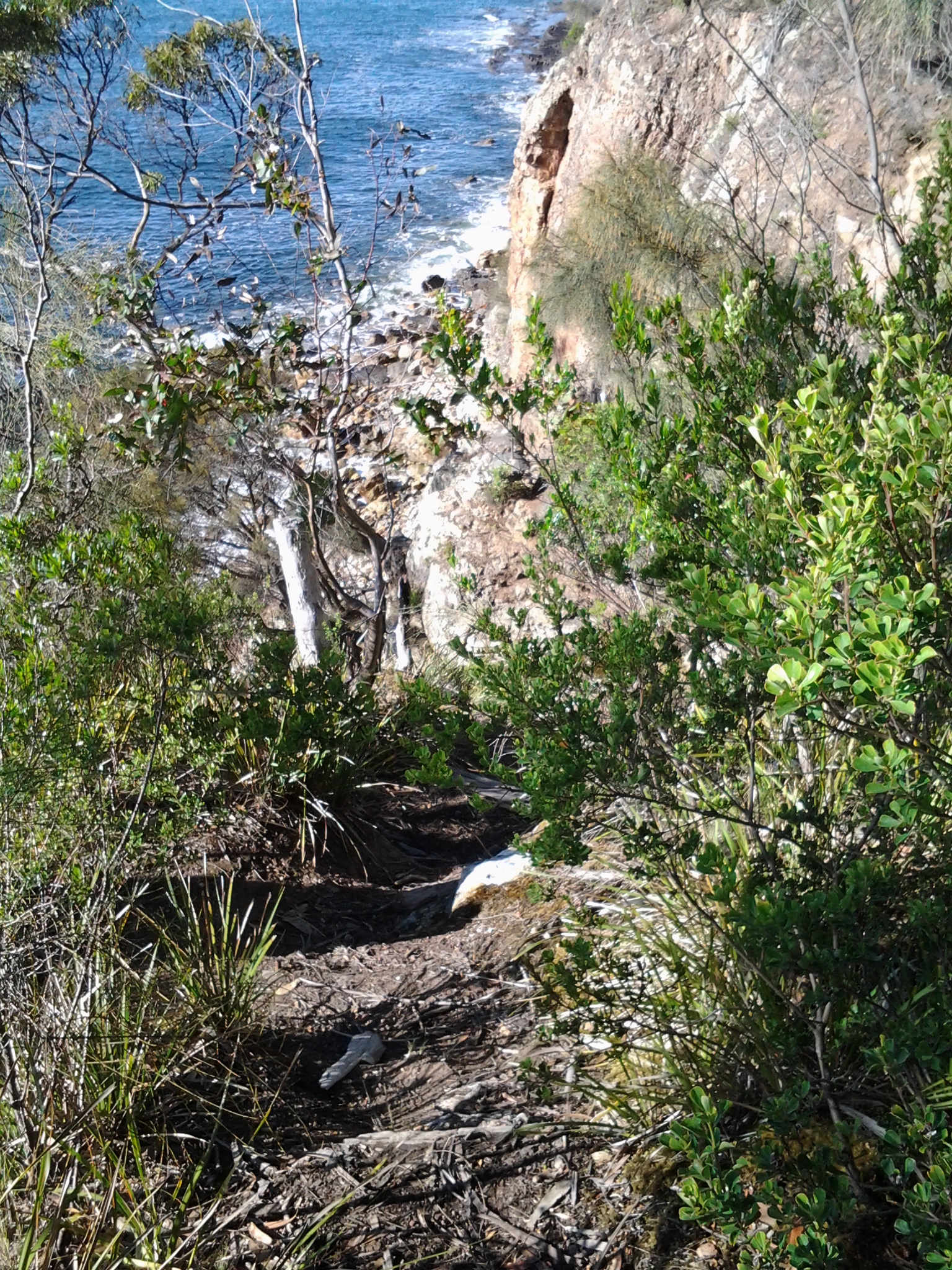
Not to be defeated, I retraced my steps down the original pathway until I discerned an old disused track that seemed to continue along the Cliffs.  I walked it but casual inexperienced walkers and those walking alone absolutely should not. Incredibly unsafe in just about every way.  I didn’t fall nor receive injuries but there were so many ways and places I could have damaged or killed myself on that route.  I won’t relay all the details of that walk except to say that the views across the Derwent River though the trees were grand. Blue Wrens darted around me through the bush. Waves pounded against the Cliffs, and I could hear the roar of waves crashing on distant beaches.  Because photographs flatten the vistas, the ones I have taken do not present the feeling of isolation, steepness nor roughness of this non-track.  But it was incredibly beautiful and I am glad to have seen that landscape.
20150202_085324

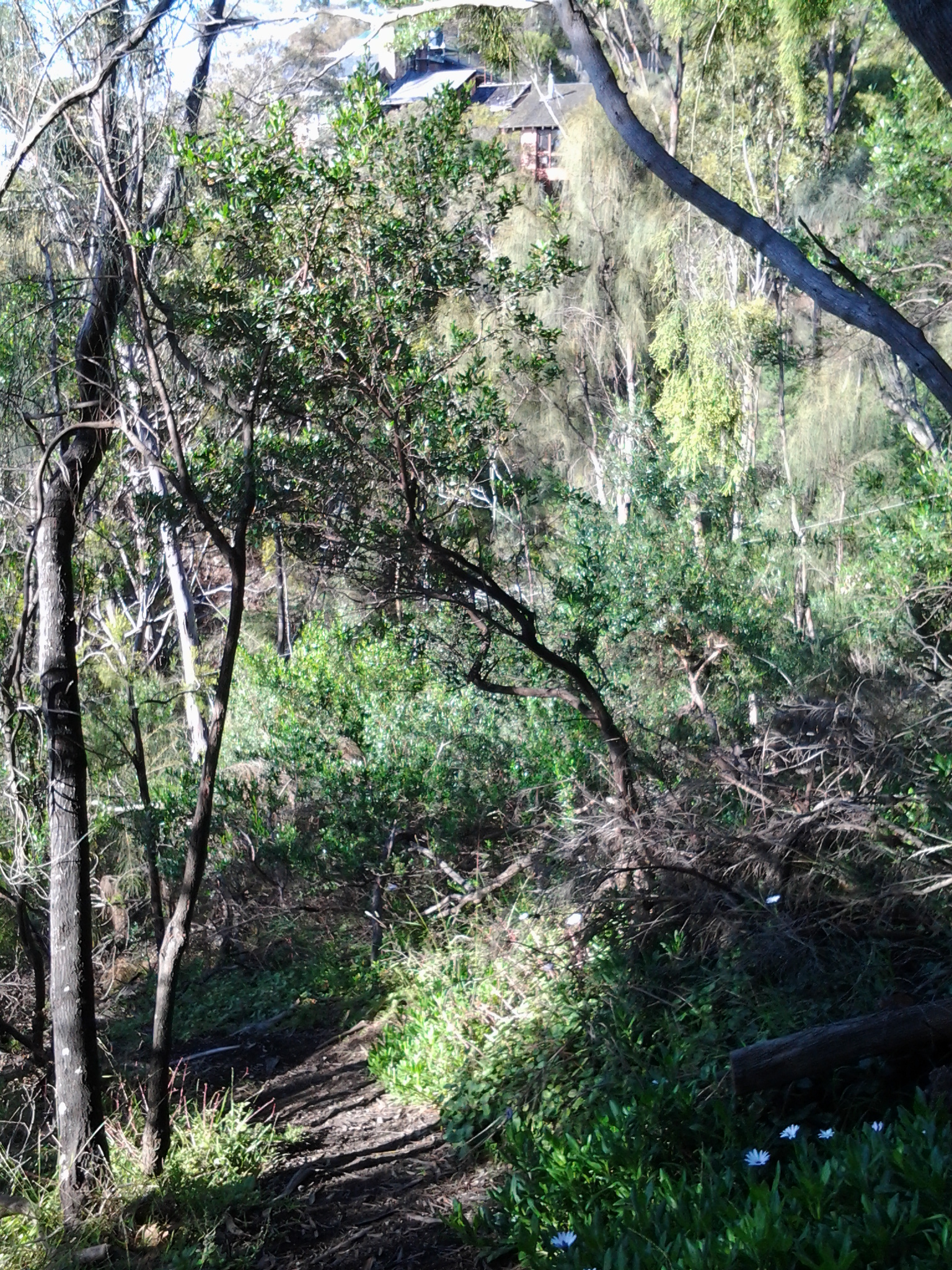
I started this diversion at 8.37am. After following a collapsing path (although parts were good), I managed a deep descent into and an ascent out of an unnamed gully by 9.12am, rounded an extensive private house, talked with the house owner about the future of tracks along the Alum Cliffs and the non-availability of any tracks passing his house (which stood on the very edge of the Cliff) around 9.25am, and walked down and around the very long winding private driveway over a trickling creek, I reached suburbia again at 9.35am – the same point on Wandella Ave I had been earlier in the morning. I had completed a loop. Certainly I had been close to the Derwent River more than most but I had not advanced along the River.

The first photo below shows the house I climbed up to on top of the cliff after descending into a gully, the waters of which plunged over a rocky edge to the River.
20150202_084704 20150202_085446 20150202_092605

I recommend that all evidence of the existence of the disused track should be eliminated.
From Hinsby Beach to Blackmans Bay accomplished on Stage 12 yesterday

The goal of my walk along the Derwent River for Stage 12 was to start at my last stopping point, Bus Stop 30 on the Channel Highway at Taroona on the western shore of the Derwent River, and continue to Blackmans Bay in the local government area of Kingborough.  I did not get as far as expected, but I was satisfied when I finished 2/3 of the way along the Blackman’s Bay Beach.

Over future posts, I will write up the stories of the walk, what I saw and what I experienced, but for now it’s enough to say that I am continuing with this massive project to walk both sides of the Derwent between the mouth and Bridgewater, and then onwards to Lake St Clair.

Yesterday I covered 5 ¾ kilometres of the length of the Derwent River on the western shore (making 35 3/4 kms in total on the western shore), and walked approximately 11 kilometres (making a total of 154 kms to date) to achieve that distance; there were a lot of steep ascents and descents.

20150202_085332

This distance also takes in the streets and paths on which I walked that led to dead ends so that I needed to retrace my footsteps.

The highlights of the walk include finding a way through some of the early part of the almost untracked Alum Cliffs, the delightful walk along the tracked part of the Alum Cliffs, meeting some friendly people along the way, the unusual snake sign at Tyndall Beach, stopping for a long cup of tea in Kingston with a friend, my discovery of another tucked away beach – Boronia Beach, and the Blackmans Bay Blowhole.

There are many memorable images but my favourite for today is one of my photos of mussels growing on the rocks at Boronia Beach.  I have already made it my desktop background image. When enlarged, the blues glow.

20150202_142540

Fundamentally the Stage 12 walk was about forest and water.

20150202_113014 20150202_104740  20150202_115156 20150202_152557

The day started with my being roughly opposite Gellibrand Point at the northern tip of South Arm and finishing opposite the long South Arm Beach.

I intend my next walk will start from where I left off at Blackmans Bay and then continue into the Tinderbox area to Fossil Cove.  But before then I need to record the details of yesterday’s walk.  So Stage 13 will be a while away.

Hobart Regatta – it is on this weekend!

Only a couple of Stages ago I walked through the Hobart Regatta Ground as part of my trek along the Derwent River. At the time, other than a few fishermen the area was people-less and very dull.

20150109_160021

By contrast, next weekend the area will be crowded with people involved in all sorts of Regatta related activities. The place will be buzzing. You only have to read the blurb offered by the Royal Hobart Regatta organisers on http://www.royalhobartregatta.com/ to realise there will be something that should interest everyone. Serious boat races and silly community fun races will be the mainstays of the Regatta. Concerts, movies, music, wood-chopping contests, pageants and trans-Derwent swims will support the event. Members of the Royal Australian Navy will arrive on the Flagship HMAS Sydney, complete with helicopters simulating live rescues etc. Finally, a fireworks display will light up the Derwent Harbour on Monday night.

The Regatta experience runs in tandem with the Australian Wooden Boat Festival over the weekend. Hobart’s waterfront will come alive with festivities. Thousands of people will throng the area over the four days.

Wooden boats will be afloat on the Derwent River this coming weekend

The Australian Boat Festival will run from Friday 6th to Monday 9th February centred around Hobart’s city waterfront and the Derwent River.

Every two years we remember that the first indigenous inhabitants made wooden canoes and the first European settlers arrived here in tall sailing ships constructed from wood, and we look at our historical (this time 20 of the boats will be over a century old) and current wooden boats. Around 550 vessels will be part of this Festival in 2015.

Apparently this has now become the southern hemisphere’s largest wooden boat festival.  These days in southern Tasmania we have a new history of a boat building industry that produces custom made craft, and restoration of older boats.

The spectacular Parade of Sails starts the program on Friday at 1pm and so I, like many others, will gather somewhere along the Derwent River to witness the event.

The program is detailed and complex; you can read more and view fabulous photographs taken at previous events at http://www.australianwoodenboatfestival.com.au.

Involved in the last Wooden Boat Festival was a replica of an ancient Viking ship.  I wait with interest to see what surprises will turn up this weekend.

Impressive swim down the Derwent River on Saturday

The air temperature didn’t rise above 20 degrees C and while I do not know the Derwent River’s water temperature, I imagine the swim was invigorating to say the least.

On Saturday, a Massachusetts (USA) marathon swimmer survived an overarm feat that nobody apparently has completed for 40 years. He swam from New Norfolk, 19kms by road west of Bridgewater Bridge (the Bridge I reached when walking a few Stages ago), southwards until he reached the Tasman Bridge which is the last bridge across the Derwent River before the mouth of the River. Dan Curtis began ‘The Big Swim’ at 6am and just on 10pm he reached his destination.  Photos of the man (http://dailynews.openwaterswimming.com/2015/01/dan-curtis-to-take-on-big-swim-after-39.html) indicate he is no spring chicken so I am very impressed.  This is another wonderful example of having a goal, giving it a go, then finding out whether success is possible.

Buses in southern Tasmania – tips for their use

In communicating with some people, it has become clear that using the local public bus service makes them nervous. They don’t know how it works and therefore they are cautious about following in my footsteps as I walk in Stages, along the Derwent River.  I have written some tips which might allay fears. You can read these at:

https://walkingthederwent.com/about/buses-in-southern-tasmania-tips-for-their-use

If you have a question concerning my experience with bus travel in southern Tasmania, don’t hesitate to ask.  I sold my car almost 4 years ago, so I have considerable experience getting around using public transport.

Taroona’s coastline as experienced on Stage 11 of my walk along the Derwent River

The last leg of this Stage was the most interesting because I made discoveries which delighted me deeply.

At 12.18pm, I left my Channel Highway resting spot and walked downhill toward the people-free Taroona High School (closed for school holidays). Close to the bottom of the hill I could see the tops of boathouses and a ‘beach’ to my right so I took a dogleg to Melinga Place on my right and continued downhill.

20150119_122623

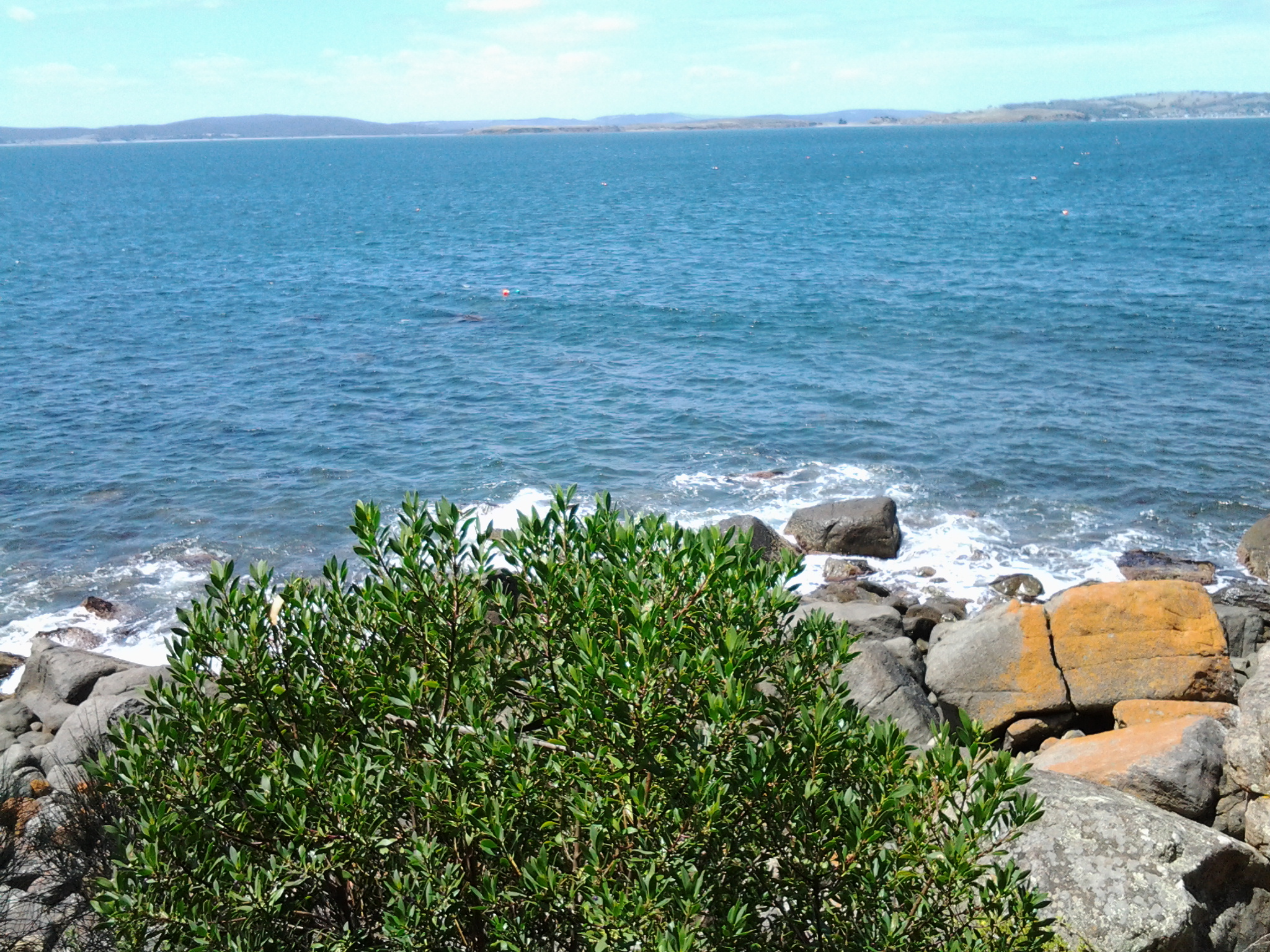
I didn’t know this existed. Mostly a rocky shore, a little sand, edged by a mown green lawn.  Serene.  Across the Derwent River, I could see Gellibrand Point at the north of the South Arm peninsula.

20150119_122608

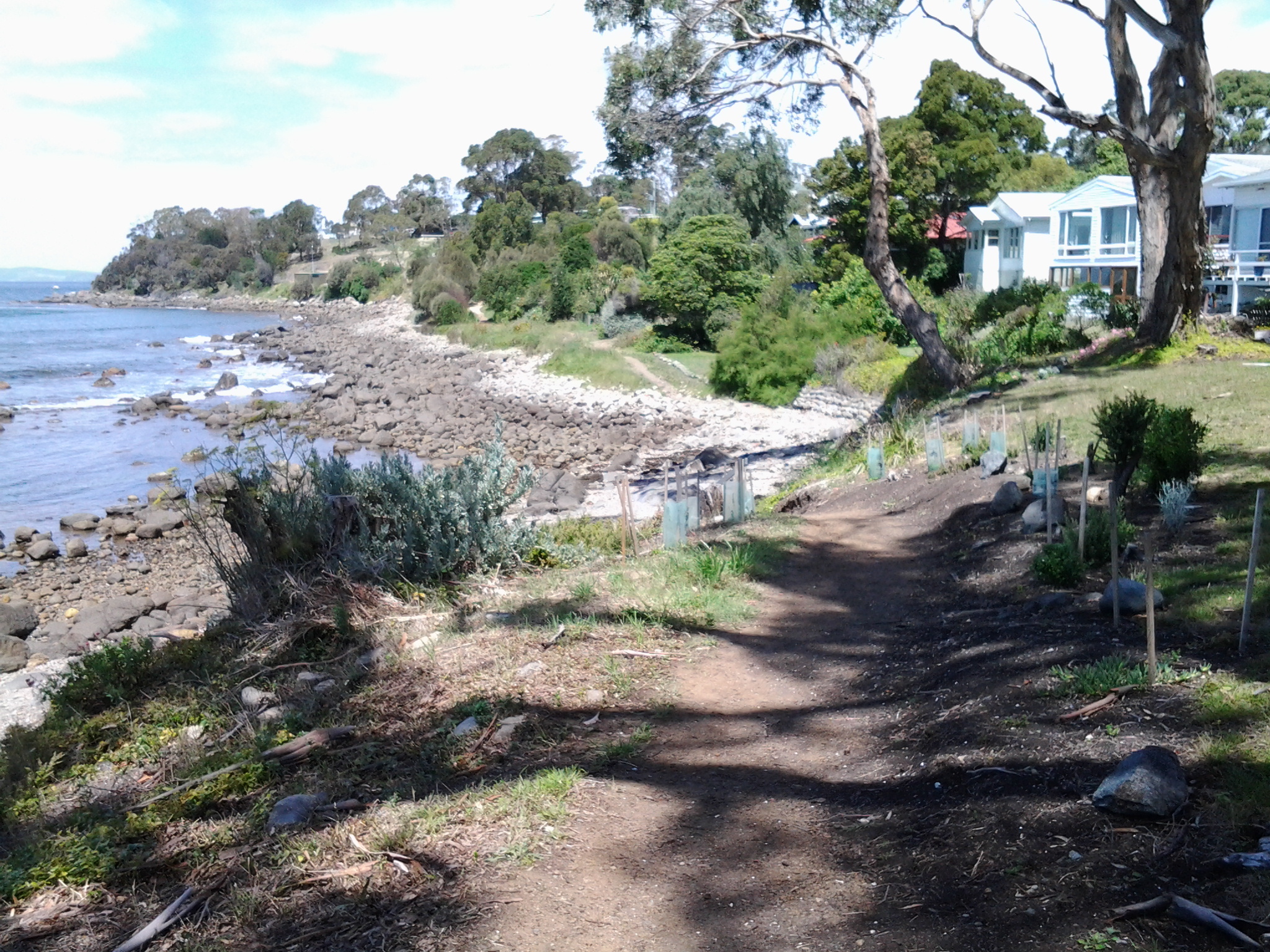
Walking southwards it wasn’t long before I entered the foreshore bushland on an easy-to-walk dirt track.

20150119_122632 20150119_123039

Later I found this had a name: the Taroona Foreshore Track. At one point the ‘track’ passed over a ‘beach’ of shells and rocks then returned to dirt and rose up over areas raised above the water.

20150119_123407 20150119_123610

An onshore breeze kept me moving.  Every so often, steep trails descended to the rocky shore but I realised that staying on the track would be more comfortable than rock hopping the edge of the River.

When I walked through a grove of trees that were obviously different, I was delighted to read an information panel which informed me this was an “unusual and isolated stand of blackwoods.  Acacia melanoxylon.”  The species is also known as Sally wattle, lightwood, hickory, mudgerabah, Tasmanian blackwood or black wattle. Their rough bark seemed as if it would flake off in small pieces but it was toughly attached.

20150119_124053 20150119_124059

At 12.46pm I looked back northward and could still see the boathouses near the High School.

Looking back to boathouses below Taroona HS

A couple of minutes later I reached Crayfish Point where I noticed craypot markers bobbing in the Derwent River as evidence that fishing for crayfish/lobster was taking place.  However, a sign seemed to indicate this was part of fisheries research by the University of Tasmania.

20150119_124945

Brilliant orange lichen sprawled across some of the rocks.  Huge Pied Cormorants rested on rocks with water lapping at their feet.  This was one of those brilliant days when all the superlatives in the world seem inadequate.

It was near here that an information panel enlightened me about some of the native vegetation.  Now I can identify not only Pigface which I love, but also Bower Spinach and Grey Saltbush. Why I didn’t take photos of the real thing while I was walking I cannot say. Daft!  So I have Googled for images:  If you type in Bower Spinach Tasmania Images, up comes a suite of pictures showing this fleshy leaved plant.  Try something similar to find images of the softly grey coloured Grey Saltbush.

When I reached the start of Taroona Beach at 12.53pm, I looked up the hill and in the distance I could see the Shot Tower that had been built in 1870 (the Shot Tower, a major tourist attraction, is normally accessible from the Channel Highway).

The Batchelor’s Grave Historic Site, just above the foreshore of Taroona Beach, was a surprise.  Wikipedia provides the information that this is “the grave of a young sailor, Joseph Batchelor, who died on the sailing ship Venus in the Derwent Estuary in 1810, and was buried ashore on 28 January 1810. It is reputed to be the oldest European grave in Tasmania”. I am amazed at this idea.  I cannot imagine that many Europeans didn’t die and were buried in Van Diemens Land before 1810 – however, maybe this is the only stone grave marker left from early in the 19th century.

20150119_125452 20150119_125441

Taroona Beach is backed by Taroona Park with pleasant picnicking facilities and public toilets.

20150119_125327 20150119_125918

I left at 1.06pm and walked along Niree Parade for a couple of minutes until the Taroona Foreshore Track restarted.

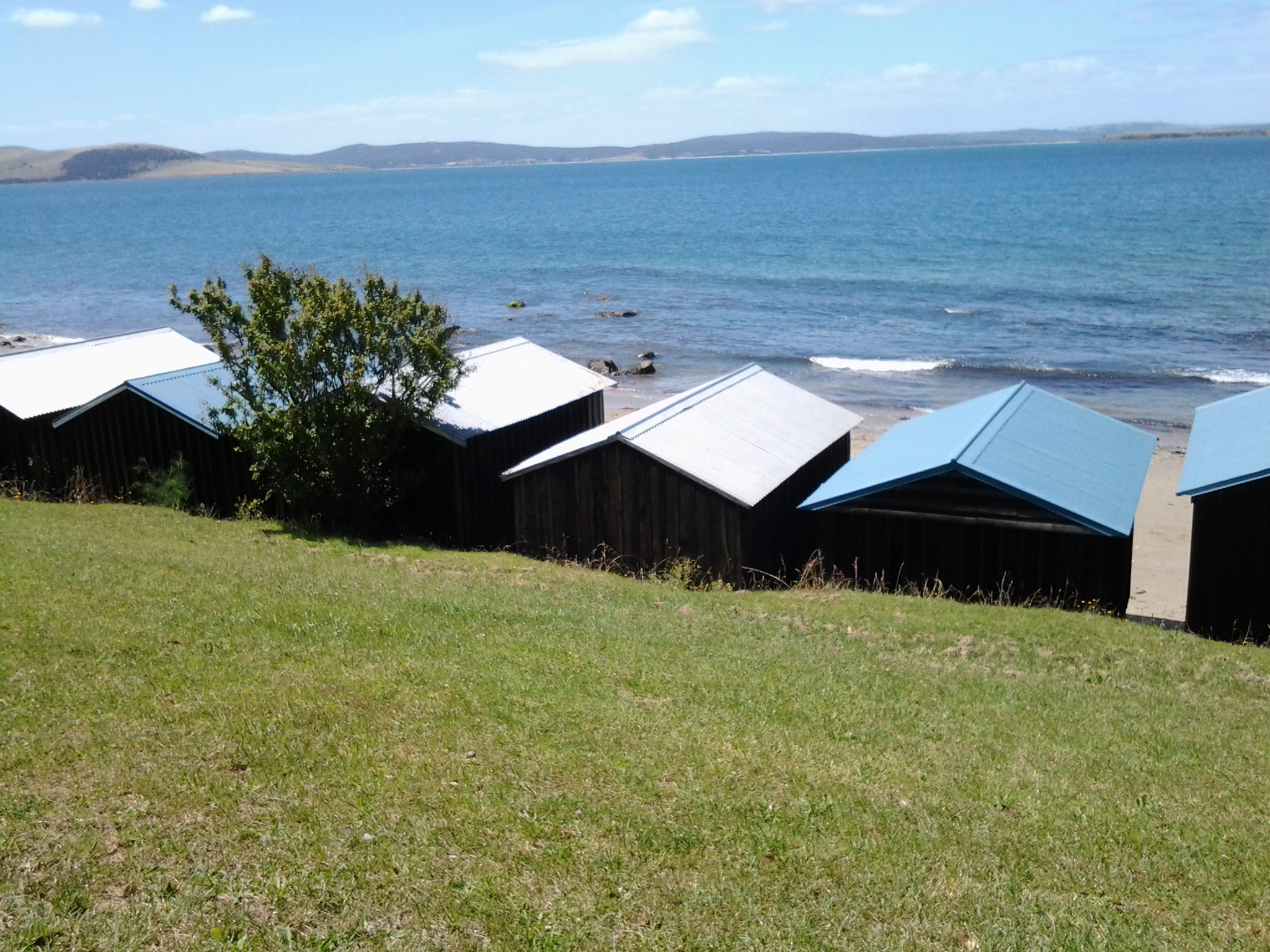
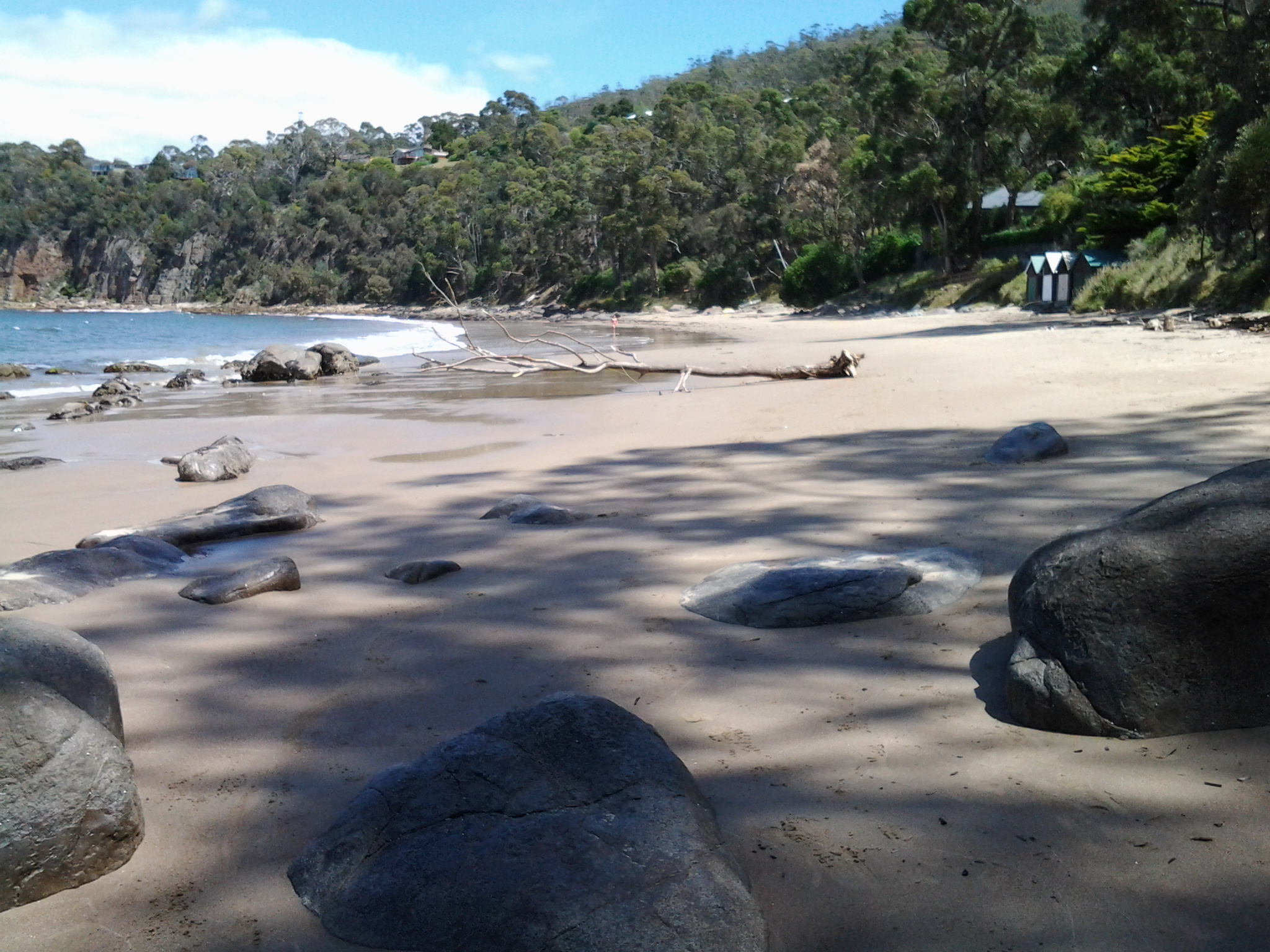
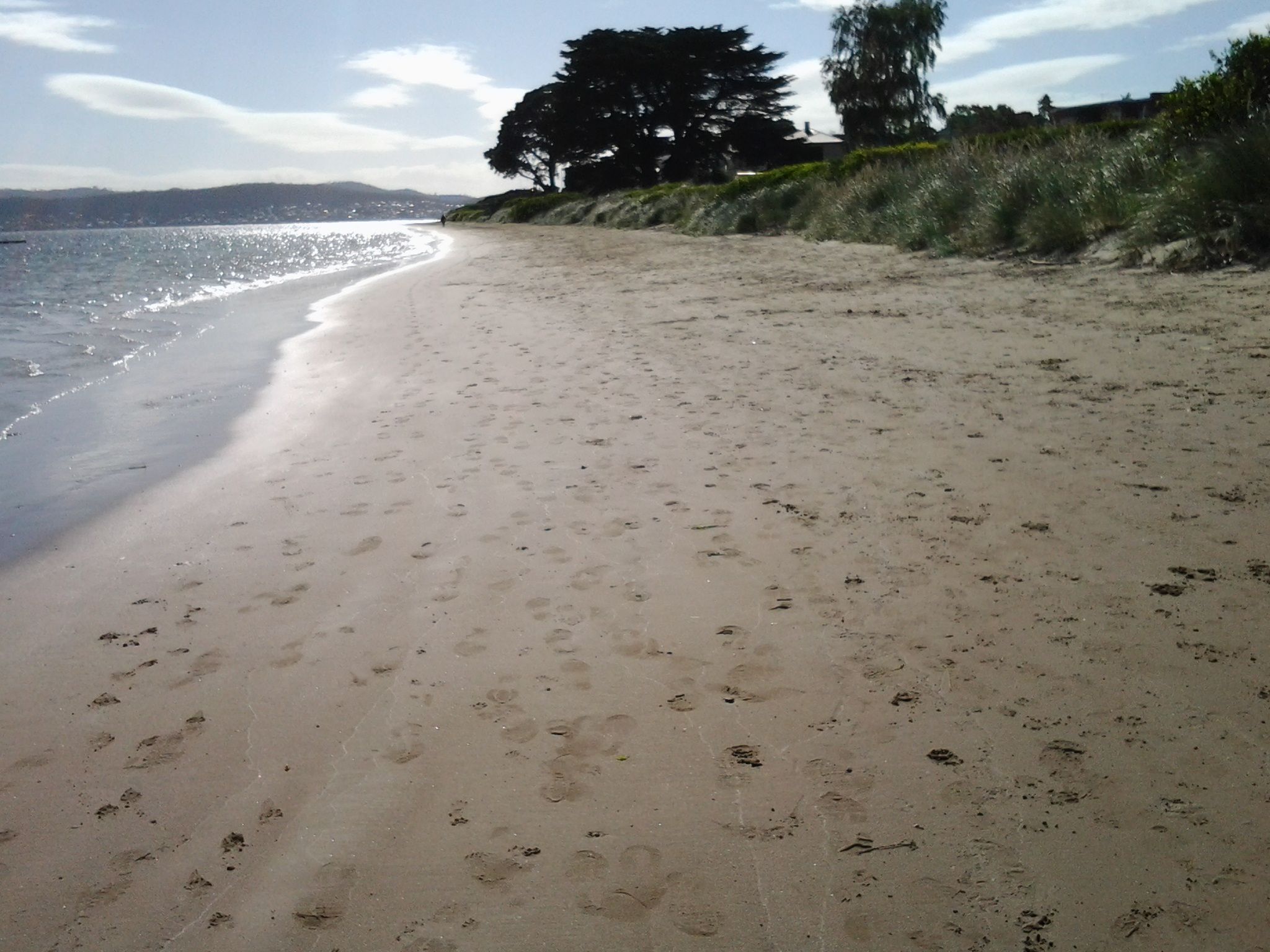
Within moments I arrived at Hinsby Beach, which was the find of the day as far as I am concerned. Isolated.  Small.  Tree edged. Calm.  Small wave break.  A few boathouses.  A family beach with a few swimmers and sun bathers.  Located at the end of the River edge before the steep Alum Cliffs which flow for 3 or four kilometres to Kingston.
20150119_131323 20150119_131402

I soaked in the atmosphere before starting uphill on a public access walkway at 1.22pm, under shady bushes with lush surrounding ground cover. The track connected to the bottom of Hinsby Road. At the top of Hinsby Road the Channel Highway flowed by. As I arrived at bus stop 30 at 1.36pm, a Metro bus came by on which I made the trip back into Hobart. Half an hour later I was in the city and ready to make the bus trip back home in Bellerive.  I walked in the door at 2.40pm after an exhilarating day when my feet didn’t want to carry me, but I insisted and they persisted. This really is a wonderful part of the world.

From Lower Sandy Bay to Cartwright Park Reserve and beyond on Stage 11

After leaving breezy Blinking Billy Point, I arrived back on the main road (Sandy Bay Road) at 10.20am, and turned left ready to continue my southward walk.

I was aware the Alexandra Battery once stood in all its glory, waiting to defend Hobart Town from invaders, on the large hill on the other side of the road. Construction on this site commenced around 1880 using stone from the dismantled Battery Point batteries. The heartfelt need of 19th century locals to defend the Derwent River and the new settlements from Russian invasion along its edges has never seemed necessary to me. When I read the following Wikipedia entry I could only think about how fear feeds off misunderstandings. “On 11 May 1870, the corvette Boyarin appeared at the Derwent River and rumours spread in Hobart that a Russian invasion was almost a certainty. The reason for the appearance of the Russian warship was humanitarian in nature; the ship’s purser was ill and Captain Serkov gained permission to hospitalise Grigory Belavin and remain in port for two weeks to replenish supplies and give the crew opportunity for some shore leave. The ship’s officers were guests at the Governor’s Ball held in honour of the birthday of Queen Victoria, and The Mercury (newspaper) noted that the officers were gallant and spoke three languages including English and French. The following day a parade was held, and the crew of the Boyarin raised the Union Jack (the colonys’ ‘national’ flag) on its mast and fired a 21-gun salute in honour to the British queen. This was reciprocated by the town garrison which raised the Russian Naval flag of Saint Andrew and fired a salute in honour of Tsar Alexander II. After the death of Belavin, permission was given to bury him on shore, and his funeral saw the attendance of thousands of Hobart residents, and the locals donated funds to provide for a headstone on his grave. In gratitude of the welcome and care given by the Hobart citizenry, Captain Serkov presented the city with two mortars from the ship, which still stand at the entrance to the Anglesea Barracks. When the Boyarin left Hobart on 12 June, a military band onshore played God Save the Tsar, and the ship’s crew replied by playing God Save the Queen (then our national anthem).”

Alexandra Battery is currently a public access park with some of the original structures embedded in the landscape.  I imagine the view along and across the Derwent River would be spectacular, but since visiting the site would have moved me away from the water, I simply walked on and made a mental note to come back another time and have a close look.  This hill would provide an easily accessible location on which to watch the dying stages of the first Sydney to Hobart Yacht race yachts surging towards the finish line.  I must remember that at the end of this year.

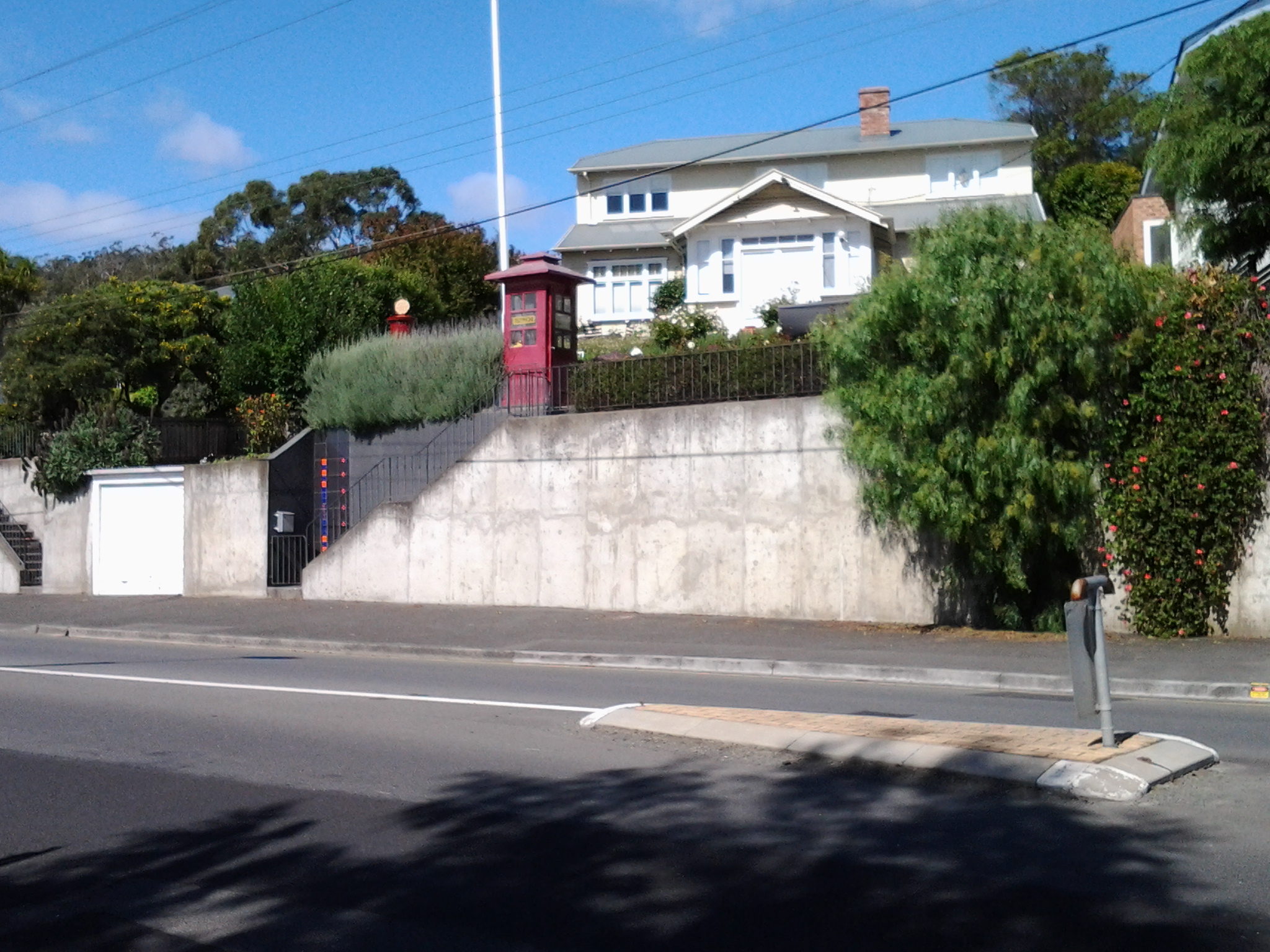
By 10.25am I was continuing past the junction of Sandy Bay Road with Churchill Ave a major thoroughfare wandering across the lower slopes of Mount Nelson.  All the time I was inspecting houses and gardens.  I cannot imagine why an old fashioned red telephone box is now pride of place at the top of entrance stairs to this house.

20150119_102631

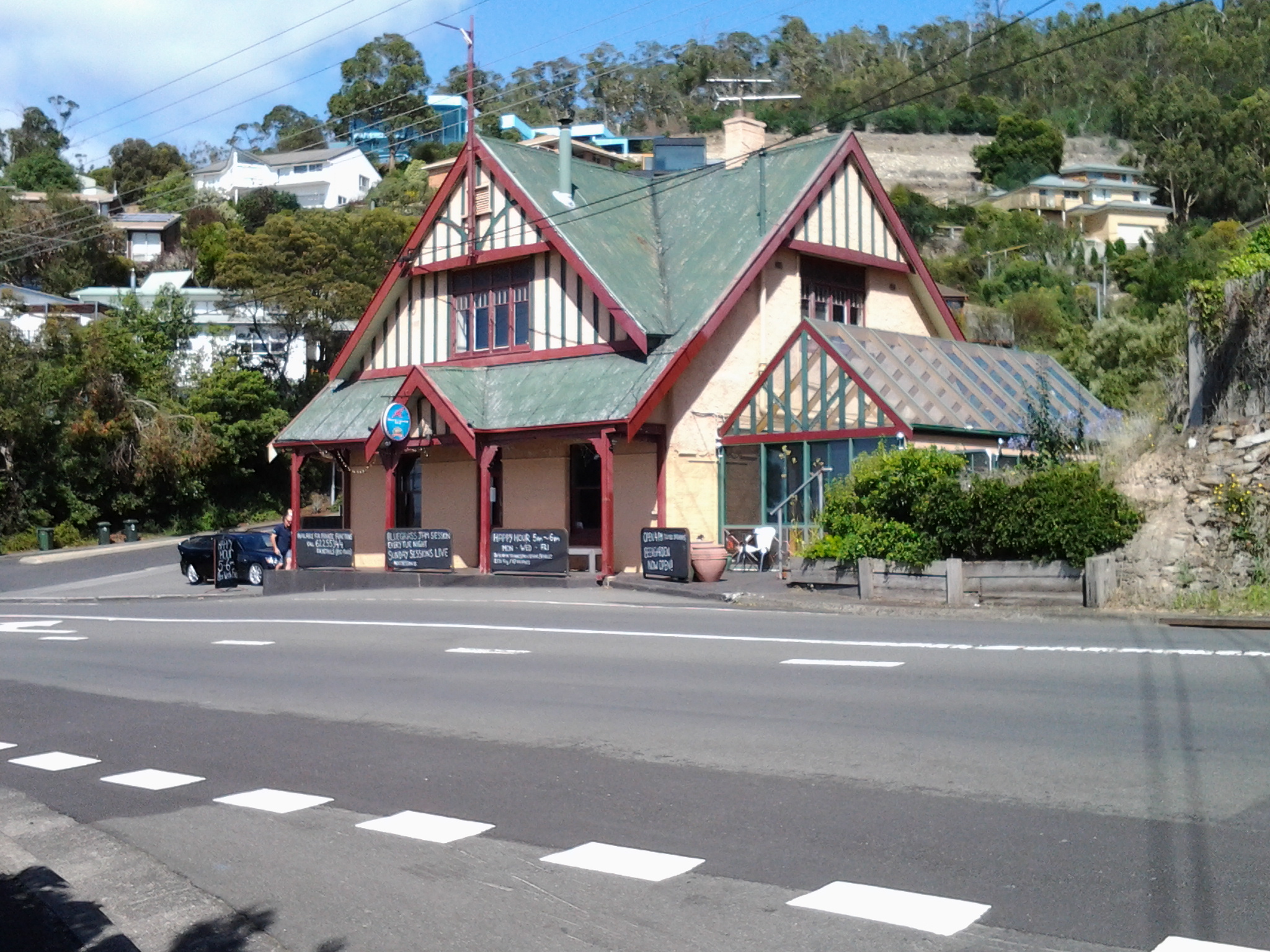
I seriously contemplated popping over to this pub (Riverview Inn) for a glass of cold wine, but restrained myself.  I am surprised with my self-discipline that I have passed a great number of good ‘watering holes’ but have not deviated from the walk – so far.

20150119_104012

Twenty minutes later I reached Pearce’s Park.  I had never realised before but there are two bits of this Park located either side of the road but with quite some distance between them down the road. Rather strange.  The sign at the Park on the Derwent River side declared it was created to become ‘a window to the River Derwent’.

20150119_104733

An excellent idea to break the relentless strip of residences hogging the river’s edge.  I could look across the Derwent River to Trywork Point south of the suburb of Tranmere on the eastern shore.  Sulphur Crested Cockatoos screeched somewhere behind me.  The day seemed so beautiful.

Around 11am I stood at the entrance to the Cartwright Park Reserve.  This parkland swept downhill through open forest and a cleared area with flitting cheeky Wrens, before arriving on a rocky shore of the Derwent River near Cartwright Creek.  The last part of this informal track was a mix of slippery dirt and pebbles and intrusive tree roots like bad varicose veins rippling through the surface – the track was not for those with poor balance or walking limitations.  And the range of rocks on the shore were most unstable and required great care to navigate safely. I learnt this area was settled by the brothers who established the Grange Estate (around the corner in Taroona) in the 1820s. It all seems so long ago, and I can’t help thinking how isolated the area would have been. Beautiful yes, but remote from Hobart Town.  I wonder if the settlers reached the area by boats or whether it was a horse riding trip.  Did they bring in provisions with teams of bullocks.

Once I was stepping across the foreshore rocks it was clear that the track had come to an end. However, because I never like to retrace my steps unless I absolutely must, I stumbled on.  I wondered if I could get back to a road or a track if I continued. I aimed at reaching a tiny smidgin of sand and then decided I would walk up a set of weathered wooden steps next to a blue-doored boathouse.  Was this private property? There were no signs declaring restricted access. It certainly wasn’t clear at the bottom of the steps what the status of the steps was, so I felt it wasn’t unreasonable for me to climb up and find out more.  As it turned out, I walked through someone’s garden (quite lovely) and eventually let myself out through a security gate onto Grange Avenue.  Thankfully no guard dogs were in attendance. The time was 11.20am.

If I had stayed on the main road I would have seen the signs indicating I was leaving the City of Hobart and changing into the Municipality of Kingborough.  As it was, all I knew was that I was leaving Lower Sandy Bay and entering into the suburb of Taroona – and enjoying every moment.

Blinking Billy Point, Lower Sandy Bay next to the Derwent River

Continuing Stage 11 of my walk along the Derwent River, I walked the foreshore from Long Beach towards Blinking Billy Point. Looking northwards, the crescent of Long Beach stretched before me.

20150119_100336

I passed a new set of public toilets around 10am and ten minutes later I was walking around Blinking Billy Point.

20150119_101600

This was an area to which Charles Darwin (http://www.biography.com/people/charles-darwin-9266433) walked from Sullivans Cove (my starting point for this Stage of the walk) in February 1836. The area’s local government has remembered the occasion with an information plaque.

20150119_101336

Out in the water is a marker for water craft: the John Garrow Light (established in 1953).  I have known this was a marker used in the Sydney to Hobart Yacht race but I had never known where it was located.  Now I know: almost east of the Blinking Billy old lighthouse.  According to http://www.maritimetas.org/sites/all/files/maritime/nautical_news_winter_2002.pdf, John Garrow was a Sandy Bay pastry-cook, who lived in Bath St. Battery Point and died 1924. This begs the question – how did a nautical navigation tool come to be named after someone that seemingly had no connection with the Derwent?
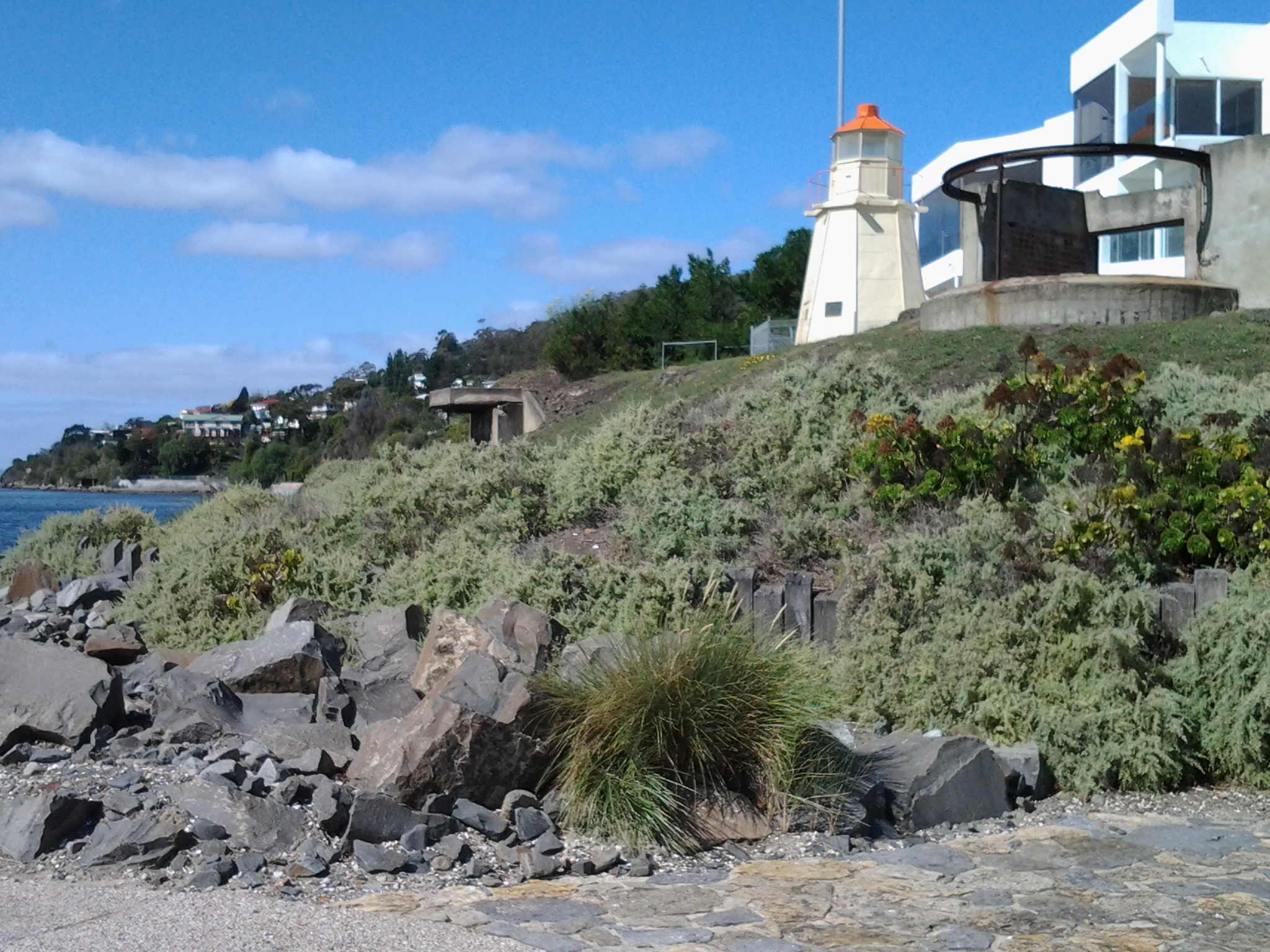
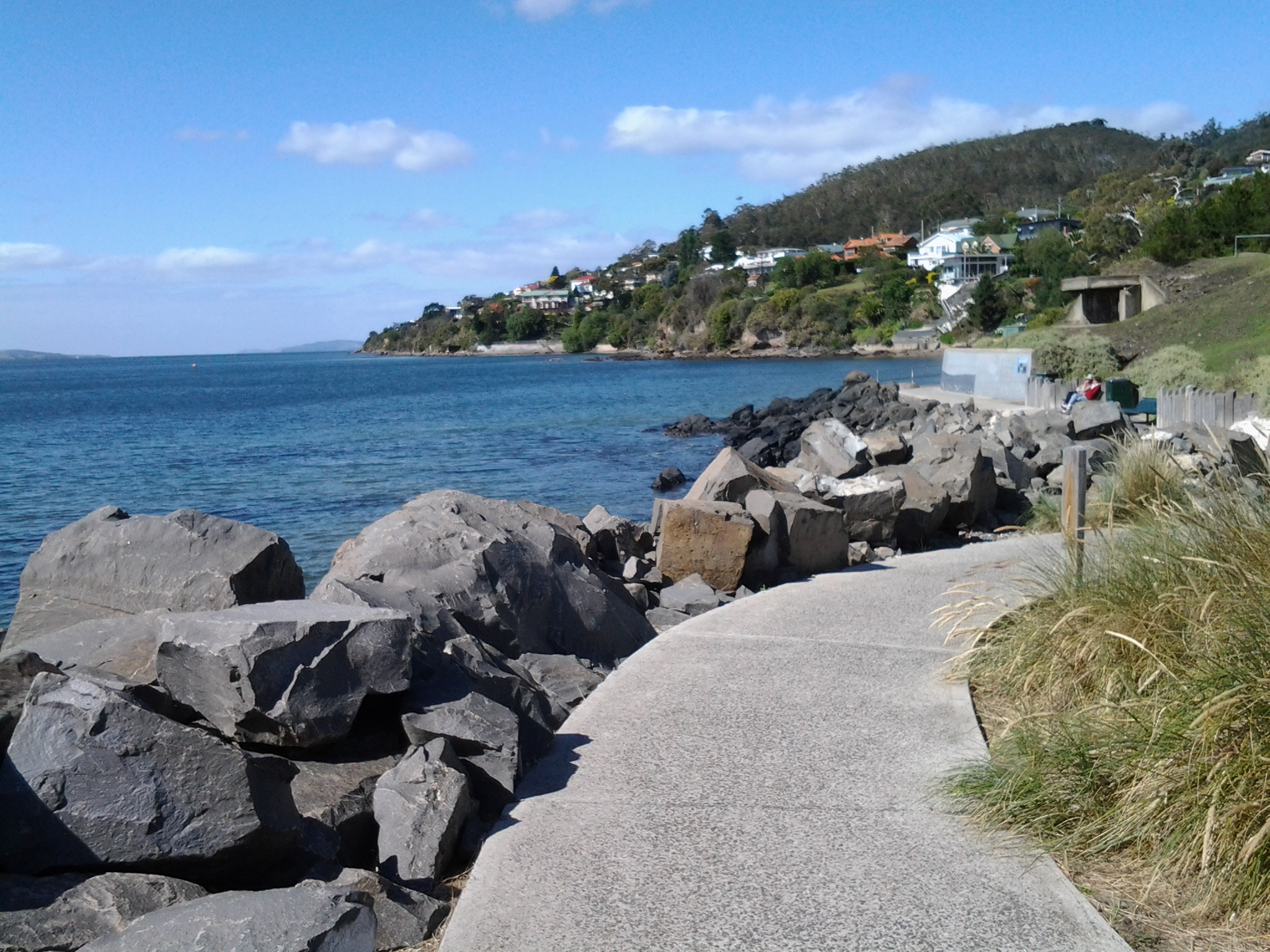
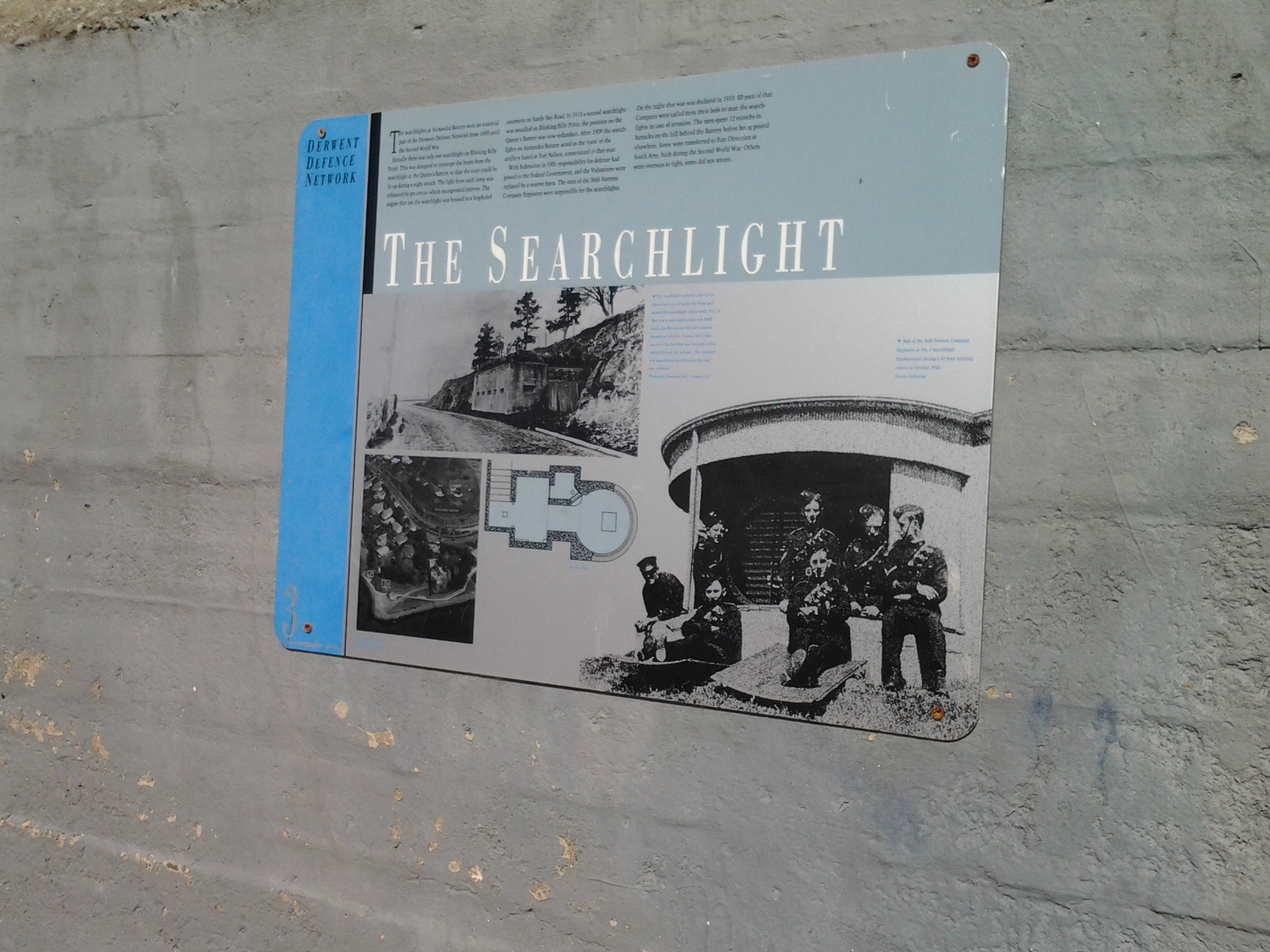
I noticed that the Point has old defence structures embedded in the cliff. I learned that these were an adjunct to the huge hill behind with the remnants of the 19th century Alexandra Battery.

20150119_100941

20150119_101150  20150119_101159

Looking down the Derwent River through the glitter of the distance to the eastern shore, I could pick out Trywork Point (the southernmost tip of land before Ralphs Bay begins) and Gellibrand Point (the northern most point of the South Arm peninsula) both providing the ‘gateposts’ to Ralphs Bay. Previously, I explored these distant Points on Stage 2 and 3 of my walk.

20150119_100933

Then I looked back to Long Beach from Blinking Billy Point with Mount Wellington in the distance. How peaceful the world seemed.

20150119_100704

Despite the promises of a short beach in Geography Bay after the Blinking Billy Point, I knew better than to have expectations that continuing my walk on the foreshore was possible. The Sandy Bay Foreshore Track finishes at Blinking Billy Point.

20150119_101600

Some years ago a friend and I tried to walk the rocky shore southwards from Blinking Billy Point but, as the tide came in, there came a moment when we couldn’t move forward or backwards.  I remembered we scrambled up through someone’s property; the people were not at home and we let ourselves out onto the street hoping no alarm systems would be alerted. We were lucky that day.

Based on that memory, I knew it was not worth proceeding any further and retraced my steps around Blinking Billy Point until I could walk up to Sandy Bay Road.

From Sandy Bay to Lower Sandy Bay on Stage 11 of my walk along the Derwent River

After Maning Ave Reserve I continued walking along Sandy Bay Road and used every opportunity to glimpse the Derwent River down the driveways of large houses with expensive River frontage.

By 9.10am I reached the Red Chapel Reserve. Red Chapel Ave is one of Hobart’s well-known streets extending up the hill and connecting to other main streets but I had never known, until this walk, where the name came from. I wonder how many Hobartians know the source. Of course the source turned out to be so obvious once I knew and used my eyes. It was named after the red coloured chapel of the 20thcentury St Stephens Anglican church that was built on the River side of the Road next to the Reserve and opposite the uphill Avenue.  What can be said about the impoverishment of imagination? Refer to https://stainedglassaustralia.wordpress.com/2014/08/02/1914-st-stephens-anglican-church-lower-sandy-bay-tasmania/ for some glorious images. The photo below is courtesy ofhttp://www.anglicantas.org.au/parishes/?item=37

St Stephens Church

A minute or so further down the road and on the right was the highly esteemed Lipscombe Larder on the corner of … Lipscombe Ave.  Where else would it be?

20150119_091152

In addition to all its tasty delicatessen products and wines, this food paradise also sells exquisite cakes: refer to http://lipscombelarder.com.au/  for images.

At some stage during my walk in this suburb, I realised that no one was walking a mongrel dog. At the end of leads were expensive pedigreed dogs.  Certainly their owners seemed happy.

Before long, a set of steep stairs attracted my attention on the left. These were for public access to Nutgrove Beach. As I approached the Beach I was staggered by the size of an old pear tree on the dune edge, and loved the pigface plant which carpeted the area either side of the pathway. I was on the beach at 9.20am and turned right to walk southwards.

20150119_091845 20150119_092401  20150119_091903 20150119_091858

Behind low sand dunes on my right, the roofs and second storeys of beach front houses were visible. At 9.23am, I passed public toilets almost hidden under a large pine tree, and by 9.30 I reached a corner of the beach with the Sandy Bay Sailing Club located up in the dunes.

20150119_093155

Moments later I turned the corner and was no longer able to look back at Wrest Point and Battery Point in the distance.

20150119_092759

I continued on a pathway over the shore and over the dunes some of which would be impassable at high tide without getting wet feet. Some of the rocks were unstable underfoot presenting the risk of a turned ankle or knee. Nutgrove Beach had been a simple delight, and before long I was on an easy, vegetated, and shaded walking track to Long Beach at Lower Sandy Bay. Then I arrived.

20150119_093816

Back out into the open by 9.35am, I could see public toilets nearby, and by looking across the Derwent River to the eastern shore, the yellow strips of Bellerive and Howrah Beaches (on which I walked in an early stage of my walk) were visible.

20150119_100332

I had been walking for over two hours so sat for a while in the gorgeous sun, watched the tiny waves rippling fluidly and regularly, stared at two fishing boats motoring out of the Derwent Harbour, listened to kids’ riotous laughter in a kids’ playground nearby, and then stood up and got going again at 9.50am.

I was delighted to discover Stephen Walker’s huge many part bronze sculpture, Tidal Pools, with its inbuilt water feature at Long Beach in Lower Sandy Bay.

20150119_095728 20150119_095831 20150119_095757 20150119_095739

The remarkable 86 year old Tasmanian artist died only about 7 months ago leaving a great many large scale works around Tasmania and other parts of Australia, such as his Tank Stream Fountain (1981), near Circular Quay in Sydney. In the 1950s, Stephen Walker studied under the celebrated sculptor Englishman Henry Moore. Apparently Walker continued his bronze casting work well into his 70s using his foundry underneath the house.

Five minutes of walking the developed walkways of Long Beach brought me to a cul-de-sac with its carpark full of vehicles.  Further along that loop off Beach Road were bakeries, cafes, restaurants, etc.

Selection of landmarks along Sandy Bay Road

Once on Sandy Bay Road I turned left and continued walking southwards.When past the University of Tasmania grounds, over the road on my right was a Catholic co-educational secondary school operating in the Josephite tradition. This Mt Carmel College site includes an attractive 19th century sandstone building.

In a small park, a family of Sulphur Crested Cockatoos feasted on insects in the grass along with ducks and Silver Gulls.

20150119_083933

The day was very peaceful.

20150119_083937

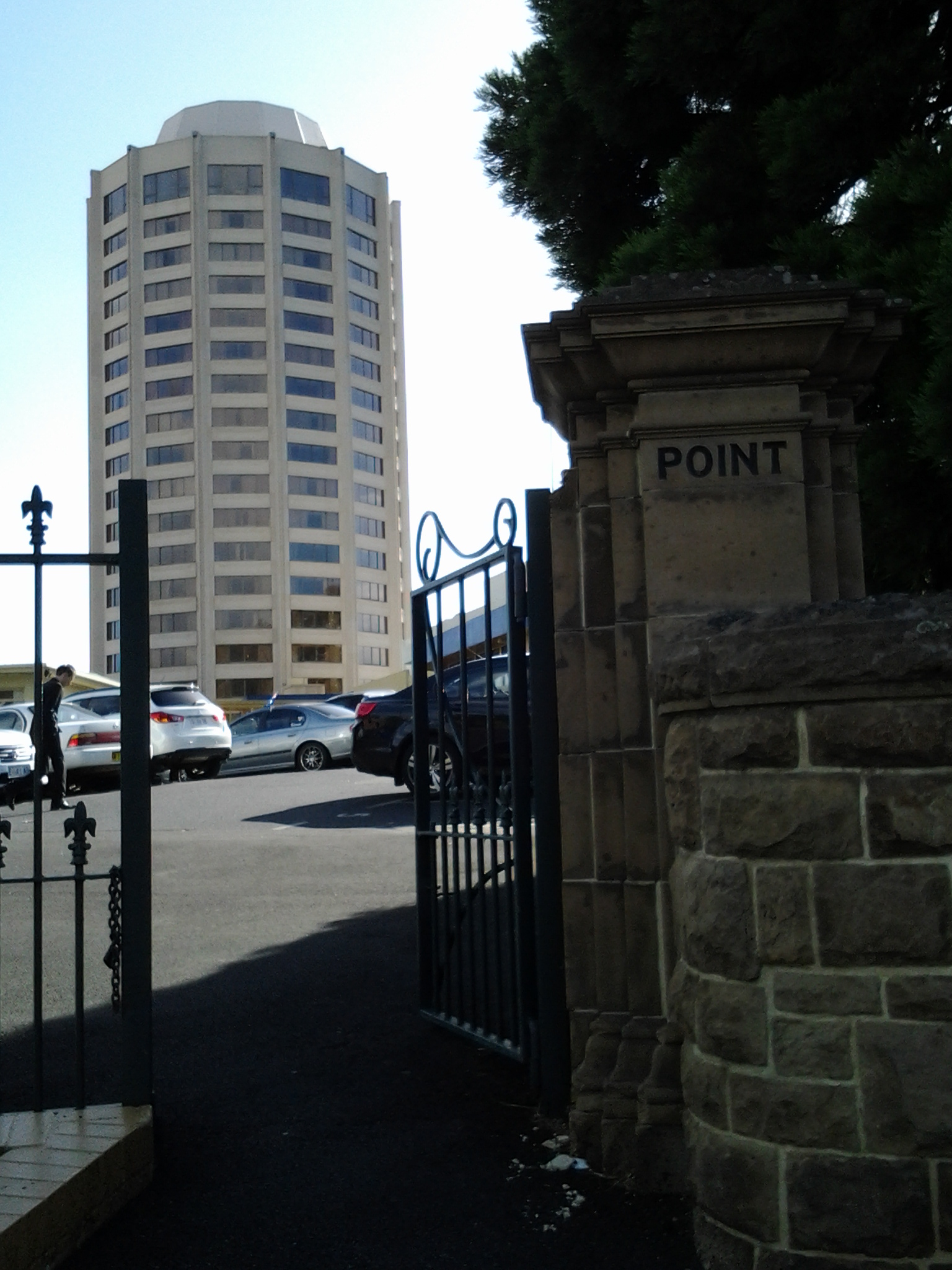
At 8.40am I reached the entrance to Wrest Point Hotel (http://www.wrestpoint.com.au) which, in the 1970s, established the first legal casino in Australia.

20150119_084114

Apart from its poker machines and gambling rooms, this Hotel offers many bars and different restaurants. In addition, it runs a continuous program of concerts, guest artists and other entertainment events so that thousands of people pass through its doors weekly. With exploratory meandering I think it may be possible to walk through different parts of this Hotel and find a route close to the water’s edge. I didn’t feel confident that I would find my way around without finding myself in ‘no go’ areas. Instead I continued walking along Sandy Bay Road.

The business Network Gaming lives in what used to be a well-known and much loved pub, Travellers Rest:  one which I knew well in my student days.

20150119_084249

The Wrest Point Hotel land wraps around the old Travellers Rest hotel so, it wasn’t until I continued to walk along Sandy Bay Road that I discovered an original entrance to the Wrest Point property area.

20150119_084657

I reached the Derwent Water Beach Reserve at 8.50am.

20150119_085149

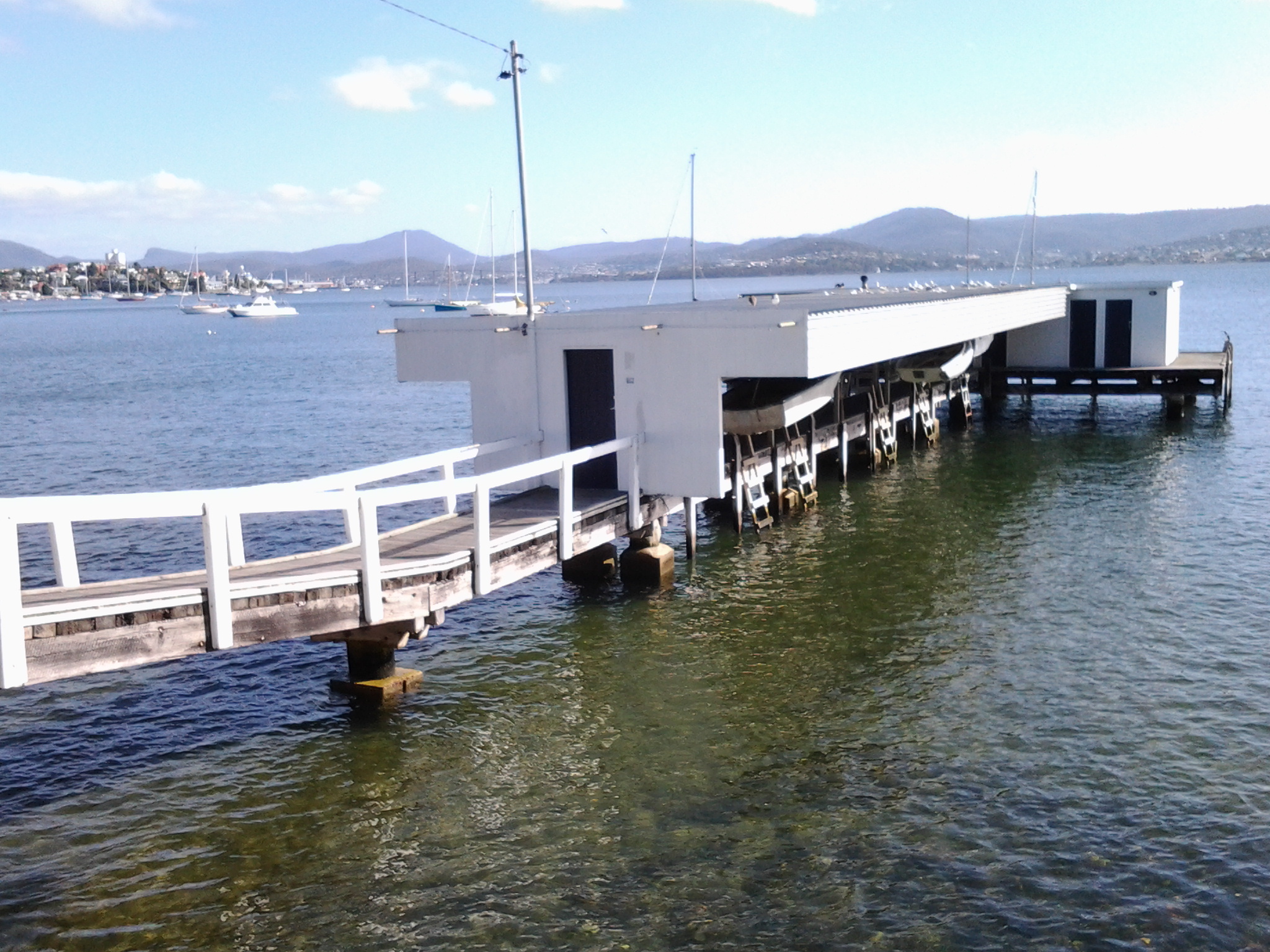
From there I could see two private jetties jutting out into the water.

20150119_084905

When I walked closer, it was clear that dozens of dinghies hung under protection waiting for their owners to come and row them out to yachts moored on the Derwent River.  In fact, as I watched, one fellow set off rowing.

20150119_085231

The time of day and the quality of the sunlight made this vista exceptionally beautiful; seagulls perched on the jetties, the water sparkled, a mild breeze dappled the surface of the River, happy dogs walked along attached to owners, and I was able to blot out the sound of noisy traffic streaming past behind and beside me. The water was crystal clear.

20150119_085408 20150119_085637

By 9.05am I was reading the information panel at the Maning Ave Reserve. This Reserve seemed to mark the change from the suburb of Sandy Bay to the suburb of Lower Sandy Bay. I learnt Fred Maning arrived in 1824 and his family farmed in the area (however I understand he spent most of his life in New Zealand, and it is not clear why he is remembered with his name on this park and on streets etc in the Lower Sandy Bay area).  Information boards such as these help me to understand how Hobart developed.

Sandy Bay along the foreshore

On Stage 11 of my walk along the Derwent River, having enjoyed Hobart’s wharf area and the edges of Salamanca and Battery Point, I continued walking along Short Beach at the beginning of Sandy Bay, past public toilets at 8.20am, towards the Sandy Bay Rowing Club and then along Marrieville Esplanade.

20150119_081832 20150119_081815

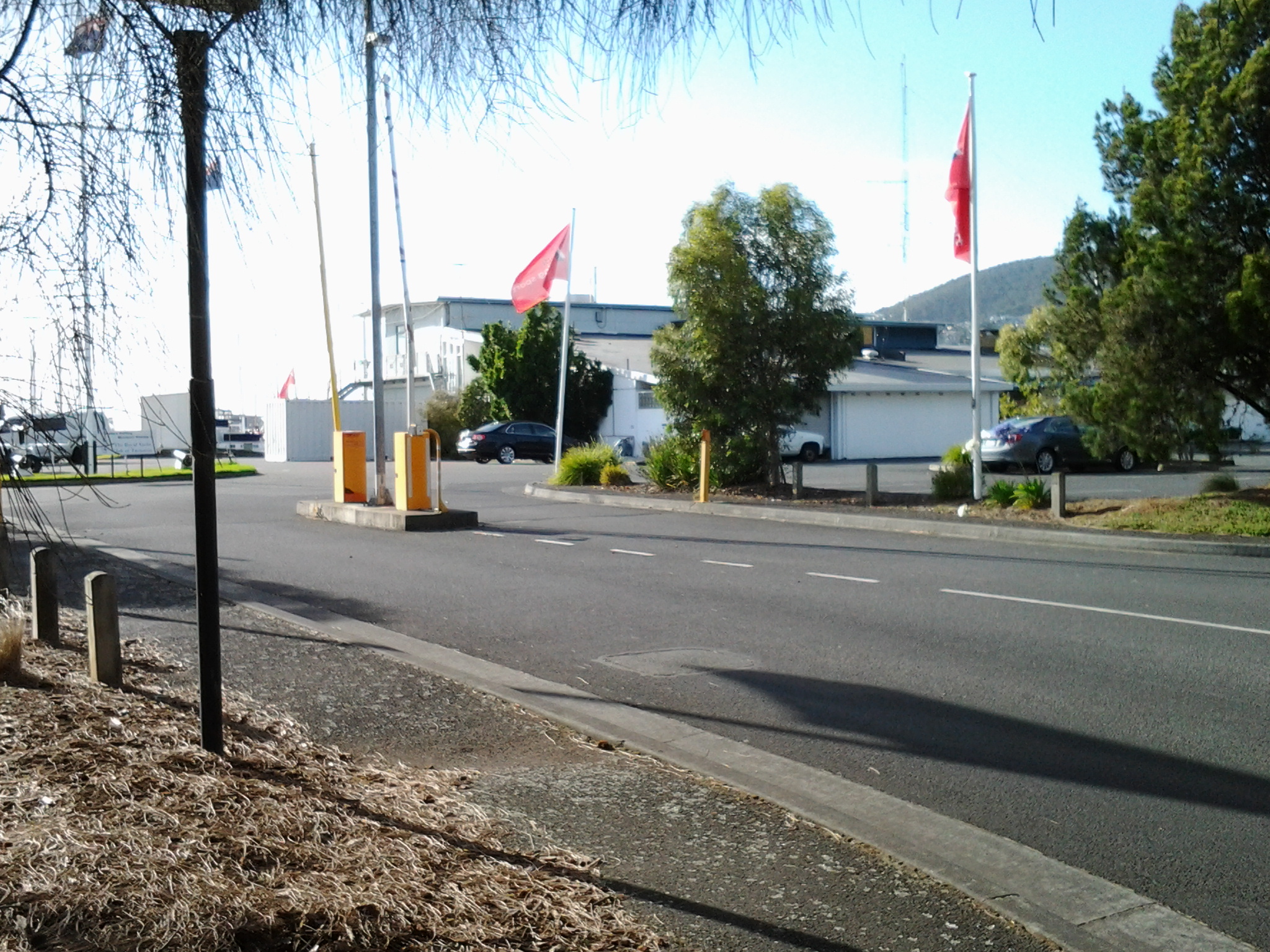
At 8.28am I reached the Royal Yacht Club of Tasmania and remembered my first Hobart job many years ago.  The photo below shows the entrance to this complex.

20150119_082553

A friend waitressed in the Club restaurant and I went to see if I could get a similar job. I had no experience in hospitality but, full of unsubstantiated confidence, I approached the head chef. He told me that without experience he could not give me a job. I stood my ground and said that until I had worked in a job I wouldn’t have experience and therefore the only way I could get experience would be if he hired me.  And he did.  As a washer of dishes and all the kitchen wares.  Eventually I was allowed to place the lettuce on plates, then make the salads, then cook the potato chips and fried rice in large pots, and finally I reached the heights of being permitted to cook steaks for customers.  After many months the head chef recalled his first meeting with me and how (I forget the word he used but its meaning was clearly something like) pushy, stubborn, strong willed and unable to take no for an answer I was, and it was my approach which inclined him to give me a go. It certainly helped to pay the rent and I was very grateful.  I remain grateful because I learnt a lot about human nature in that hot kitchen where pressure turned people into animals.

But back to my Stage 11 walk.

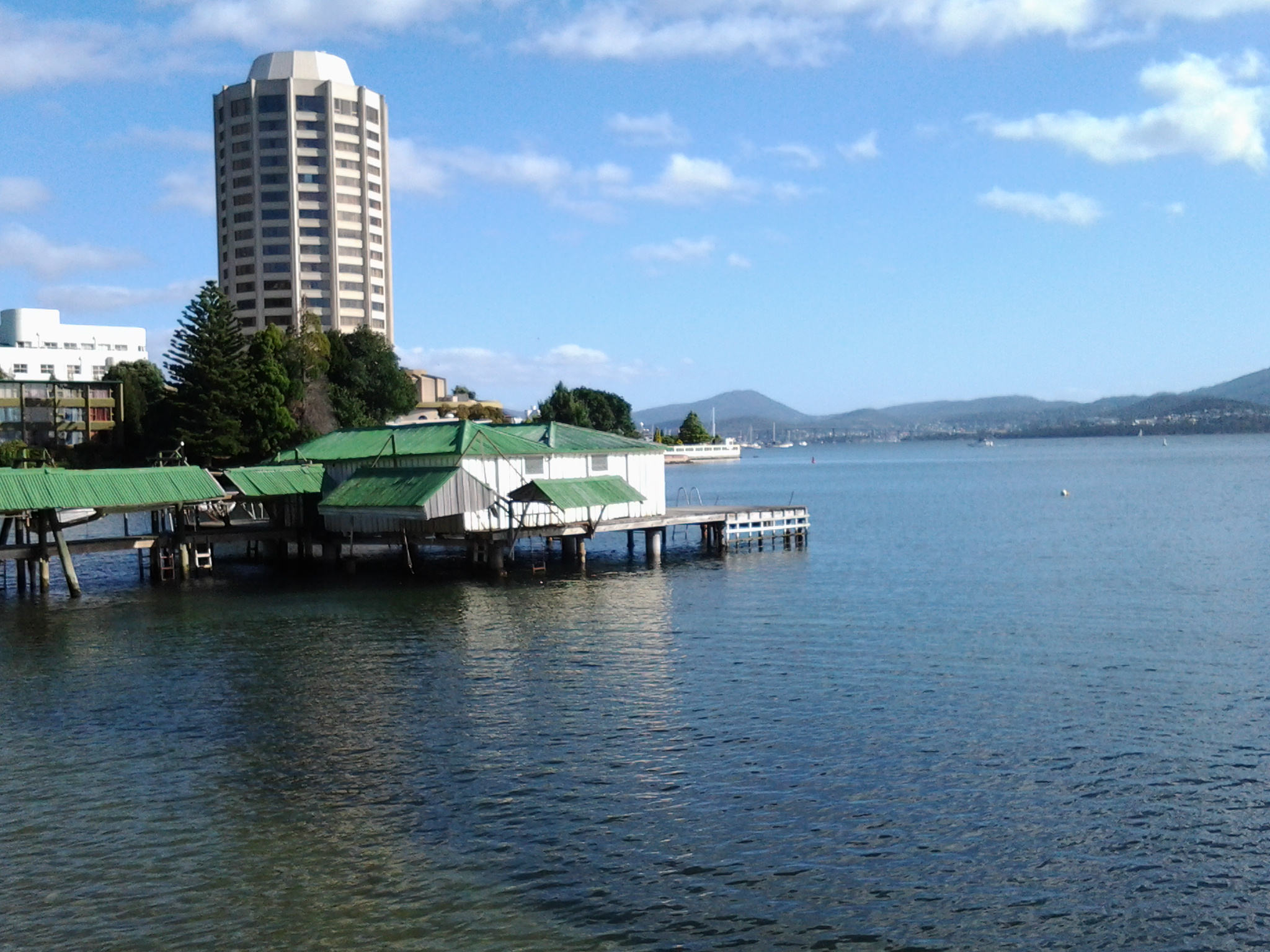
A couple of minutes later I was walking past the Derwent Sailing Squadron buildings and could see yachts everywhere in and out of the water.  Past the Squadron buildings, in the distance, the tall building indicated Wrest Point Hotel was not far away and I knew I would walk past it a little later.

20150119_082956

In the distance, slightly inland on my right, the many buildings of the University of Tasmania cascaded down the hill; part of the slope of Mount Nelson.

20150119_083125

A car drove past and the driver waved and smiled at me. Once friend Ma was out of her car, she explained that with her husband she was about to put their yacht into the water (after its recent debarnacling – if there is such a word) and enjoy a sail along the Derwent.  “Would I like to stay and watch?’ she asked. I wanted to stay focused on my walk in case weather might not be suitable on other days, and declined with some inner hesitation.  What a great offer.  Maybe another time I can say yes.  Perhaps a sail??? Who knows.

The opportunity to continue walking close to the foreshore came to an abrupt stop and it was clear private houses owned the area at the back of their houses to water level. So I took a path to Sandy Bay Road, arriving at 8.35am.

Battery Point on Stage 11 of my walk along the Derwent River

Many websites provide information about the very old suburb of Battery Point; for example, read http://www.batterypoint.net/; http://en.wikipedia.org/wiki/Battery_Point,_Tasmania; or http://www.hobartcity.com.au/community/arts_and_culture/public_art/battery_point

I walked as close to the Derwent River as I could and therefore did not wind around the cute streets with their changing architecture, and I was not on the hunt for historical landmarks within the suburb. A morning’s meander through the streets can be very instructive but a walk close to the foreshore also has its attractions. Besides, every street in Battery Point is interesting.

Having left Salamanca and the Castray Esplanade, I walked to the River and along a pathway. When I reached the A J White Park I looked around and absorbed some of the contemporary sculptural forms which were sited there.

20150119_075652 20150119_075552 20150119_075450

At 7.55am I turned up and away from the water because continuing access around the few rocks jutting out of the water was not possible. At 7.58am I turned left at Clarke Ave and at 8.03am I turned left at Marine Terrace.

A few minutes later, as I approached Derwent Lane which led to a dead-end down at the water (with previous knowledge I decided it was not worth the effort of walking down and then straight back up) a woman stopped and questioned me. ‘What are you writing?’ she wanted to know. Her body frame relaxed when I explained my project. I didn’t need to be told that the issue of public access to the foreshore is a very sore and contested point in this suburb as homeowners are feeling increased pressure to agree to a boardwalk being built in front of their very expensive and private homes  – residents believe they purchased sole and permanent access to the high tide mark. Undoubtedly the woman was wondering whether I had been commissioned to do another survey or some other work without community consultation.

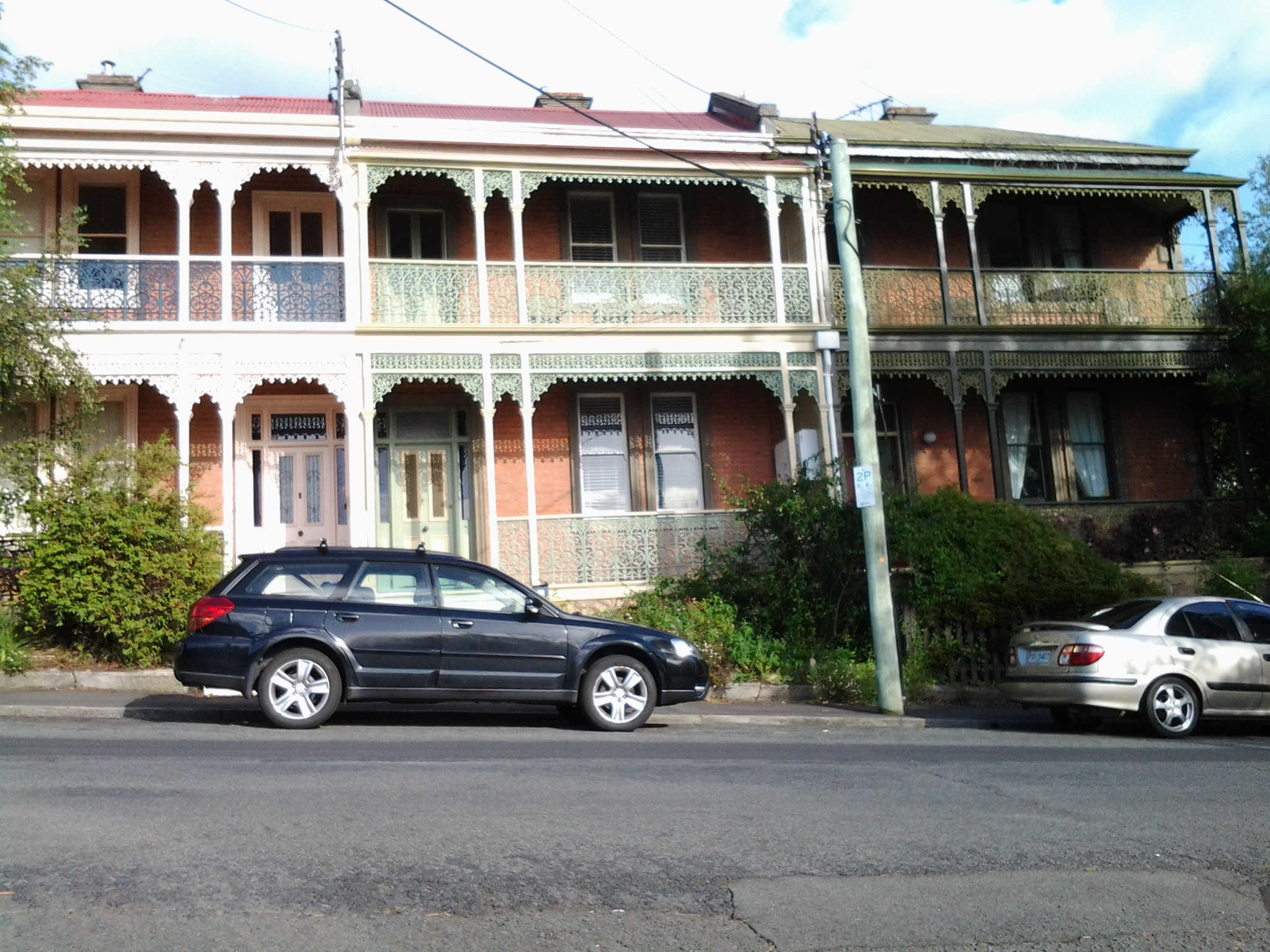
If you are following in my footsteps, then the path southwards continues by walking along Napoleon Street. Either side of the road I enjoyed the spectacle of exceptional houses of many vintages and styles.

20150119_080926 20150119_080931 20150119_081054

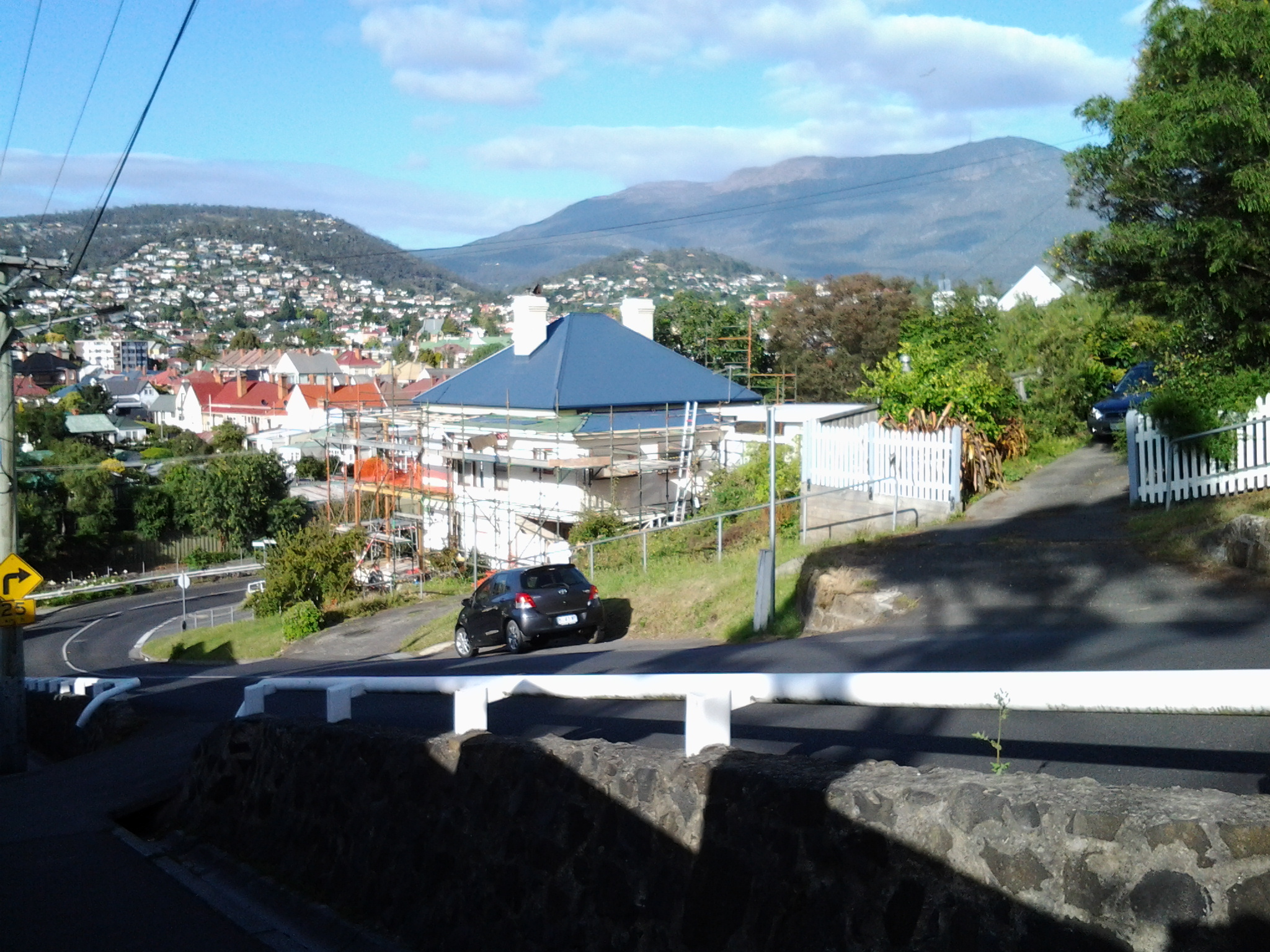
Eventually I stepped down an extremely steep part of Napoleon Street and could see Mount Wellington to my right and Mount Nelson to my left with great clarity.

20150119_081413 20150119_081326

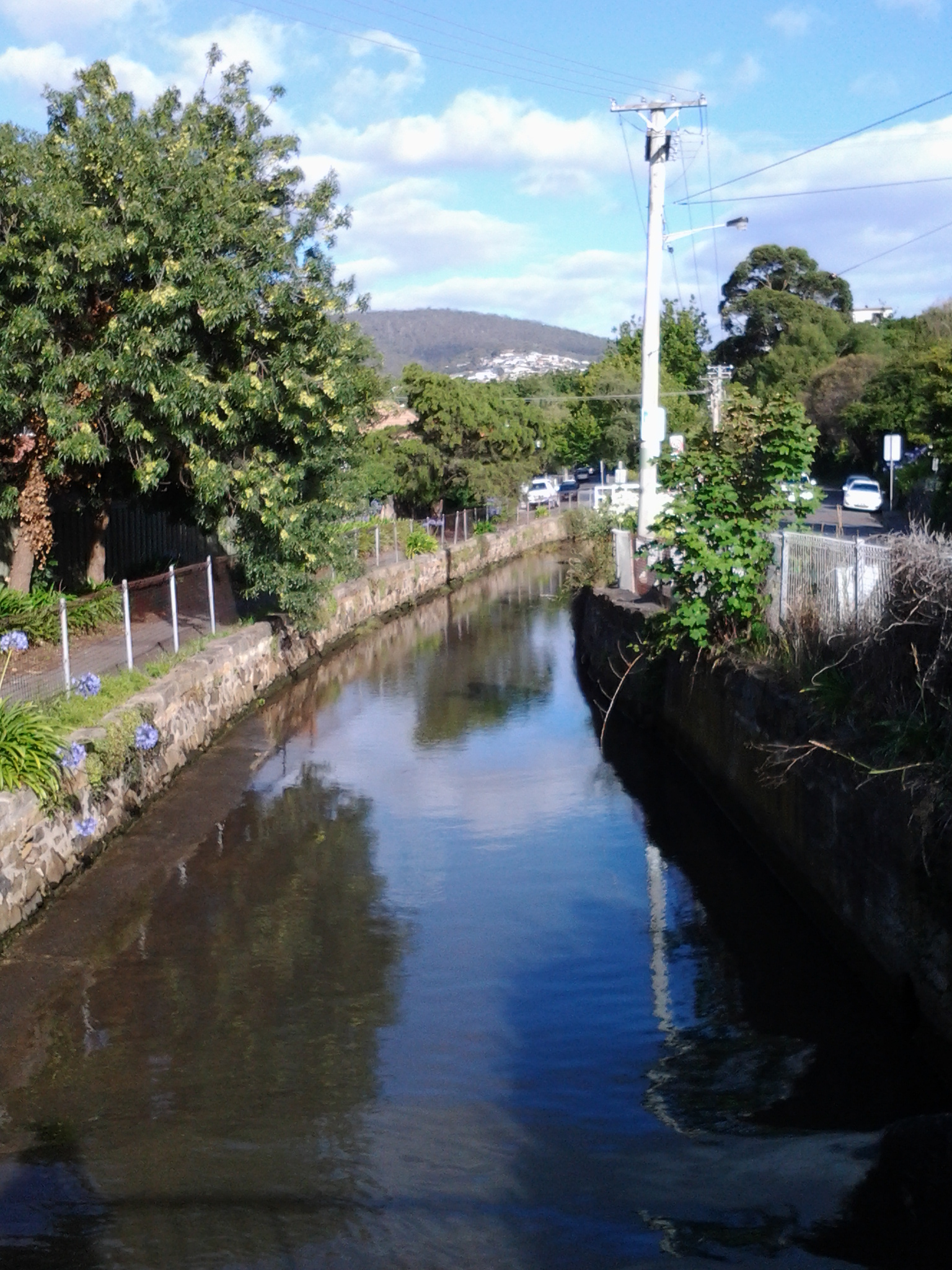
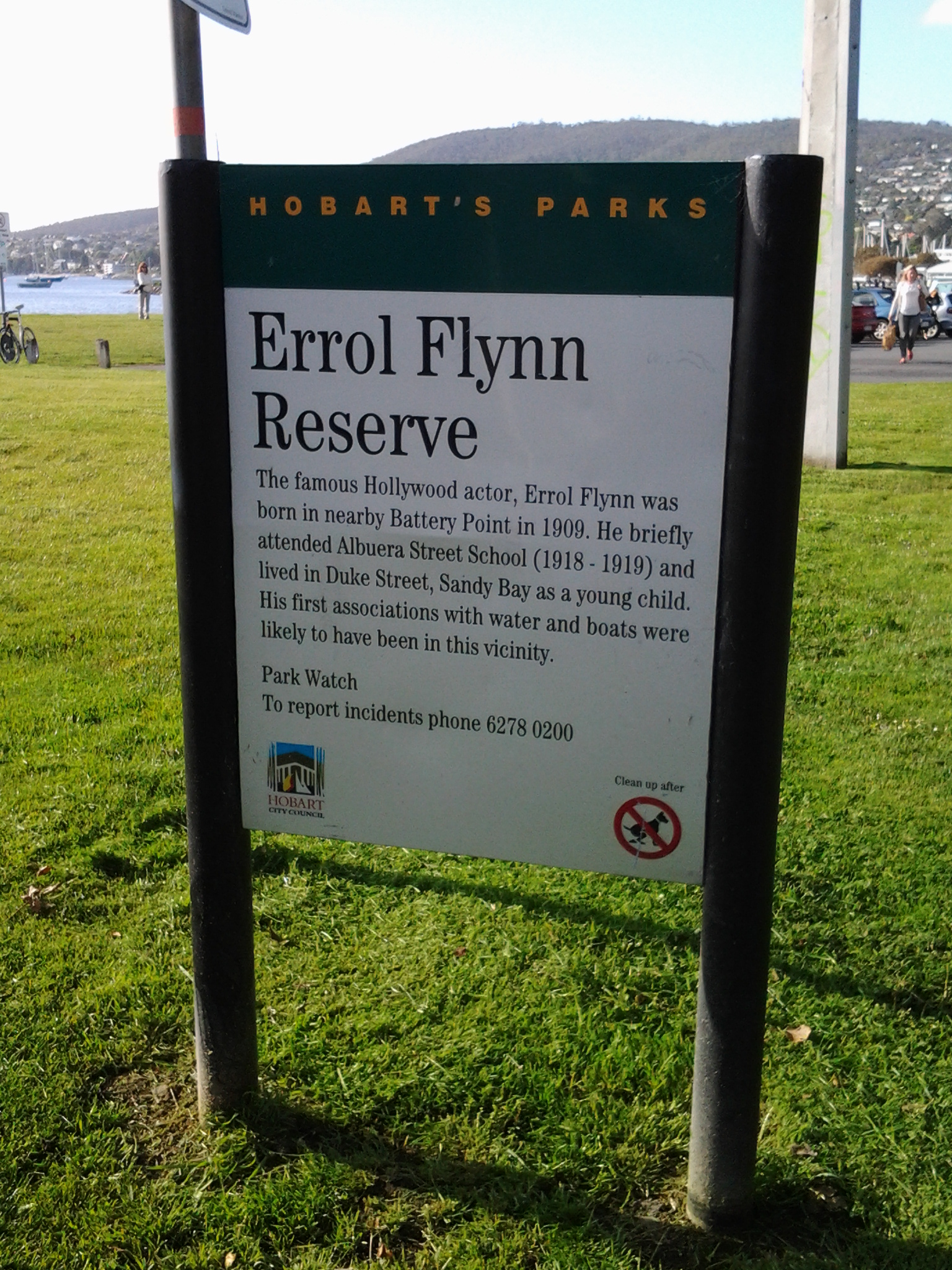
At the bottom of the street I crossed the Sandy Bay Rivulet and arrived at the Errol Flynn Reserve.

20150119_081611 20150119_081658

The Rivulet runs out into Short Beach which edges the Derwent River at this point.

20150119_081621

I had left the suburb of Battery Point and arrived in the suburb of Sandy Bay and it was only 8.15am.

From Parliament House via Salamanca towards the suburb of Battery Point

Preceding Salamanca Place where the famed Salamanca Market occurs every Saturday throughout the year, Tasmania’s House of Parliament sits atop a green leafy Parliamentary Gardens on the other side of Morrison Street away from the Derwent River.  I walked past this on Stage 11 of my walk along the Derwent River, at 7.38am.

20150119_073520 20150119_073636

I continued around Princes Wharf as close to the River as possible and joined Castray Esplanade. Within a couple of minutes the historic buildings of Salamanca Place were separated from me by the strip of Salamanca Gardens.  Most of these sandstone buildings were built early in the 19th century and therefore present a considerable part of the story of the early history of Hobart settlement.

20150119_073809 20150119_073821 20150119_074117 20150119_074129 20150119_074133

By 7.43, I had almost reached the southern end of Castray Esplanade, was passing the Institute for Marine and Antarctic Studies, and could see the old buildings on Hunter Street away in the distance.

20150119_074424

A few minutes later I was abreast of the CSIRO Marine Laboratories, behind which I could see that Tasmania’s latest massive ice breaker ship was in port, presumably loading up before travelling to the Antarctic.  Before I reached that location I passed a very red piece of history; an old fashioned postal box.  The large scale of this ‘box’ made me stop. I marvelled about how much postal material must have been in circulation in the 19th century to warrant such a beast.

20150119_074726

At 7.50pm the tiny Princes Park was opposite.

20150119_074955

Near the end of the Laboratories I took a walking path to the left through a car park to the edge of the Derwent River. The photo below shows my view as I continued my walk toward Battery Point.

20150119_075227

Walking along the wharves of Sullivans Cove, Hobart

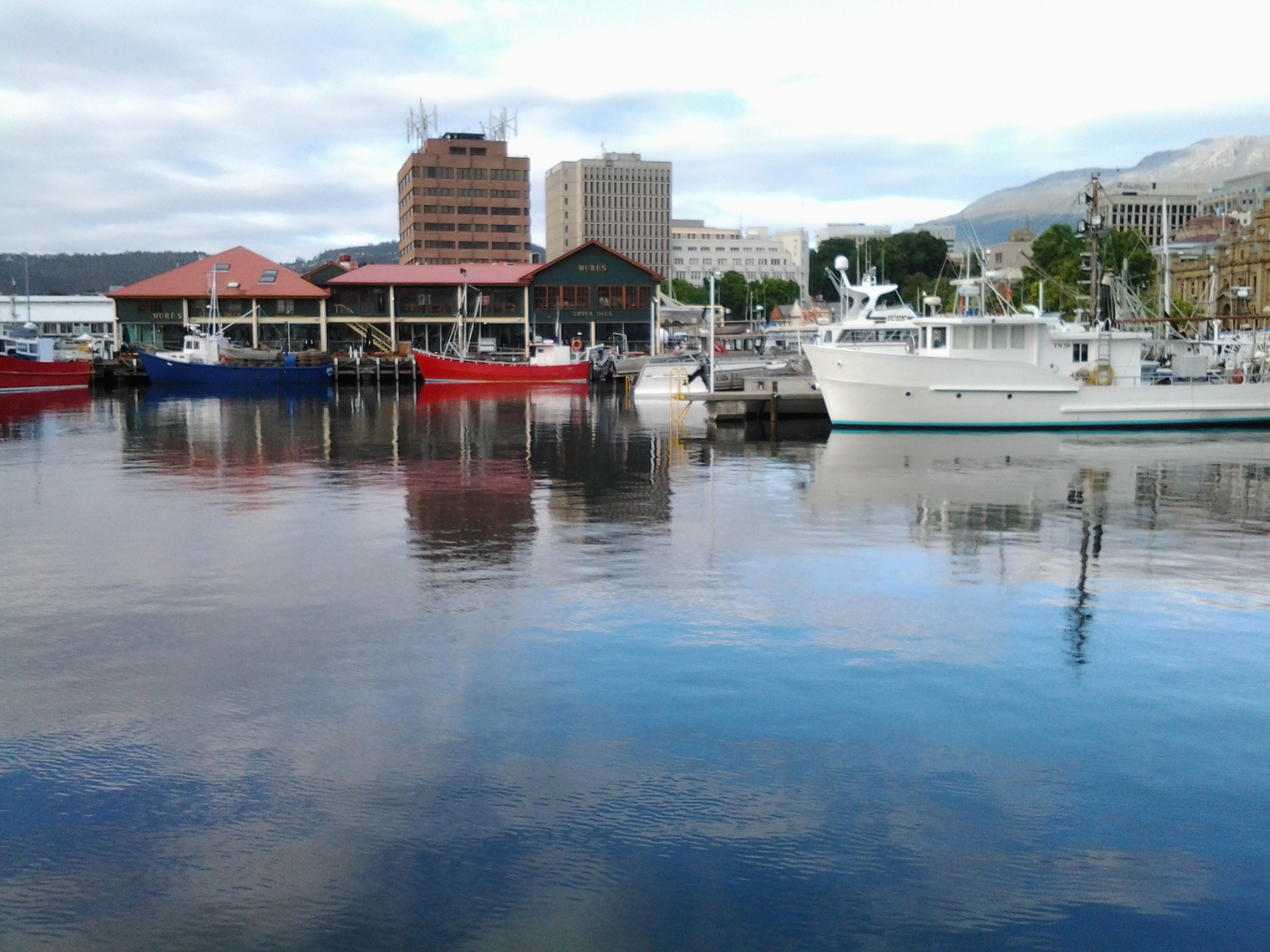
On Stage 11, after walking along Hunter St, I turned right to walk along the Franklin Wharf street, and had the Derwent River on my left and an enclosure for fishing and other vessels to my right. The morning was fresh, the sun was shining and it was all together delightful. Not many people around. The mountain, clearly visible, looked down on the centre of Hobart and over the wharves. Clouds were reflected serenely in the water.

20150119_072745 20150119_072147

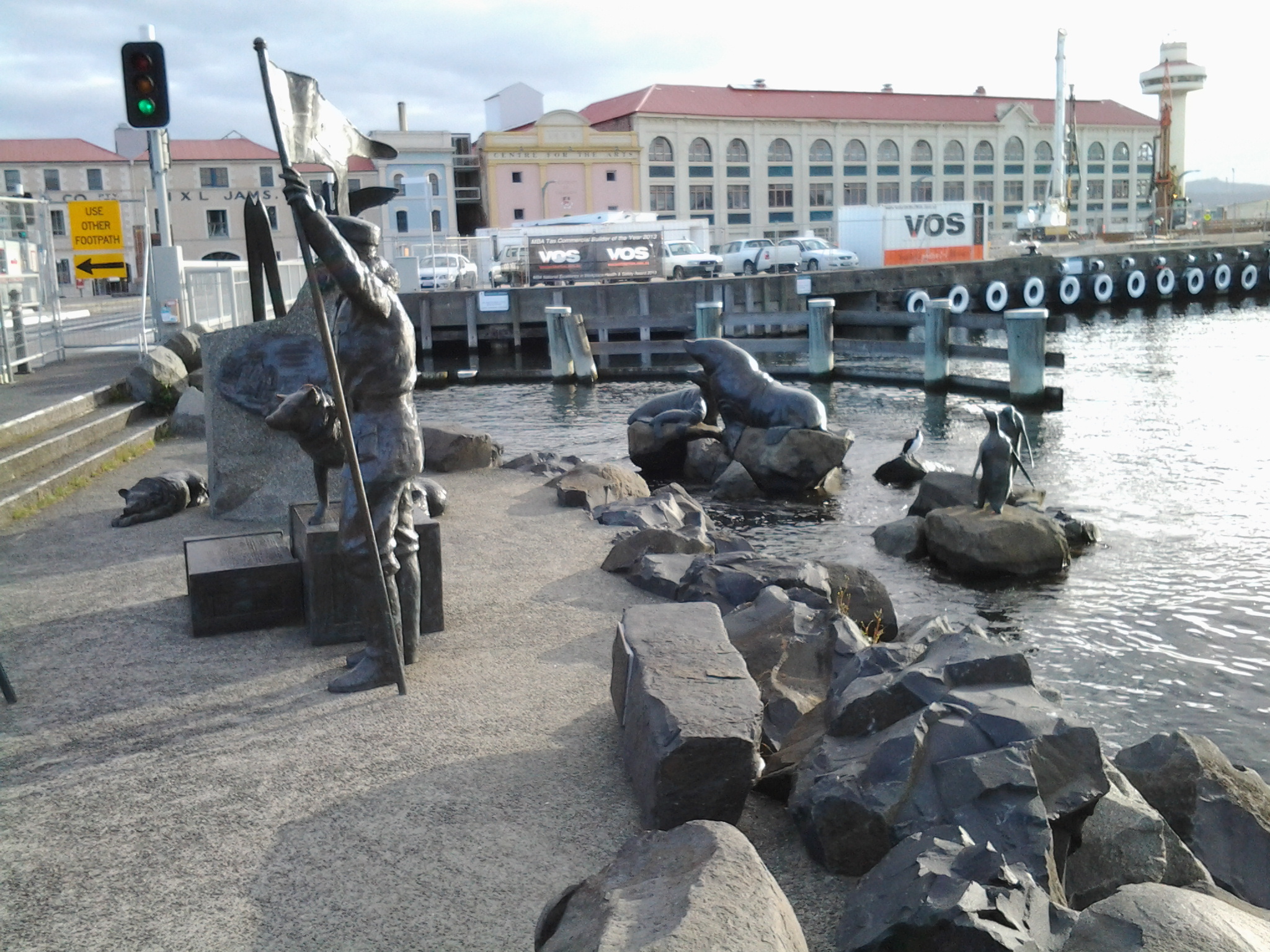
A family of bronze sculptures, perched life-like on rocks on the River side, is much loved by visitors.

20150119_072515 20150119_072503

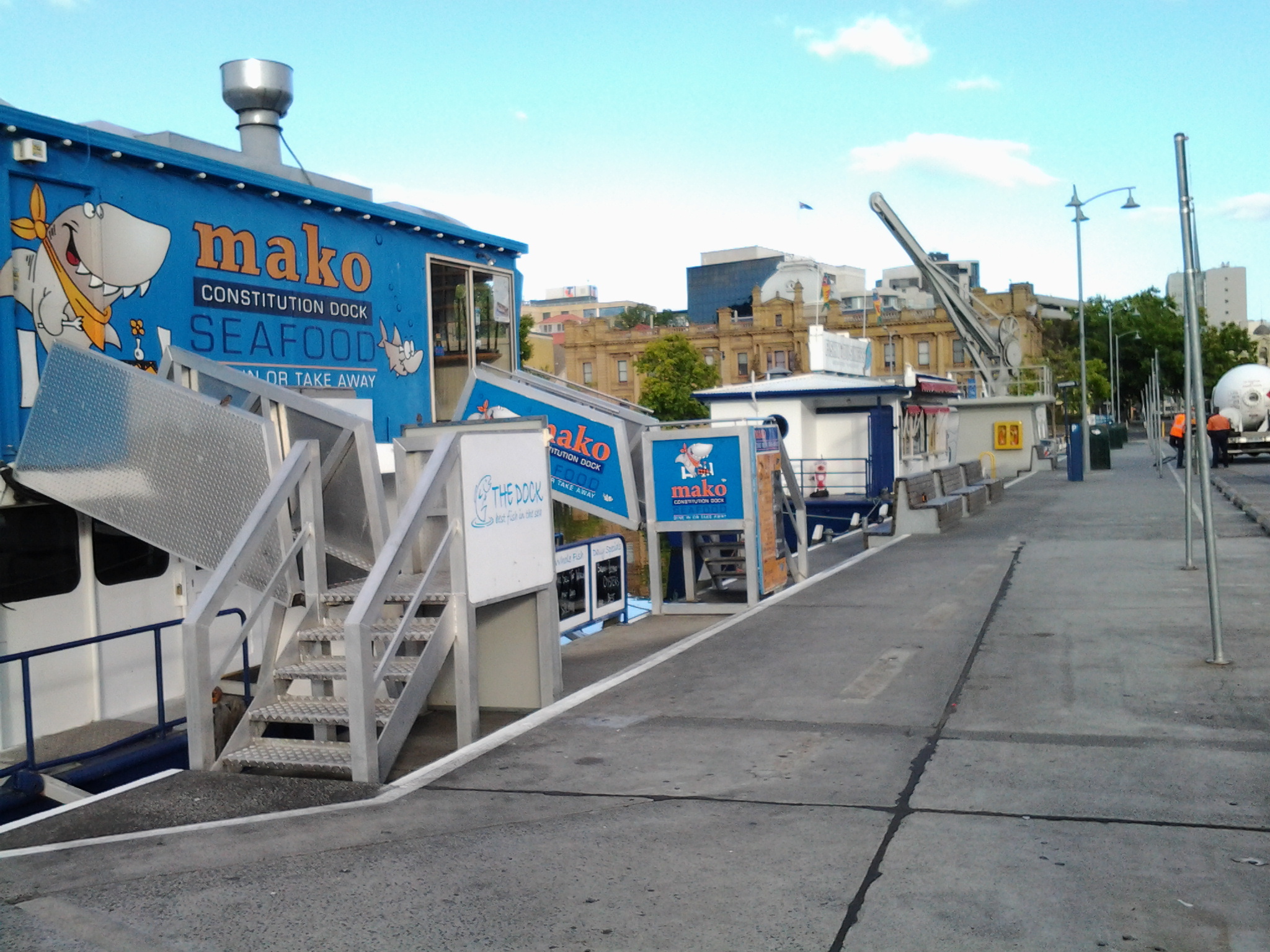
Passing Mures fish restaurant on my right, I continued on until I could see the row of floating fish shops selling fresh and cooked fish and other seafood.

20150119_072706 20150119_072651

A minute later, I was standing on the celebration platform used when the Sydney to Hobart Yacht race boats arrive. I looked across to Elizabeth Pier which contains accommodation, conference facilities and a number of eateries (where sitting outside is such a pleasure).  In the photo below the ‘tall-ship’ replica Lady Nelson sits outside the T42 restaurant.

20150119_072901

Opposite Elizabeth St pier, a number of buildings of different architectural styles and vintages line part of the street. Continuing to the other side of the Elizabeth St pier, a second tall ship, the Windward Bound offers sailing trips.

20150119_073148 20150119_073111

On the next pier after the one in the photo above, a couple of the contemporary camouflaged MONA ferries sat either side within the slightly mobile surface of beautiful glassy water.  Taking a trip on these ferries down the Derwent to and from MONA (Museum of New and Old Art) located in the suburb of Berriedale (I walked through that on recent Stages) helps you to see parts of Hobart you would not normally see, and it gives you a perspective on the distances over which the Greater Hobart Area sprawls. It is interesting to reflect on the two extremes of water vessel technology, when you look at the 19th century sailing ship close by a state-of-the-art catamaran.

20150119_073231

These starting sections of my Stage 11 were colourful and tranquil. It’s a free, easy, stroll along the waterfront and there is much to see looking out onto the side of the Derwent River. The next posting on this blog will look at landmarks on the non-River side of the streets.