Tag Archives: Van Diemen’s Land

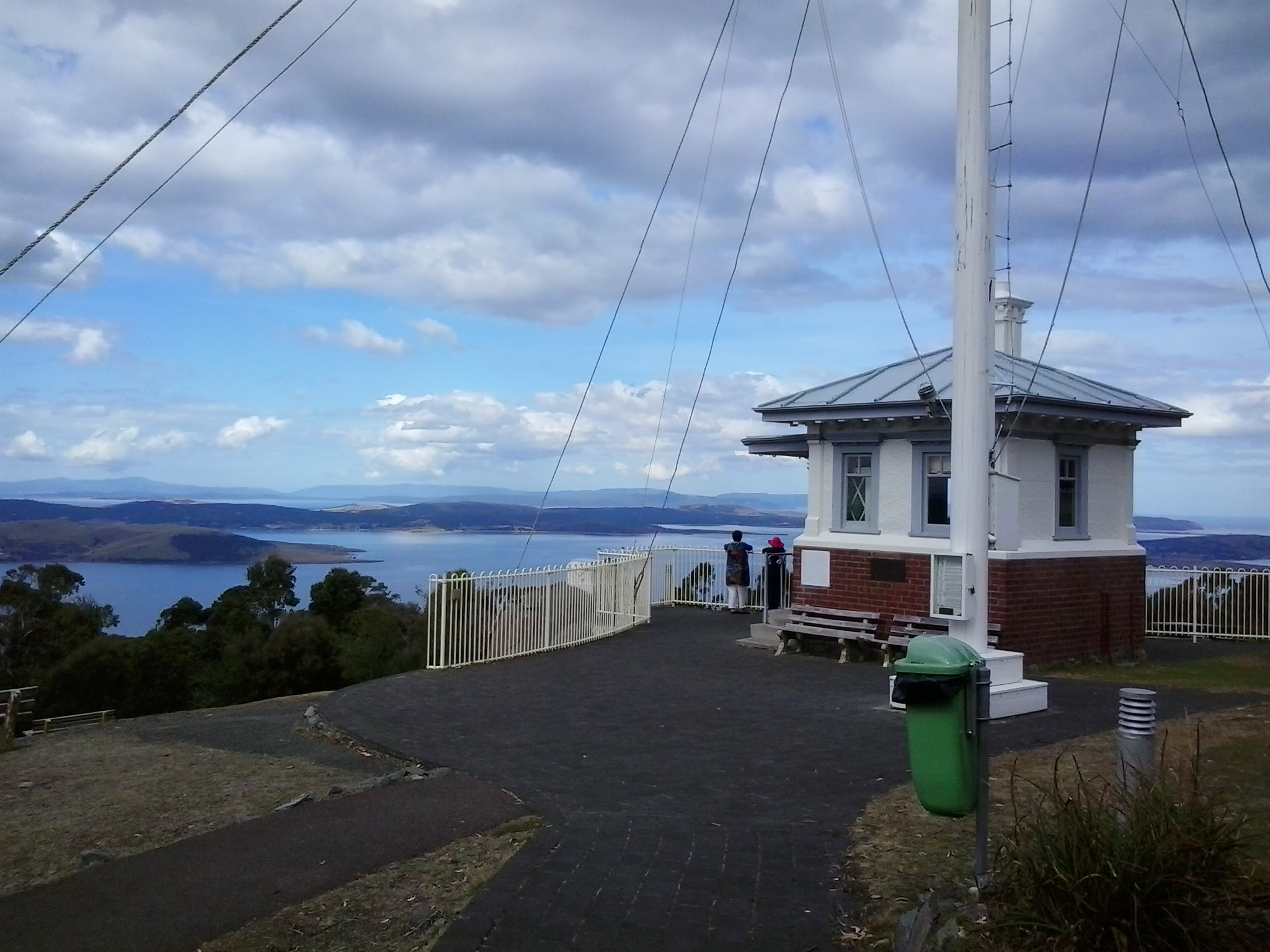
Mount Nelson Signal Station

Overlooking the centre of the city of Hobart and with a view sweeping across to the eastern shore of the Derwent River, Mount Nelson is host to a significant historical site, the Mount Nelson Signal Station.

2015-03-09 14.49.17

Wikipedia provides the information that originally this rise in the landscape was named ‘Nelson’s Hill’ after botanist David Nelson, who sailed on the ship ‘Bounty’ which visited Van Diemens Land on its way to Tahiti (the ship that was involved in the infamous Mutiny on the Bounty). In geological form, Mount Nelson amounts to not much more than a low foothill, however its name gives an indication that something grand awaits you if you venture to the top.

And such a visit is easy in a vehicle, or if you want to take an uphill walk from Hobart’s suburb of Sandy Bay.  In addition, the Mount Nelson via Dynnyrne and Tolmans Hill Metro bus service can deliver you to your destination.  If you like walking, you might choose to catch a bus to the top and then follow any one of a number of clearly marked tracks downhill. Yesterday I made a visit thanks to blog follower Je’s transport, accompanied by another follower Be who is visiting from Cairns.

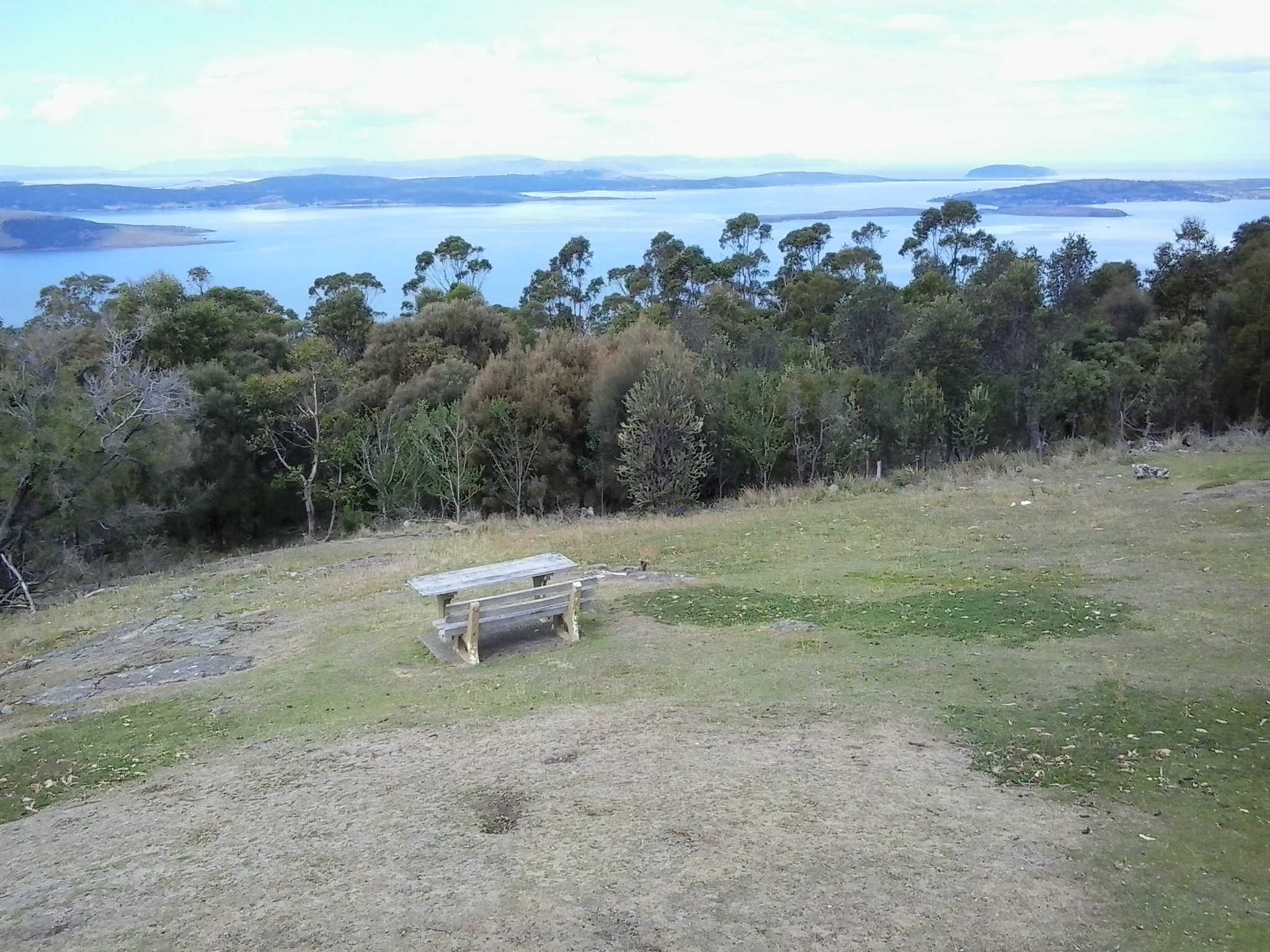
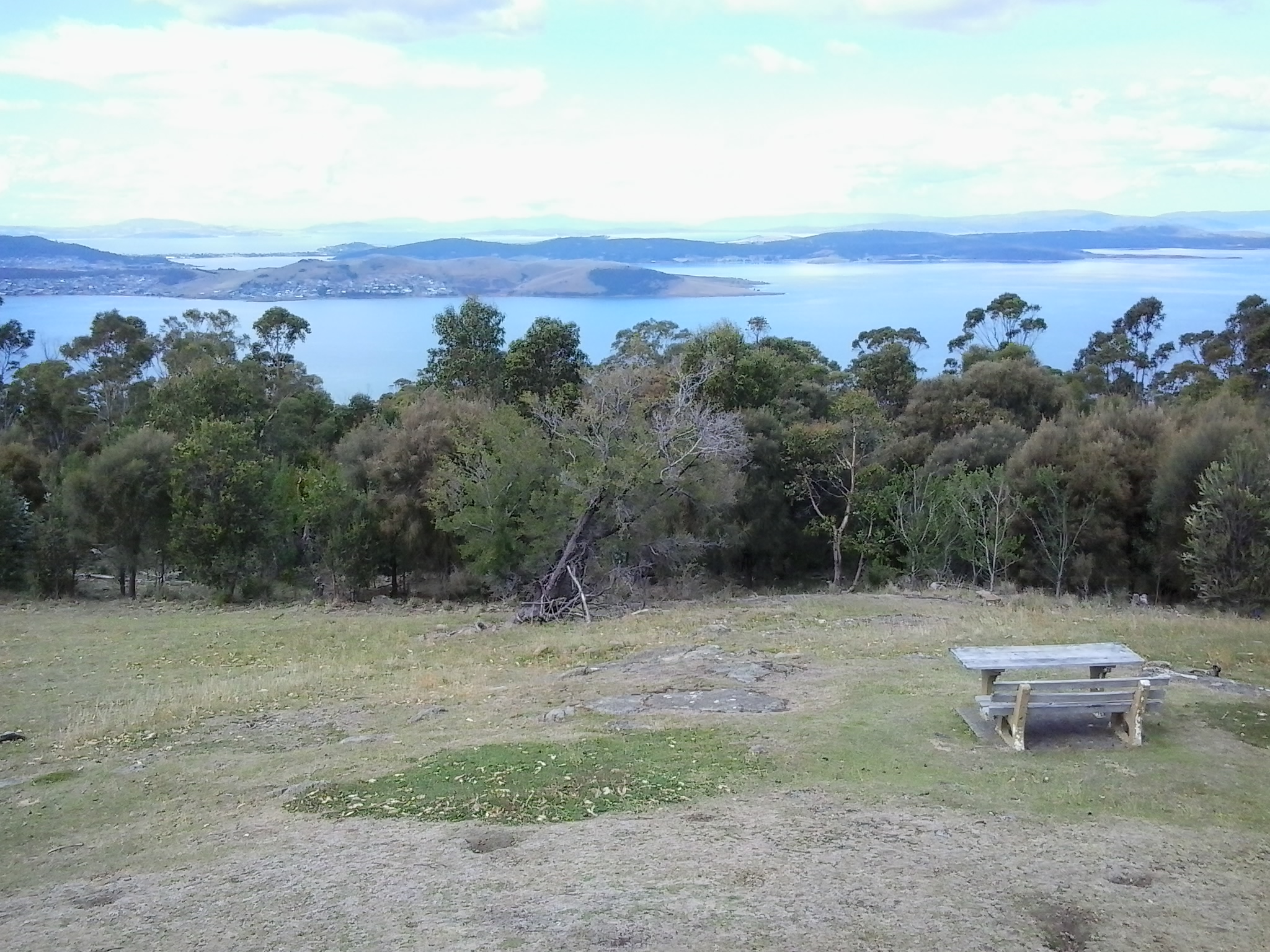
From different vantage points, the spectacle of the Derwent River spread out below, made us breathless with delight. When I am walking at ground level along the Derwent River, the grand panoramas extending into the distance are denied me.  But yesterday it was exciting to see the bays and hills further afield.

2015-03-09 14.50.30

The photo above looks toward the mouth of the Derwent River on the eastern shore. South Arm peninsula can be seen extending along the water.  As  I stood on Mount Nelson I could clearly identify the Iron Pot, Fort Direction Hill, South Arm Beach, Opossum Bay and its beach, and  Gellibrand Point all of which I walked on during Stage 1 and 2 of my walk along the Derwent River.

2015-03-09 14.50.16

The photo above shows the eastern shore of the Derwent River with Gellibrand Point to the right on the northern tip of the South Arm peninsula. Then the great gaping space of Ralph’s Bay appeared straight ahead. To the left of the image, Trywork Point is in view; this was the starting point for Stage 3 of my walk (after I had walked there from the suburb of Tranmere).

2015-03-09 14.50.09

The photo above shows Ralphs Bay to the right, Trywork Point and then the suburb of Tranmere to the left – on the eastern shore of the Derwent River.

2015-03-09 14.49.55

The photo above shows the eastern shore from Tranmere on the right, through the suburbs of Howrah to Bellerive on the left – the River edges which I walked during Stages 4 and 5.

Across the parkland at the Mount Nelson Signal Station, native Wrens flitted around feeling safe as they hunted for insect meals on the ground.

I enjoyed looking at information panels on the site and learning more about how the place operated.  In addition, one panel showed the location of walking tracks.

2015-03-09 14.53.12

So … what is the history? Not long after Hobart was settled in the early 1800s, locals needed speedy and efficient communication between the convict settlement at Port Arthur and Hobart.  In addition, Hobart residents wanted foreknowledge of sailing ships approaching from the ocean through Storm Bay and on their way to the Derwent River in case any provided a threat to trade or security. To gather this information, in 1811 the Mount Nelson Signal Station was established and designed to use semaphore.  The method of communication was flags waving across the hills.  Details about the semaphore flag signalling system can be read at http://www.anbg.gov.au/flags/semaphore.html.  The site http://en.wikipedia.org/wiki/Semaphore_line provides further information. At the Mount Nelson Signal Station, flags were run up a pole – this seems a very cumbersome process compared to a person waving flags. I hope that someday the signal station will offer a demonstration to the public so I can understand the process.  Give me a re-enactment please.

This semaphore communication service continued in use until a more reliable system was available (what happened at the Signal Station on windy days, in wet weather and when clouds obscured the view?).   It was not until 1880 that a telephone line connected Hobart and Mount Nelson.

Walking around the area is free of charge.  Some pathways are provided. The site has various public amenities including picnic tables, public toilets, carpark, barbecues and a restaurant.

2015-03-09 14.50.39

For further information about eating in the heritage building pictured above, go to http://www.signalstation.com.au.  I recommend that you phone in advance if you are depending on eating there. Yesterday, despite permanent signs indicating the Brasserie was open, another sign on the building indicated it was closed.

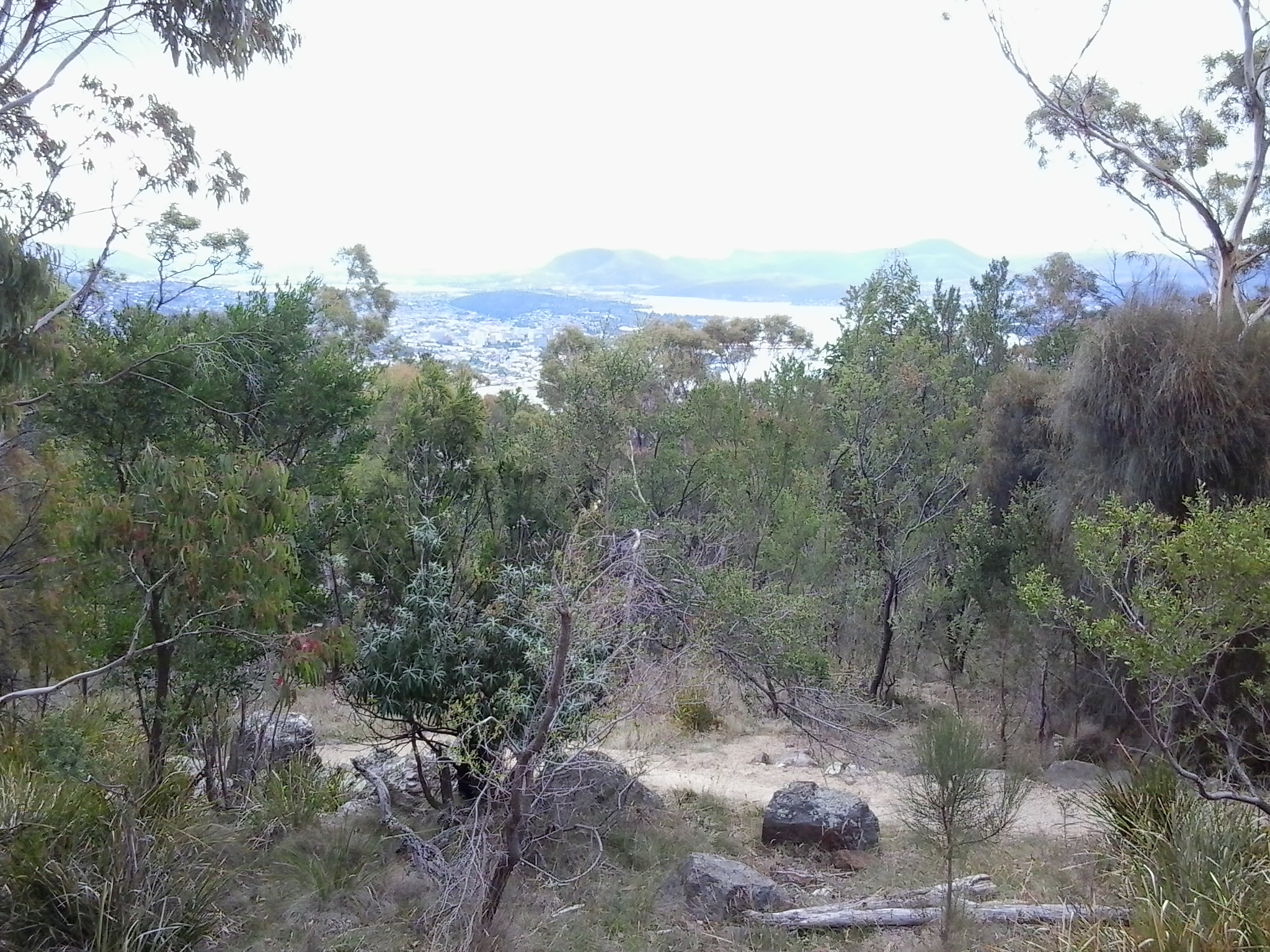
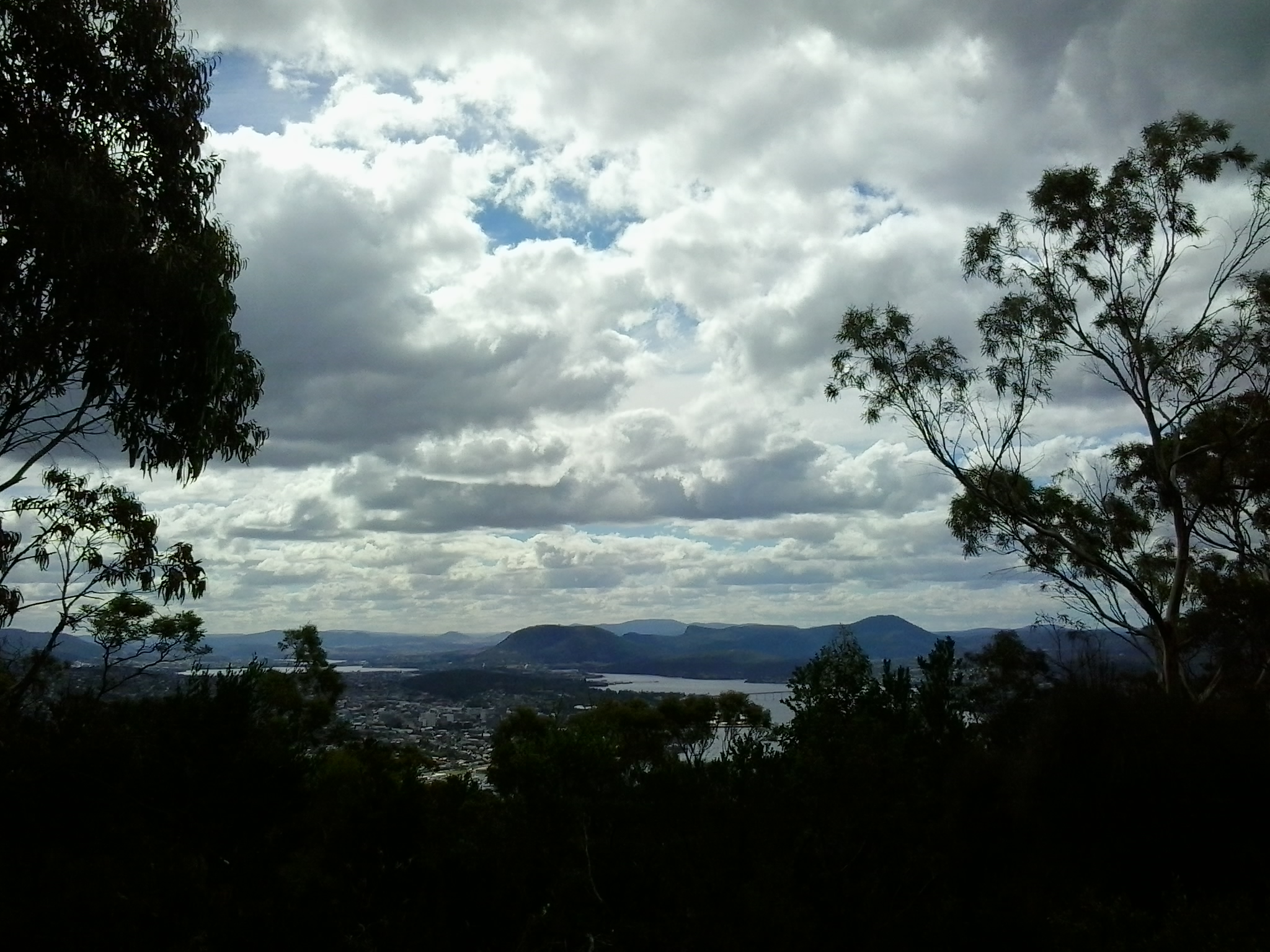
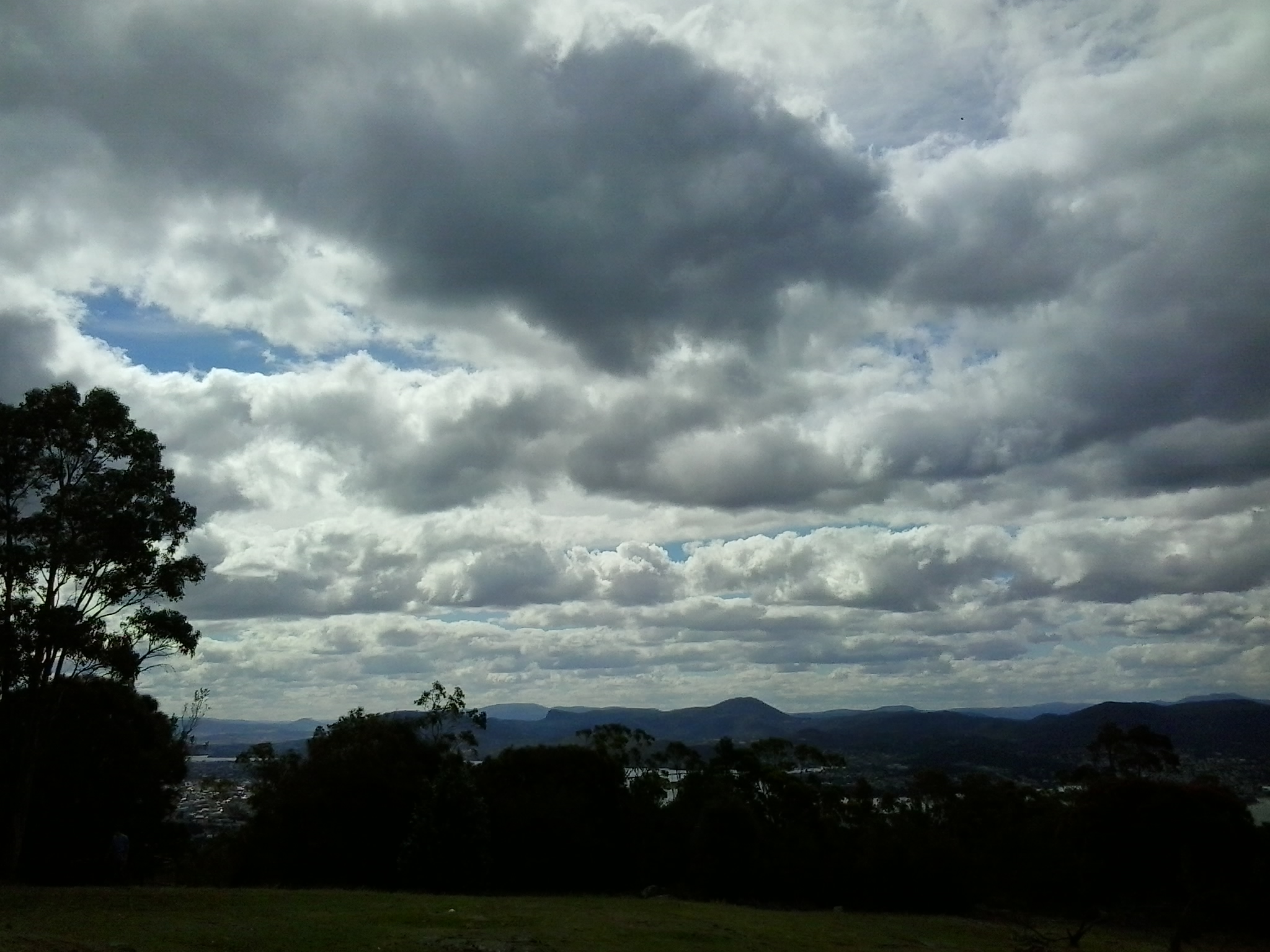
During my visit, clouds loomed powerfully over the city and river. The day light was so bright and strong that when I turned northwards and photographed the land and riverscapes, the sky glowed white.  So I clicked a few images pointed at the sky and this silhouetted the landscape.  Using my simple mobile phone as camera, I was never able to control the light of the images.

2015-03-09 14.55.09 2015-03-09 14.55.16 2015-03-09 14.51.33 2015-03-09 14.51.23

Although these looked like rain clouds, it did not rain.  These large puffs were just passing through.

An extra historical morsel regarding Browns River which runs out into the Derwent River

Browns River separates Tyndall Beach (below the Alum Cliffs) from Kingston Beach. On the Kingston side, a plaque remembers Robert Brown.

According to http://www.rampantscotland.com/placenames/placename_hobart.htm  the township of “Browns River was named after the noted Scottish botanist Robert Brown who explored the area a week after Hobart was founded. “  Apparently Hobart (Sullivans Cove) was established on 21 February 1804 (I shall remember the date because it is my birthday – well not the 1804 bit) and therefore before the end of February this ‘township’ of Browns River was in its infancy. A week – ye gods!  How quickly these pioneering settlers got around.  Nothing could happen so fast these days.  But, is the timing true or simply a legend? I don’t know.

The name was changed to Kingston in 1851 by the Governor of Van Diemens Land, Sir William Thomas Denison.  The website http://tasmaniaforeveryone.com/tasmanias-names-the-suburbs-of-hobart suggests “The name Kingston was advocated by the then Police Magistrate, Mr Lucas. Although his exact reason for deciding on the name of Kingston is unknown, there are many theories. His parents, Thomas and Anne Lucas, the district’s first settlers, lived at Norfolk Island before coming to Van Diemen’s Land and the capital of Norfolk Island was Kingston. Another possible reason is that Thomas was born in Surrey, England in a village close to New Kingston. It had been settled in 1808 by Thomas Lucas and his family, who were evacuated from Norfolk Island. He named his property ‘Kingston’, after the settlement on Norfolk Island. “

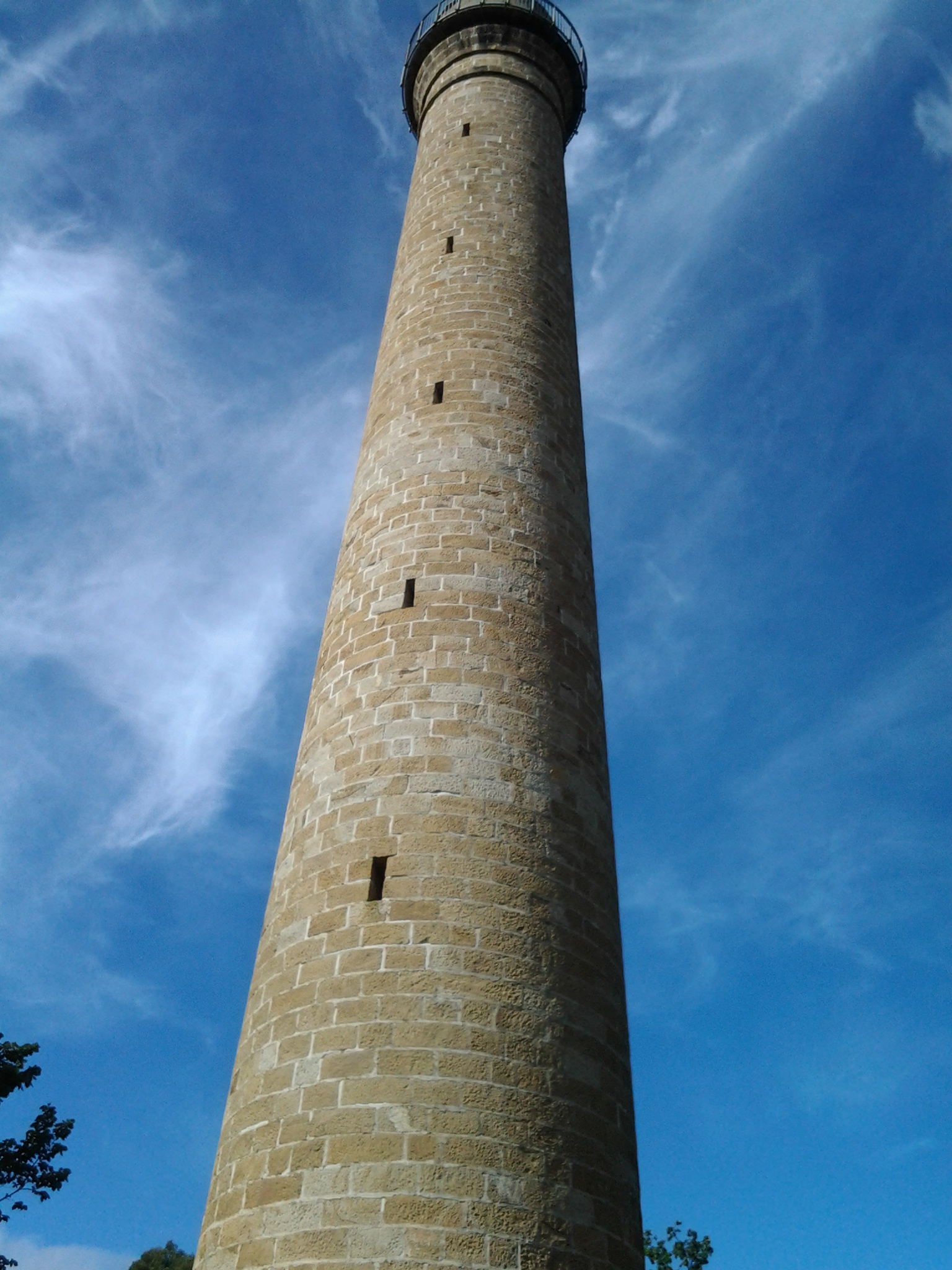
The Shot Tower, Taroona, Tasmania

Was someone shot here?  Was gunshot made here? What is the story of Taroona’s Shot Tower?

The website http://taroona.tas.au/shot-tower provides the full and correct name of what I visited on Stage 12 of my walk: Joseph Moir’s Shot Tower.

20150202_095850

Another website http://www.parks.tas.gov.au/index.aspx?base=2820, explains “Joseph Moir’s factory, which operated for 35 years from 1870, manufactured lead shot for contemporary muzzle loading sports guns.”  This second website offers background information about Moir: a Scot, he arrived in Van Diemens Land as a free settler in 1829. Details and photographs of some buildings, the choice of the site, the manufacturing process and Moir’s burial are all covered on this website for those who are interested to know more.

The man seems to have been both industrious and enterprising. Wikipedia claims he “issued tokens in his own name during a currency shortage in the colony”.  The Museum of Victoria (http://museumvictoria.com.au/collections/themes/2164/joseph-moir-ironmonger-1809-1874) confirms this story and offers more detail.

In relation to shot towers generally, the first one in history was created in 1783 in England, not many years before Moir was born and emigrated half way around the world. The early process involved molten metal being dropped from a great height in order to turn it into spherical shapes, and letting it land in a pool of water which cooled the metal.  Late in the 19th century, a wind method (short fall and blast of cool air) replaced the long drop and water method.

20150202_095810

Taroona’s coastline as experienced on Stage 11 of my walk along the Derwent River

The last leg of this Stage was the most interesting because I made discoveries which delighted me deeply.

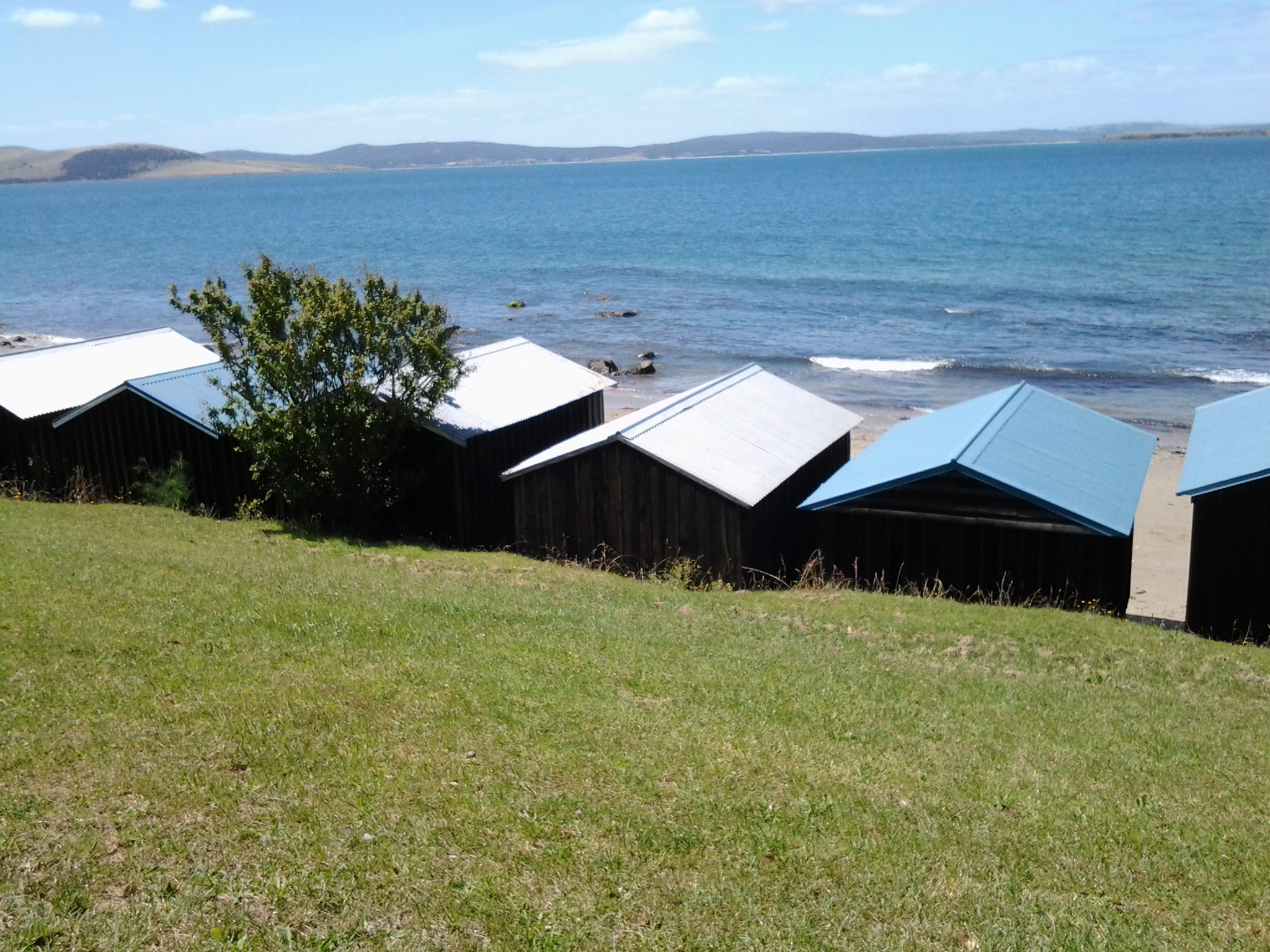
At 12.18pm, I left my Channel Highway resting spot and walked downhill toward the people-free Taroona High School (closed for school holidays). Close to the bottom of the hill I could see the tops of boathouses and a ‘beach’ to my right so I took a dogleg to Melinga Place on my right and continued downhill.

20150119_122623

I didn’t know this existed. Mostly a rocky shore, a little sand, edged by a mown green lawn.  Serene.  Across the Derwent River, I could see Gellibrand Point at the north of the South Arm peninsula.

20150119_122608

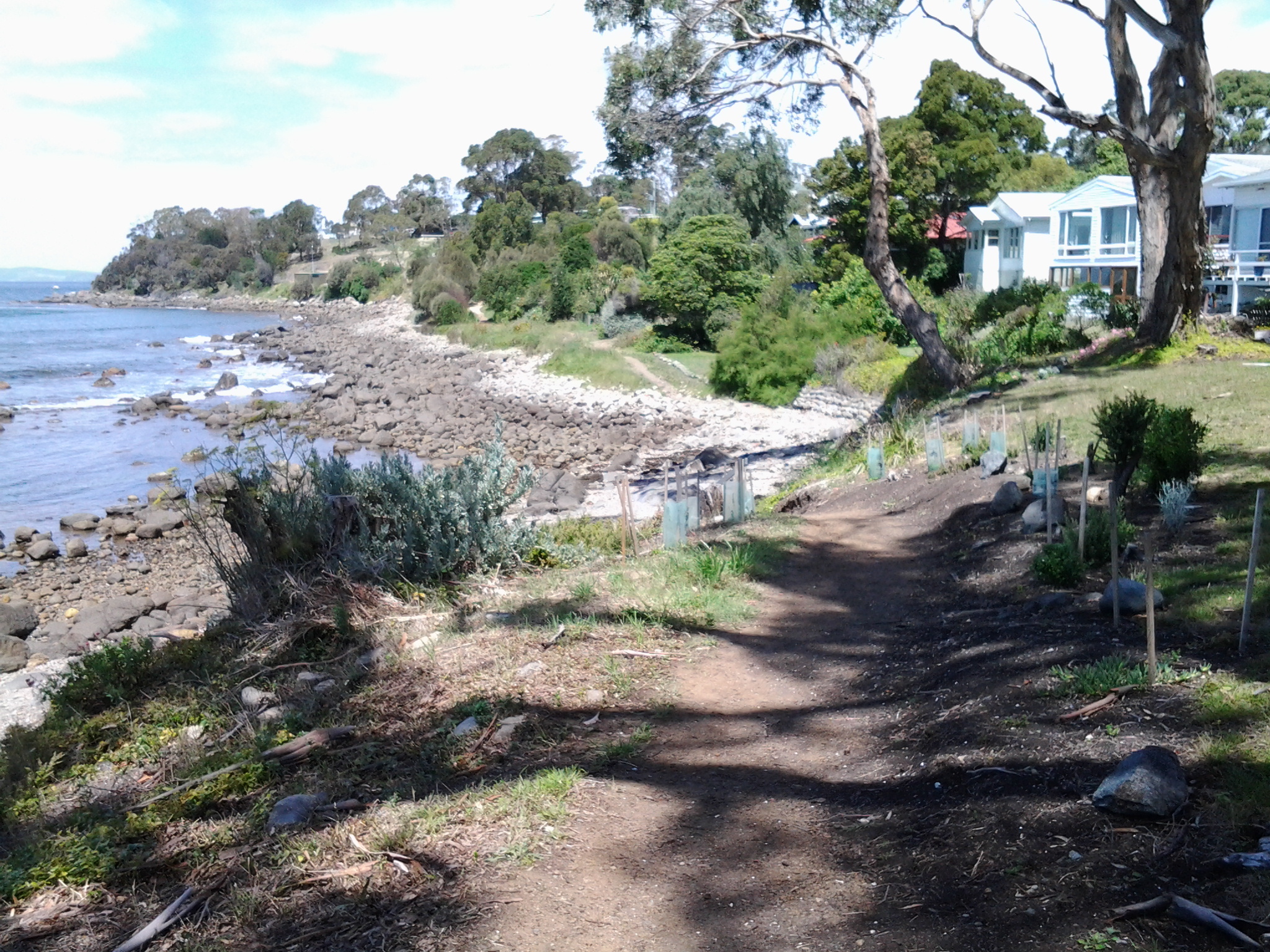
Walking southwards it wasn’t long before I entered the foreshore bushland on an easy-to-walk dirt track.

20150119_122632 20150119_123039

Later I found this had a name: the Taroona Foreshore Track. At one point the ‘track’ passed over a ‘beach’ of shells and rocks then returned to dirt and rose up over areas raised above the water.

20150119_123407 20150119_123610

An onshore breeze kept me moving.  Every so often, steep trails descended to the rocky shore but I realised that staying on the track would be more comfortable than rock hopping the edge of the River.

When I walked through a grove of trees that were obviously different, I was delighted to read an information panel which informed me this was an “unusual and isolated stand of blackwoods.  Acacia melanoxylon.”  The species is also known as Sally wattle, lightwood, hickory, mudgerabah, Tasmanian blackwood or black wattle. Their rough bark seemed as if it would flake off in small pieces but it was toughly attached.

20150119_124053 20150119_124059

At 12.46pm I looked back northward and could still see the boathouses near the High School.

Looking back to boathouses below Taroona HS

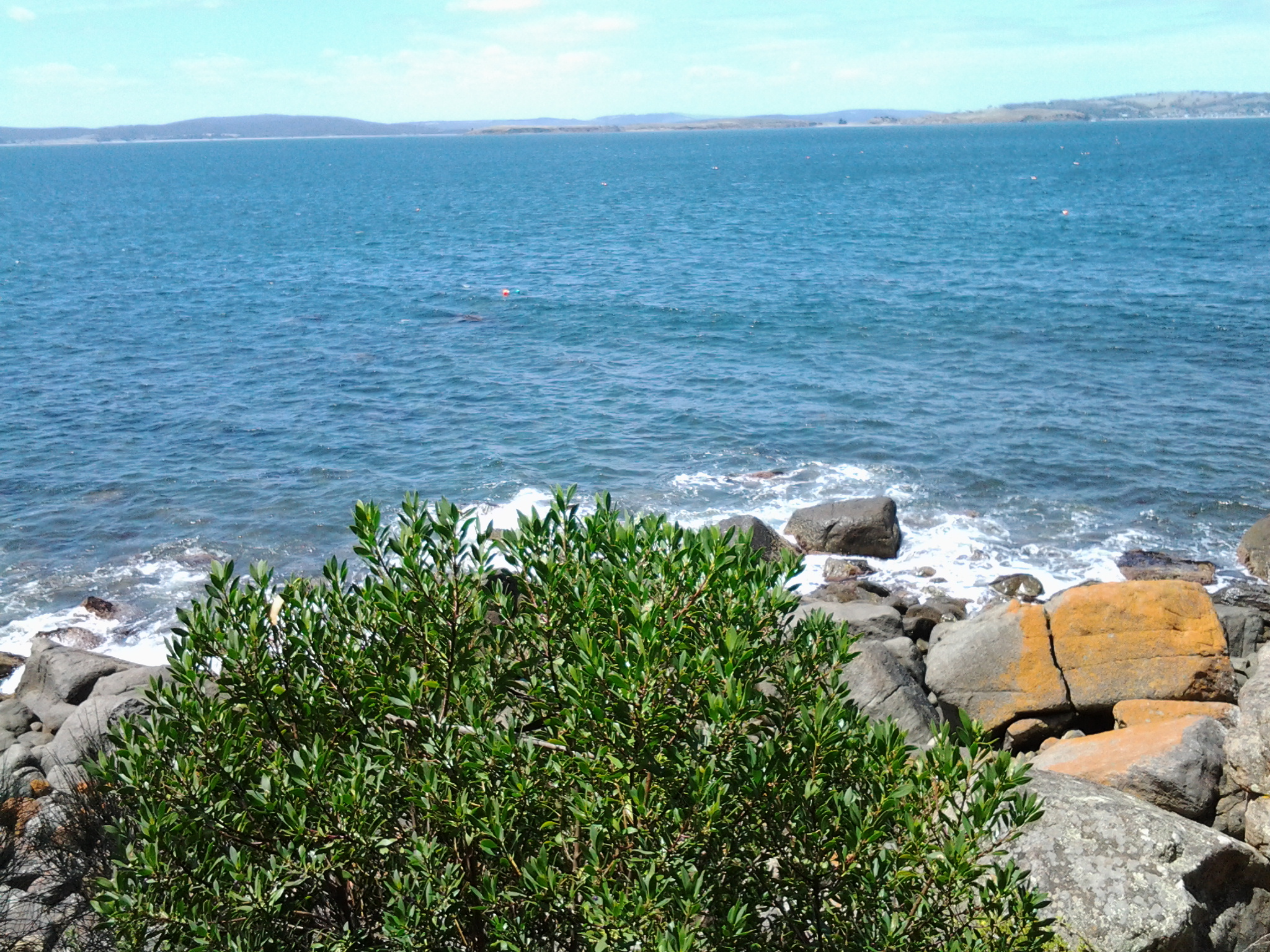
A couple of minutes later I reached Crayfish Point where I noticed craypot markers bobbing in the Derwent River as evidence that fishing for crayfish/lobster was taking place.  However, a sign seemed to indicate this was part of fisheries research by the University of Tasmania.

20150119_124945

Brilliant orange lichen sprawled across some of the rocks.  Huge Pied Cormorants rested on rocks with water lapping at their feet.  This was one of those brilliant days when all the superlatives in the world seem inadequate.

It was near here that an information panel enlightened me about some of the native vegetation.  Now I can identify not only Pigface which I love, but also Bower Spinach and Grey Saltbush. Why I didn’t take photos of the real thing while I was walking I cannot say. Daft!  So I have Googled for images:  If you type in Bower Spinach Tasmania Images, up comes a suite of pictures showing this fleshy leaved plant.  Try something similar to find images of the softly grey coloured Grey Saltbush.

When I reached the start of Taroona Beach at 12.53pm, I looked up the hill and in the distance I could see the Shot Tower that had been built in 1870 (the Shot Tower, a major tourist attraction, is normally accessible from the Channel Highway).

The Batchelor’s Grave Historic Site, just above the foreshore of Taroona Beach, was a surprise.  Wikipedia provides the information that this is “the grave of a young sailor, Joseph Batchelor, who died on the sailing ship Venus in the Derwent Estuary in 1810, and was buried ashore on 28 January 1810. It is reputed to be the oldest European grave in Tasmania”. I am amazed at this idea.  I cannot imagine that many Europeans didn’t die and were buried in Van Diemens Land before 1810 – however, maybe this is the only stone grave marker left from early in the 19th century.

20150119_125452 20150119_125441

Taroona Beach is backed by Taroona Park with pleasant picnicking facilities and public toilets.

20150119_125327 20150119_125918

I left at 1.06pm and walked along Niree Parade for a couple of minutes until the Taroona Foreshore Track restarted.

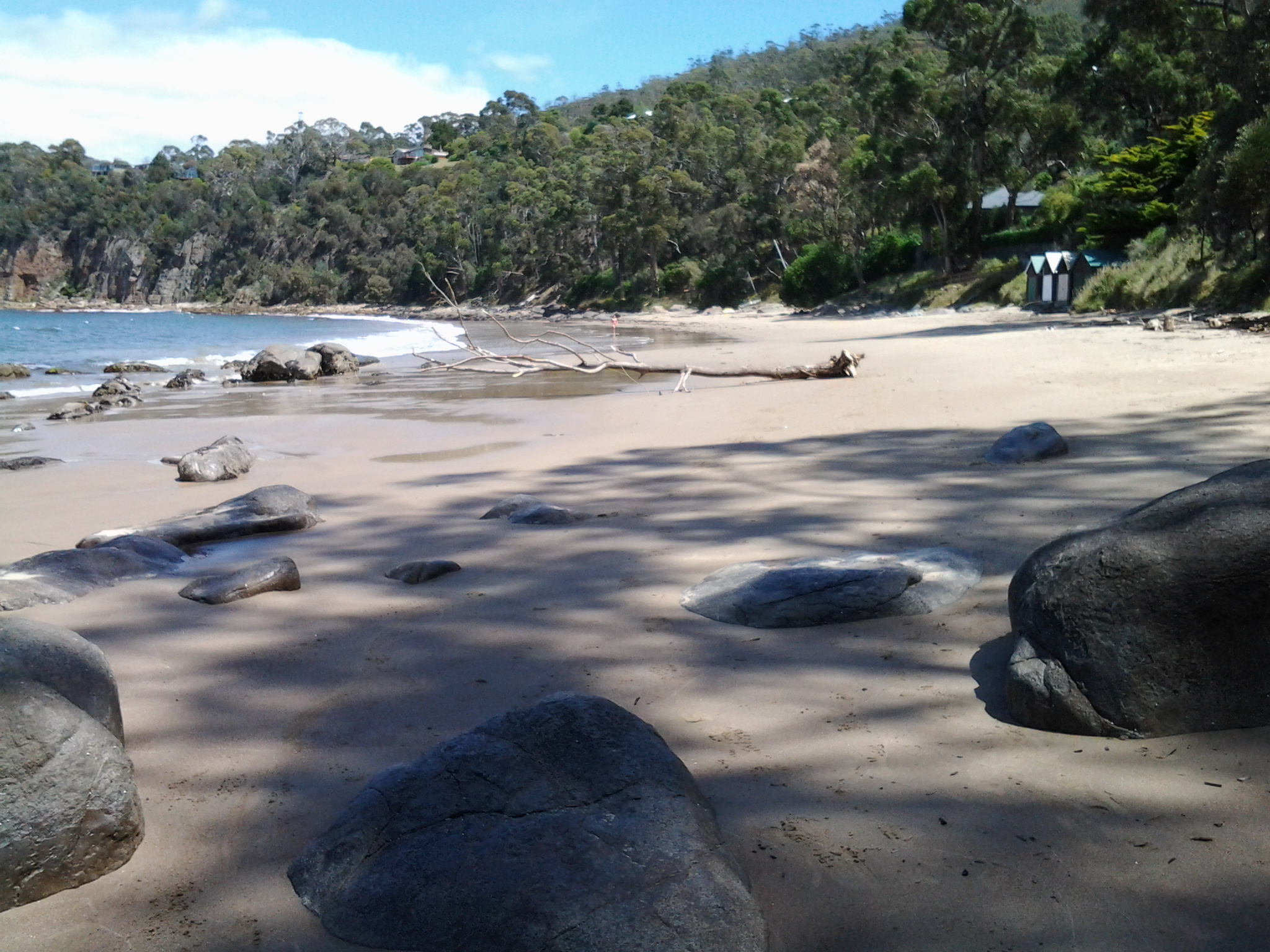
Within moments I arrived at Hinsby Beach, which was the find of the day as far as I am concerned. Isolated.  Small.  Tree edged. Calm.  Small wave break.  A few boathouses.  A family beach with a few swimmers and sun bathers.  Located at the end of the River edge before the steep Alum Cliffs which flow for 3 or four kilometres to Kingston.

20150119_131323 20150119_131402

I soaked in the atmosphere before starting uphill on a public access walkway at 1.22pm, under shady bushes with lush surrounding ground cover. The track connected to the bottom of Hinsby Road. At the top of Hinsby Road the Channel Highway flowed by. As I arrived at bus stop 30 at 1.36pm, a Metro bus came by on which I made the trip back into Hobart. Half an hour later I was in the city and ready to make the bus trip back home in Bellerive.  I walked in the door at 2.40pm after an exhilarating day when my feet didn’t want to carry me, but I insisted and they persisted. This really is a wonderful part of the world.

A surprising connection, with an earlier stage of my walk, was discovered unexpectedly

On Stage 2 of my walk along the Derwent River, I hunted for and located on the South Arm peninsula the burial vault of William Gellibrand, one of Van Diemens Land’s first settlers in the early 1800s.  Readers of my blog may recall photos such as:

20140904_104548

After William Gellibrand’s residency, the land at that northern end of the peninsula was named Gellibrand Point. The photo below looks down onto Gellibrand Point.

20140904_111429

This evening I went to a music concert in a church with a powerful and large pipe organ.  While sitting floating in and out of absorption in the romantic organ music, I cast my eyes around the old church. My eyes passed languidly over a plaque attached high on a wall, then swivelled back in surprise. This was William Gellibrand’s white marble memorial plaque.  After the concert I took a closer look.

William Gellibrand burial plaque2

When I read that the plaque came from the Chapel, I wondered which Chapel. The internet has given me the answer.

The short story is that the Chapel was built on the Brisbane and Elizabeth St corner site of Hobart in the 1832, Gellibrand died in 1840 and a memorial plaque was installed in the Chapel. When the new church was built in 1872, the plaque was relocated. Seven years later the organ was installed and since then it has been rebuilt a couple of times. Tonight, the audience of pipe organ devotees were presented with a concert of examples of the work of Moeran, Darke, Lemmens, Delius, Manet and Andriessen.

From the website: https://fergusonandurie.wordpress.com/2012/03/02/26-07-1872-memorial-uniting-congregational-church-elizabeth-and-brisbane-streets-hobart-tasmania-2,  I learned that the current “church was to be known as the ‘Memorial Congregational Church’ in memory of the first Independent or Congregational minister, the Reverend Frederick Miller who arrived in Van Diemens Land in 1830. The very first chapel on the site was funded solely by him at a cost of £500 and opened on the 20th April 1832.”

The website also explained that “The foundation stone of the Memorial Independent Church was laid on the corner of Elizabeth and Brisbane streets in Hobart on the 16th August 1870 and was formally opened on Thursday 7th November 1872. In late July 1872 the stained glass windows for the church arrived from the Ferguson, Urie, and Lyon stained glass company of Melbourne and were promptly erected.”  You can see, on this website, photographs of the colourful glass windows.

A document located at http://www.ohta.org.au/gaz/GAZETTEER-OF-TASMANIAN-PIPE-ORGANSOctober2007.pdf provided the following information about the pipe organ: “MEMORIAL UNITING (CONGREGATIONAL) CHURCH, Brisbane Street. B. 1879 George Fincham; reb. 1936 & enl. 1939 Geo. Fincham & Sons (addition of choir organ). Reb. 1992 Gibbs & Thomson.“

It seems there have been many variations in the church’s name.  Currently this church is known as The Korean Full Gospel Church. The hospitality shown by the Korean pastor, his wife and other Koreans was exceptionally friendly and generous and so I had a rich experience with unexpected findings.

History of our Claremont by the Derwent River

It is one thing to muse on who my readers are but now I am focussing on our suburb of Claremont and its history. During my last walk I passed along the Derwent River foreshore of Claremont, discovered the Claremont Plaza, walked around the Claremont Golf course and spent some time in the Cadbury chocolate manufacturing factory.

Wikipedia informs me that “Claremont is a suburb of the City of Glenorchy, part of the greater Hobart area, Tasmania, Australia. It is named after Claremont House (at 12 Lady Clark Avenue, Claremont) which was built in the 1830s by local settler Henry Bilton, who named it after one of the royal homes of England.” When you read http://www.nationaltrust.org.uk/claremont-landscape-garden/, which provides some information about Claremont House in Surrey England, you will learn that it was “Once a Dukes’ retreat and a playground for princesses…” I could find no information about whether any of England’s royal family ever visited our Tasmanian Claremont House. Probably not.

Information about the original owner of the House, Henry Bilton can be read at http://claremonthouse.com.au/history/history-private-ownership-1825-1940/. He first settled in Van Diemen’s Land in 1825 and in the following year he acquired the property on which Claremont House was built. Apparently Bilton’s occupation was a General Merchant and Importer.  The site http://www.watersideaccommodation.com/downloads/HistoricalSummarytheClaremontAustinsFerryArea04May07.pdf declares: “Claremont, or Lady Clark House as it has come to be known as, was built by the early pioneer Henry Bilton. Henry came to Tasmania on medical advice in 1825. He became a merchant and later a gentleman farmer. As the first importer of Leicester sheep to Tasmania he gained significant wealth and turned his attention to politics.”

The following photo of Henry Bilton comes from http://www.glenorchy150.com.au/gallery/.

Henry-Bilton-re Claremont

Detailed information about Tasmania’s 1839 (decades before the Californian settlement) Claremont House can be read at http://claremonthouse.com.au/history/.  Right now, the house is up for sale: see photographs and details at http://www.domain.com.au/property/for-sale/house/tas/claremont/?adid=2009725372.  Perhaps you might want to buy it!  There is no range of prices given, so the sale is ‘by offer’.

Claremont House, in the Greater Hobart Area, is located away from the Derwent River foreshore so I did not go near this during my last walk.

Colonial Artists, the Derwent River and the Glenorchy area

A number of 19th century artists made visual references to Roseneath on the Derwent River within the current City of Glenorchy. These include Joseph Lycett, George William Evans and James Taylor (no not ‘Sweet Baby James’) all of whom may have a connection with each other as I will explain.

Background to Joseph Lycett

Let’s start with Joseph Lycett who left a significant body of work depicting Sydney and Newcastle in NSW, and a few pieces named with features along the Derwent River.

Lycett didn’t come to Australia by plan. He was a forger and the British government transported him to Sydney with a sentence of 14 years.  He arrived in 1814. It was clear he had skills and was almost immediately given a ticket of leave on landing, but he couldn’t help himself. Within 15 months Lycett was illegally printing bank notes for use in NSW. His new sentence was relocation to Newcastle for hard labour in the coal mines. I suspect there must have been something charismatic about this man despite the Australian Dictionary of Biography alleging Lycett had ‘habits of intoxication’ that were ‘fixed and incurable’. Before long his abilities were noted and he was out of the mines and drafting designs for new buildings in Newcastle.  In 1821 he was finally pardoned and left Australia for good the following year. But Lycett never visited Van Diemen’s Land.

I wondered how he came to produce the well-known pictorial publication Views of Australia or New South Wales & Van Diemen’s Land, published by John Souter, London, 1824-25 described by eminent Australian Art historian John McPhee as “the most lavish pictorial account of the colony ever produced”. McPhee has come to the conclusion that Lycett couldn’t help being a con man. Though his views of Van Diemen’s Land were supposedly scenes he had witnessed, McPhee (quoted in the Sydney Morning Herald 5/4/2006) says “there’s no doubt he never went there”.  We can be surprised to learn that when Views In Australia didn’t sell in England as well as Lycett hoped, he turned to forging bank notes again. He must have loved his printing press!

So I began to research how Lycett ‘knew’ what the Derwent River and the surrounding land looked like.

When Lycett first landed in Sydney, Governor Macquarie was ruling the colony. During Lycett’s sojourn in Newcastle, Macquarie became acquainted with the artist’s pictorial records of the colony. In 1818, the Governor received the personal gift of a chest. Lycett had  painted eight of the twelve panels on this chest with views of Newcastle as well as copies of William Westall’s Views of Australian Scenery.  In 1820, the year Lycett returned to live in Sydney and earn a living as a painter, according to http://www.nla.gov.au/selected-library-collections/lycett-collection ‘Governor Macquarie and Elizabeth Macquarie were among his patrons’. Obviously impressed, Governor Macquarie sent a selection of the artist’s work to Lord Bathurst, Secretary of State for the Colonies, in England.

But what does this have to do with the Derwent River?

What is the story about Joseph Lycett’s Tasmanian (then named Van Diemen’s Land) pictures? Well … Governor Macquarie visited Van Diemen’s Land on two occasions: in 1811 (before Lycett arrived) and in 1821 (a few months before Lycett left for England). I love connections and so I was pleasantly surprised to discover that Governor Macquarie named the Austins Ferry area as Roseneath when he visited Van Diemen’s Land in 1821. Did the Governor make drawings and bring back sketches?  This is doubtful.  It is more likely that others went to Van Diemen’s Land at the Governor’s request, brought their sketches back to Sydney and that these were shown (perhaps some were given) to Lycett.

I wondered whose sketches, paintings or etchings Lycett saw, and then ‘used’.Two people with drawing skills have been suggested: George Evans and James Taylor.

First, let’s consider George Evans.

In the first two decades of the 1800s, Governor Macquarie sent surveyor George William Evans to Van Diemen’s Land off and on a number of times for short trips to remeasure land previously granted (misconduct involved); various sources suggest different years so I am not sure exactly which years in the second decade of the 1800s Evans was in Tasmania; some suggestions are Sept 1812 to Aug 1813, 1814, July 1815 to 1817. Wikipedia suggests that on two occasions Evans was granted valuable acres of land near in the Coal River Valley near the town of Richmond outside the Greater Hobart Area.

According to  http://www.daao.org.au/bio/george-william-evans/biography, at the end of 1818 Evans was able to resume office as Deputy Surveyor-General of Van Diemen’s Land. His travels around Tasmania are recorded in his Geographical, Historical and Topographical Description of Van Diemen’s Land… (London, 1822). One of his watercolour sketches of Hobart Town was used for the foldout aquatint and etching used as the frontispiece in the original edition. Another of the town was published by Ackermann of London as an independent print. Both depict Hobart as a thriving British colonial seaport town with court-house, commissariat store, St David’s Church, warehouses and numerous domestic dwellings in evidence. A surviving original (Dixson Library) shows a competent understanding of watercolour technique.

The website http://www.nla.gov.au/selected-library-collections/lycett-collection offered: As well as being a competent surveyor and a resolute explorer, Evans was an artist of some note. His aquatint view of Hobart in 1820 was published as a frontispiece in his Geographical, Historical and Topographical Description of Van Diemen’s Land … (London, 1822; second edition, 1824; and a French edition, Paris, 1823). The original, with another aquatint of Hobart in 1829, is in the Dixson Library of New South Wales.’

Second let’s consider James Taylor.

Military officer, Major James Taylor, arrived in Sydney in 1817 with the 48th Foot Regiment. Taylor produced a number of paintings and prints throughout his tours and his panoramic works of Sydney were particularly popular. He travelled to Van Diemen’s Land with Governor Macquarie in 1821. On 15th February 1822 he sailed to Britain with the Macquaries on board the Surry.  Only 50 people including the crew were on board for this 5 month trip around Cape Horn and it is easy to speculate that Macquarie and Taylor would have talked about Lycett.

Comparison of art works

I decided that comparing the works of the three artists Evans, Taylor and Lycett might help me to understand where Lycett’s Tasmanian images came from.  Unfortunately, I have not been able to locate sufficient of the work of Evans and Taylor to make a solid comparison despite knowing Lycett’s work very well (having worked in the Newcastle Art Gallery for a number of years in the presence of a substantial collection of Newcastle district related images by Lycett). Nevertheless some images for Evans and Taylor are available.

Examples of Lycett’s art

Below is an image of Lycett’s etching (see below) titled Roseneath Ferry near Hobart Town, Van Diemen’s Land dated 1 December 1824 (two years after Lycett left Australia). The etching was published as plate number 4 in Views in Australia or New South Wales and Van Diemen’s Land Delineated. London: J. Souter, 1824. This etching is held in the collection of the National Gallery of Australia in Canberra. Lycett is looking across the Derwent River from somewhere above the western shore and southwards so that the ‘hill’ in the distance to the left of the picture is Mount Direction (you may recall I walked past this as I passed the Bowen Bridge on my way from the suburb of Risdon to the suburb of Otago Bay on the eastern shore).
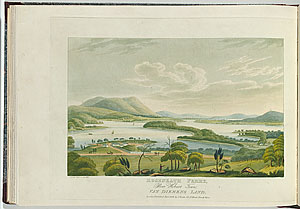
Lycett in  colour

The image below, also by Joseph Lycett, is another hand coloured etching, this time from the viewpoint of the eastern shore.  The title is View of Roseneath Ferry, taken from the Eastside, Van Diemen’s Land and it was produced in 1825 (when he was already living in England).  One of the edition of this etching is in the collection of the National Gallery of Australia in Canberra.

Lycett View of Roseneath Ferry from the eastern shore 1825

The image below is Distant View of Hobart Town, Van Diemen’s Land, from Blufhead Plate 28 from Views of Australia or New South Wales& Van Diemen’s Land,  published by John Souter, London, 1824-25. This handcoloured aquatint and etching is held in the Joseph Brown Collection of the National Gallery of Victoria, Melbourne.
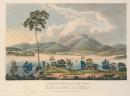
Lycett Distant view of Hobart Town VDL NGV

Examples of George Evans’s art

The image below comes from http://www.abc.net.au/news/2014-08-22/1819-slnsw-south-west-view-of-hobart-town-1819-george-william-e/5689410 It is titled South West view of Hobart Town and dated 1819
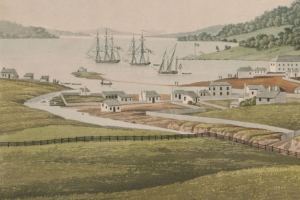
Evans Hobart

The image below comes from http://www.acmssearch.sl.nsw.gov.au/s/search.html?collection=slnsw&meta_e=350

George Evans Hobart Town 1828

Hobart Town, Vandiemen’s Land. 1828 At lower left is printed “G. W. Evans. Pinxt.”; at lower right “R.G. Reeves. Sculpt”; underneath title “Published 1828, by R. Ackermann, 96 Strand, London” he image is from the collections of the State Library of NSW.

Examples of James Raylor’s art

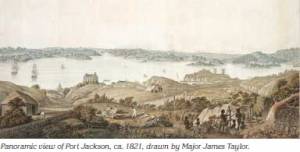
I could find no image by James Taylor that was related to Van Diemen’s Land. I only found two New South Wales images.The image below is from http://www.afloat.com.au/afloat-magazine/2010/july-2010/Lachlan_Macquarie#.VHAuwPmUdqU and titled Panoramic view of Port Jackson c.1821
James Taylor Panoramic-view-of-Port-Jackson-c1821

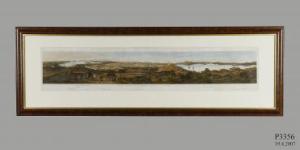
The image below, from http://www.powerhousemuseum.com/collection/database/?irn=326892 is an aquatint of Port Jackson and Sydney dated 1824.
Aquatint of Port Jackson 1824 by Major James Taylor

This panorama of Port Jackson and of the town of Sydney was taken from a hill near the Parramatta River, was produced with ink on paper by Major James Taylor, Sydney, New South Wales, Australia, 1820, then engraved by Rittner et Goulpil, Sydney / Paris in 1824. The Powerhouse Museum (Sydney) provided the following information:

‘Statement of significance

In 1820 Major James Taylor created a series of watercolours on paper which, when joined together, formed a panorama of Sydney. When he returned to England in 1822 (did Taylor and Lycett travel on the same ship? – more research required) Taylor arranged for the engraving and printing of a three sheet panorama based on his watercolours. Known as ‘Major Taylor’s Panorama’, this is one of the most informative depictions of Sydney in its early years. Taylor, a topographical draughtsman attached to the 48th Regiment, arrived in 1817 when Sydney was thriving and Governor Macquarie was trying to turn an ‘infantile’ penal colony into a ‘civilised’ society. Taylor’s pictures were intended to be a record of that change. The view, taken from Observatory Hill, encompasses Sydney Harbour from the Heads to Lavender Bay, showing many of the major buildings of the day.
Convicts can be seen cutting the sandstone which provided building material for Sydney’s expansion. The many fences indicate gardens and a respect for private property. The harbour is filled with trade and military ships. Government House and its stables can be seen set in Governor Macquarie’s private park called the Demesne. Much of this park still survives as the Botanic Gardens and the Domain. This area contrasts markedly with the small cottages in the middle ground which were typical of many in The Rocks. They were often occupied by convicts and their families who were encouraged to develop ‘respectable’ habits like gardening in their spare time.
A prominent building is the Military Hospital, built in 1815, where patients can be seen dressed in long coats. On the horizon are the impressive buildings of Macquarie St, including St James Church, the Hyde Park Barracks and the General Hospital. To the right of the Military Windmill is Cockle Bay, later called Darling Harbour. The land beyond is the Ultimo estate owned by the surgeon John Harris. To the far right are the windmills that gave rise to the name Millers Point.
Topographical artists often included indigenous people in their work. These images were intended to educate European viewers about the appearance and customs of the ‘natives’, but such depictions were informed by symbolism and ideology rather than a representation of reality. In Taylor’s panorama Aborigines stand amid uncultivated bush, in contrast to Europeans who are clearing and grazing the land. When the British took possession of New South Wales they argued that, as the Aborigines did not ‘work’ the land, they did not own it. This supported the notion of ‘terra nullius’ or nobody’s land. Taylor’s representation is a graphic rendering of that argument.

Production notes

The engraving is based on watercolours by Major James Taylor. Taylor was a topographical draughtsman attached to the 48th Regiment. He arrived in Sydney on the convict transport Matilda on 9 August 1817. He accompanied the Macquarie’s on their tour of Tasmania in May and June 1821 and some of the Tasmanian views in Joseph Lycett’s Views are probably based on Taylor’s drawings. Taylor received some training in draughtsmanship as part of his military studies and like other military and naval officers, was interested in his surroundings and recorded them in watercolours. Little of Taylor’s work survives, notably the originals of this view of Sydney Harbour. This image is held in the Powerhouse Museum collection.’
My conclusion

Lycett’s style is quite different from each of Evans and Taylor so it is difficult to attribute the work of one or the other as being the ‘aid’ to Lycett’s Tasmanian etchings.

There are three possibilities.

  • Lycett took the shape of the landscape around Roseneath from Taylor’s drawings. I am guessing that since Taylor accompanied Governor Macquarie to Van Diemen’s Land in 1821, he probably went to Roseneath with the Governor on the day that Macquarie named Roseneath. It is conceivable Taylor rushed up a few sketches and it is these that either Taylor showed or gave Lycett, or Taylor gave to the Governor who showed or gave them to Lycett. Perhaps the three of them met in London on arrival in 1822?
  • Lycett had access in Sydney to Evans maps of the land, and using their flat two dimensional nature, he fabricated a three dimensional landscape. If indeed he worked in this way, then the odd shapes of some topographical features of the landscape in Lycett’s pictures from and towards Roseneath can be explained.
  • Lycett had access to both Taylor and Evans work and amalgamated them to create a fictional but partly realistic depiction of Tasmanian sites. Lycett’s history is one of creativity, so sticking to the facts of the situation wouldn’t necessarily be important.

Incidental extra

In conclusion, there is one connection between the current Hobart and the Derwent River and the early 19th century Joseph Lycett – which could never have been foreseen.  I discovered that Lycett was on the list of prisoners that sailed to Newcastle on 8 July 1815: the name of the ship was the Lady Nelson. Pride of place on the today’s wharf at Hobart is a training sailing replica, the original having been stripped, burnt and sunk in 1825.

Aboriginal and European cultures clash at Risdon Cove

1804 was a memorable year for Van Diemen’s Land (later to be renamed Tasmania). Historical records show that in May 1804 a significant and deadly clash occurred between the European new settlers and the peoples of the local Moomairremener aboriginal tribes.

I have been trying to picture the circumstances which might have caused fighting to break out.

Starting with the European settlers

From January 1804 onwards, Bowen sailed to Sydney from Risdon Cove and back again before making a final departure from Van Diemen’s Land in August. It is not clear how many people remained at Risdon Cove while he was away. During the months from February to May, the two officers were confused in relation to who was in charge. It wasn’t until 8 May 1804 that Bowen officially handed control over to Collins.

Another problem is that personality conflicts existed between Bowen’s free settlers, and that there were difficulties working with the few members of the military which accompanied this initial settlement. The contributing factors to the uneasiness between people are easy enough to guess: an environment that is physically unusual and unknown to the new settlers, unpredictable weather conditions, inadequate food and water, no services or shelter buildings available and everything needing to be built, the hard labour required to eat and live each day, the fact that half the number were convicts and not free to do as they please, the fact the other half had to manage and feed those convicts.  In a small community of 49 people, should one person not like another, there would be no escape, and it is easy to imagine in these harsh pioneering days irritability could burst. Even minor civic scuffles would be unsettling for such a community.

In relation to the Moomairremener indigenous peoples

Their land entitlements and living practices had been established for thousands of years. Therefore, the incursion of the European strangers would have started as a puzzling surprise and then proceeded to become a despairing resentment as their land was taken over and their food sources mismanaged. The food stores brought by Bowen’s and Collins’ ships were often unusable leading the new settlers to kill kangaroo and other game for survival. Their means for obtaining such additional food supplies included using firearms. Not only were these weapons unfamiliar to the Moomairremener peoples, they were stronger and more efficiently deadly than the weapons which the aboriginal tribes owned. Without a common language nor shared cultural beliefs, the failure of the aboriginal and Europeans to communicate clearly with each other, set a path towards localised warfare.

According to Wikipedia, on the 3rd May 1804 “a large group of Abo­rigines blundered into the British settlement. The sol­diers mistakenly thought they were under attack and killed some of the intruders. About 300 aboriginals, men, women and children who had banded together, approached the Risdon Cove settlement whilst occupied on a kangaroo hunt during a seasonal migration. The Aborigines had arrived at the settlement and some were justifiably upset by the presence of the colonists. There had been no widespread aggression, but if their displeasure spread and escalated, Lieutenant Moore, the commanding officer at the time, and his dozen or so soldiers, could not be expected to be able to protect the settlement from a mob of such size. The soldiers were therefore ordered to fire a carronade (a small cannon used for firing salutes at the settlement) in an attempt to disperse the aboriginals; it is not known if this was a blank round, although some allege grape shot was used to explain an alleged but uncorroborated high figure of deaths.

In addition, two soldiers fired muskets in protection of a Risdon Cove settler being beaten on his farm by aboriginals carrying waddies (clubs). These soldiers killed one aboriginal outright, and mortally wounded another, who was later found dead in a valley. Lieutenant Moore’s account lists three killed and some wounded. It is therefore known that in the conflict, some aboriginals were killed, and that the colonists ‘had reason to suppose more were wounded, as one was seen to be taken away bleeding’. ‘There were a great many of the Natives slaughtered and wounded’ according to the Edward White, an Irish convict who later spoke before a committee of inquiry nearly 30 years later in 1830, but could not give exact figures. White alleged to have been an eyewitness, although he was working in a creek bed where the escarpment prevented him from viewing events, claiming to be the first to see the approaching aboriginals, and also said that ‘the natives did not threaten me; I was not afraid of them; (they) did not attack the soldiers; they would not have molested them; they had no spears with them; only waddies’, though that they had no spears with them is questionable, and his claims need to be assessed with caution. His contemporaries had believed the approach to be a potential attack by a group of aboriginals that greatly outnumbered the colonists in the area, and spoke of ‘an attack the natives made’, their ‘hostile appearance’, and ‘that their design was to attack us’.” Neither  Bowen or Collins were present at the time of this attack.

Ahhh. The sadness caused by misunderstandings, ignorance, fear and lack of leadership!

Another informative site is http://members.iinet.net.au/~rwatson1/bowen/risdon_cove.htm which includes  20th and 21st century history of Risdon Cove.

The five suburbs to be walked through in Stage 5 of my walk along the Derwent River

From Rosny Point to Geilston Bay, I will walk as close to the edge of the Derwent River as possible.

In so doing I will pass through five suburbs: Rosny, Montagu Bay, Rose Bay, Lindisfarne and Geilston Bay. Most were settled early in the existence of Hobart Town. In 1793, Lieutenant Hayes sailed up the River naming it and many points of interest. It was only a decade later the first settlement was made and in 1804 the final site for Hobart was established on the western shore opposite Bellerive and Rosny. Possibly Geilston Bay was named in the 1810s, Rosny in the 1820s, Montagu Bay in the late 1820s. Lindisfarne was named a century after the first settlement in 1903.

Rosny

The starting point for the 5th Stage of my walk along the eastern shore of the Derwent River will be Rosny Point. The suburb of Rosny, within the City of Clarence, is located on a narrow peninsula which juts out from the eastern shore at Rosny Point and climbs the rising slopes of Rosny Hill to the public Rosny Point Lookout.

According to one of my favourite information sources Wikipedia, Rosny was named by Walter Angus Bethune, the holder of the original grant of land on Rosny Point, after his ancestor the Duc de Maximilien de Bethune Sully of Rosny-sur-Seine  (a town situated slightly north west of Paris in France).  Bethune, a Scottish merchant, first arrived in Van Diemen’s Land in 1820 and was a significant player in the early development of Hobart and sheep farming. His descendants have played important roles in Tasmanian history.

Jean-Baptiste-Camille_Corot_-_Château_de_Rosny

Chateau de Rosny was painted by French artist Jean-Baptiste Camille Corot in 1840

Montagu Bay

This suburb was named after ‘mad’ judge Algernon Montagu, who in the early 19th century lived in Hobart Town before purchasing a property ‘Rosny’ in the Montagu Bay area of the eastern shore of the Derwent River. This small suburb sits on the river edge next to Rosny Point/Rosny and contains the Clarence Aquatic Centre and Montagu Bay Primary School. The Tasman Highway travels over a northern corner section of this suburb, leading to the Tasman Bridge which links the eastern Shore to Hobart and beyond on the western shore.

Rose Bay

The suburb of Rose Bay sits on the river edge next to Montagu Bay.

Rose Bay High School has a permanent camera facing across the Tasman Bridge over the Derwent River towards the centre of Hobart and with the back drop of Mount Wellington. Normally the site operates 24 hours of the day and night. The site is located at http://ozforecast.com.au/cgi-bin/weatherstation.cgi?station=11233&animate=6. Currently the site is being rebuilt, however I recommend you follow the progress and when re-established, save the site as a Favourite. Then you can see what the weather is like over Hobart and how gorgeous it can be to look at regardless of the weather in daylight and with the city lights sparkling at night.

Lindisfarne

While the exact origins of naming our Lindisfarne suburb remain unclear, the main thought is that from 1892 the suburb was known as Beltana. Then it was renamed Lindisfarne in 1903 after Lindisfarne a tidal Island (Holy Island) in Northumberland, a region in the far north east of England. The easternmost part of the middle of the suburb, where the Beltana Bowls Club and the Beltana Hotel are located, is still locally known as Beltana.

It has been suggested this suburb took its name from Lindisferne House, a property built in the 1820s near the suburb of Rosny. From the Clarence City Council website at http://www.ccc.tas.gov.au/page.aspx?u=1601 “Lindisfarne is thought to have been named by Hezekiah Harrison, a free settler, who was granted land in the area in 1823. Harrison had lived just a few miles from Lindisfarne Island, on the Northumbrian coast. Known as the ‘Holy Island’, Lindisfarne was the base from which St Aidan worked to spread the Christian faith through the north of England in the eighth century AD. However, it is unclear whether the area was named by Harrison or the next owner, Thomas George Gregson, a prominent free settler who purchased much of the land between Risdon and Rosny. Gregson grew up in Lowlynn, very close to Lindisfarne Island in England.”

Geilston Bay

Apparently the inlet of Geilston Bay was named after Colonel Andrew Geils who was appointed Commander of the settlement of Hobart in 1812. Colonel Geils lived on a property in Geilston Bay which he called ‘Geilston Park’.

Kangaroo Bluff Historic Reserve and Bellerive Fort

Near the end of my Stage 4 walk from Tranmere to Bellerive Bluff along the Derwent River, I saw a sign pointing to the Kangaroo Bluff Historic Reserve which I chose not to visit. However, my curiosity was aroused. So the next day, last Saturday, I made a special trip and walked to the Reserve to find out more.

20140927_091124

As I walked toward the entrance, I was puzzled. I could see a narrow road passing between two raised hills. On closer inspection when I discovered a massive deep and long ditch from the left to the right outside the stone edged wall of earth, clearly this site was the remains of a fortification.

20140927_091051

The site was a battery complex with underground tunnels and chambers for magazines, stores, the lamp room, a well and loading galleries. The public do not have access to the underground since these parts were bricked up in the 1920s: I would have been very interested to see the speaking tubes set into the walls used for communication purposes.

However there are many metres of well-preserved channels which can be walked in and around.

20140927_090522

20140927_090924

Signage provided useful information. I now understand that the idea of a protective Fort was first discussed in the 1830s as a means to protect the merchant ships travelling up the Derwent River, although I am unclear who might have attacked from the sea because Van Diemen’s Land (now named Tasmania) was very isolated from the rest of New Holland (now named Australia). However, it was not until difficulties were being felt between England and Russia in the 1870s that a renewed push for a Fort was made.

20140927_085957

By 1885 the defensive Fort was built – although I cannot imagine why anyone would think that Russia would believe it useful to send a war ship to the tiny colonial and penal colony in Hobart. It does not surprise me that the two canons were never used as war weapon.

20140927_090533