Tag Archives: Greater Hobart Area

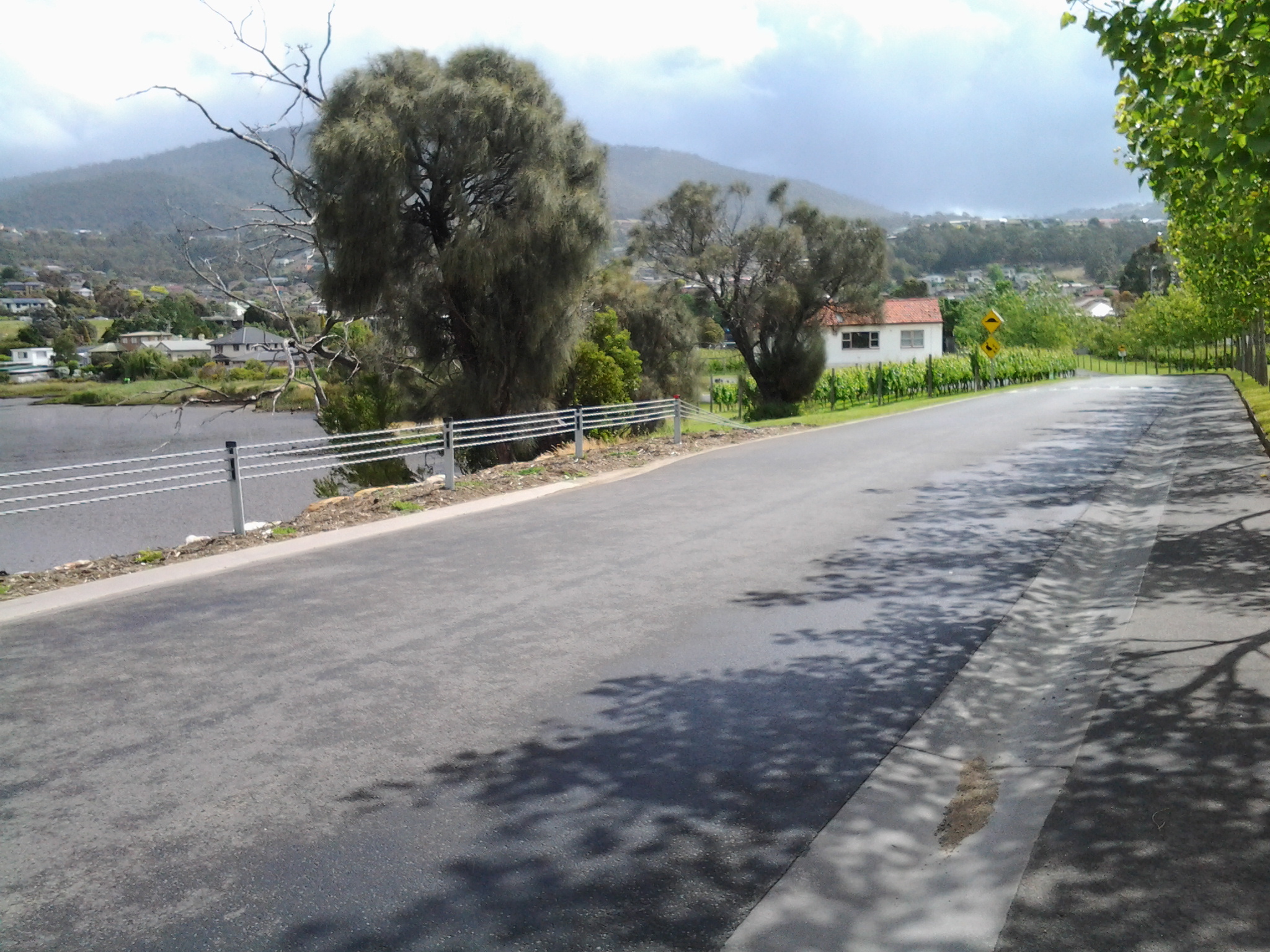
Claremont beside the Derwent River

I have wondered why there has been so much interest from USA readers for my posting about the Claremont Bowling Club.  The Club is an ordinary lawn bowling club the like of which is found in every town and city across Australia.  My blog site statistics do not indicate which part of the USA my readers come from, so more research was required.

The name Claremont derives from the French for clear mountain, and was introduced into England by refugee French Hugenots in the early 18th century.  The concept of clear mountain works here in Hobart because our town of Claremont sits comfortably at the feet of Mount Wellington.

There a city named Claremont in Sullivan County, New Hampshire, USA. It was named after Claremont, also known historically as ‘Clermont’, an 18th-century Palladian mansion of Thomas Pelham-Holles, Earl of Clare less than a mile south of the centre of Esher in Surrey, England.  This New Hampshire city is located between the Ascutney State Park and the Hawks Mountain area to the west and Mount Sunapee to the east.  Presumably offering clear mountains.

In addition, Wikipedia informs me that “Claremont is a college town on the eastern border of Los Angeles County, California, United States. Claremont is known for its many educational institutions, its tree-lined streets, and its historic buildings. In July 2007, it was rated by CNN/Money magazine as the fifth best place to live in the United States. Due to its large number of trees and residents with doctoral degrees, it is sometimes referred to as “The City of Trees and PhDs.”

Our Claremont in the City of Glenorchy within the Greater Hobart Area is very different than the Californian town with the same name.

In America, the Gold Rush of 1849 opened up California so I suspect the name Claremont was probably given by someone remembering their English heritage when the town was created in the 1880s, or by someone who had travelled west from the New Hampshire town of the same name.  I understand that the peaks of Mount Baldy, Mount San Antonio, Timber Mountain and others in the distance overlook the Californian city.

So now I have either or both California readers on the west coast of USA and New Hampshire readers on the east coast of the USA.  Will the real reader/s stand up!

Moorilla Estate on the edge of the Derwent River, and Claudio Alcorso’s legacy

Two weeks have passed and I am yet to plod along a new stage of my walk along the Derwent. Unfortunately a number of commitments and inclement weather have kept me off the path but for the followers and other readers of this blog, I hope to be walking later this week or early next week and lodging new stories onto the blog.

History

Meanwhile a little history of the fabulous location at Berriedale where my last walking stage finished and the next stage starts needs to be provided.

20141125_155820

Moorilla is an estate producing wonderful wines from the vineyards that sit around MONA (Museum of New and Old Art) in the northern suburbs of the Greater Hobart Area.  Details about these good drops can be found at http://www.moorilla.com.au/. In addition, the world famous Moo Brew Brewery operates from the site.  Read more at http://www.mona.net.au/mona/moobrew

Claudio Alcorso

The estate and vineyard was originally established by entrepreneur and Italian textile merchant Claudio Alcorso in 1947. Read more at http://www.moorilla.com.au/winemaking/history/. Claudio Alcorso was well known for setting up Silk and Textile Printers Ltd. at Derwent Park, a suburb in the City of Glenorchy in the Greater Hobart Area.  He was also a patron of the arts. For example, in 1947 and other years Alcorso commissioned selected Australian artists to design new fabrics and then these were printed on silk, wool and linen. The artists included William Dobell, Hal Missingham, William Constable, Russell Drysdale, James Gleeson, Francis Lymburner, Adrian Feint, Jean Bellette, Donald Friend, Margaret Preston, Justin O’Brien, J. Carrington Smith, Loudon Sainthill, Frank Hinder, Carl Plate, Margo Lewers, Douglas Annand, Alice Danciger, and Desiderus Orban.  Tasmanians may recognise that our Jack Carrington Smith was recognised in this list of celebrated Australian artists. Their designs were displayed in substantial national exhibitions and helped to create a design shift nationally and were part of a global development in the design of fabrics. Have a look at http://news.google.com/newspapers?nid=1301&dat=19470821&id=fgNVAAAAIBAJ&sjid=25MDAAAAIBAJ&pg=7284,3275402 to see some of the fabrics.

Alcorso sponsored the Alcorso-Sekers Travelling Scholarship for Sculpture with the Art Gallery of New South Wales and helped bring some of the most controversial art to Australia in the 1960s and 1970s.

You can read a transcript of a short interview with this wonderful man at http://eprints.utas.edu.au/16629/2/alcorso-transcript.pdf.  Alcorso’s autobiography The Wind You Say. An Italian in Australia – the True Story of an Inspirational Life was published by Angus & Robertson in 1993.

Handing over to David Walsh

Alcorso sold the property to David Walsh in 1995 who, in concert with the current wine maker, has continued the open-mindedness of the original owner with a search for, and presentation to the public, of new and exciting and beautiful objects and experiences.

Stacks of wonderful photographs of Moorilla and MONA can be seen at https://www.google.com.au/search?q=moorilla+images&espv=2&biw=1366&bih=643&tbm=isch&tbo=u&source=univ&sa=X&ei=XreGVP8Lg4PyBcWxgTA&ved=0CDMQ7Ak

Since MONA opened to the public a few years ago, hundreds of thousands of people from around the world have poured into Tasmania and made the pilgrimage. It offers a feast for all the senses and no-one leaves the estate unchanged.

Just remember the estate and MONA are closed to the public every Tuesday.

20141125_155805

9th Stage of walk along Derwent River completed yesterday, Tuesday 25 November

I caught two buses from my home in Bellerive on the eastern shore, via the Elizabeth St CBD Hobart and the Glenorchy City bus malls, to reach Granton on the western shore of the Derwent River in the northern suburbs of the City of Glenorchy in the Greater Hobart Area.

At 8.26am I stepped off the Metro number X1 bus at stop 47 outside the York Hotel in Granton South and, with excitement about what the day might bring, I looked around and admired the view across the River to the suburb of Bridgewater before starting the tramp south.

20141125_082854

No footpaths or walk ways had been laid for pedestrians and so vigilance was required against the traffic on the Main Road. Occasionally a few metres of concrete or bitumen were laid for a new subdivision but generally a track for smooth safe walking was not on offer.

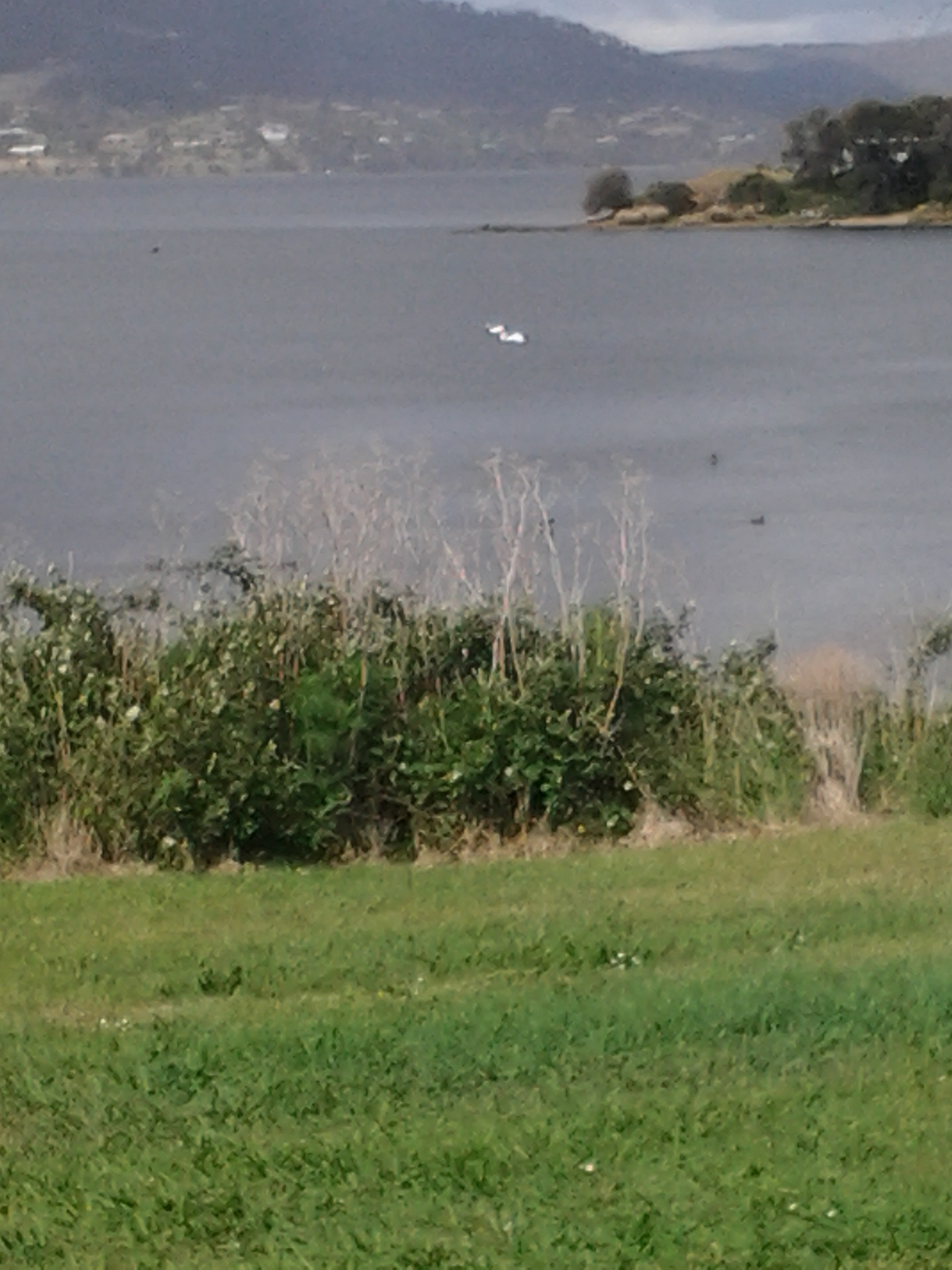
The weather started sunny but during the afternoon rain passed intermittently. In the photo below you can see the grey background blurred by rain, but meanwhile three pelicans were enjoying themselves on Lowestoft Bay.

20141125_150144

Relentless buffeting wind was the main feature all day. As a result, I couldn’t keep my sun hat attached to my head. Needless to say, I returned home with a blasted red face.  But happy from the pleasure of walking, discovery and the fresh air. Being a tourist in my home town is a revelation and a joy.

I walked southwards from Granton South to MONA (the world famous Museum of New and Old Art) at Berriedale and passed through the suburbs of Granton South, Austins Ferry, Claremont and half of Berriedale.

I experienced Goulds Lagoon, Austins Ferry Bay, Rusts Bay, Beedhams Bay, Bilton Bay, Dogshear Point, Windermere Bay, Knights Point, Windermere Beach, Connewarre Bay, McCarthy’s Point, Lowestoft Bay, and Cameron Bay. I plodded around bays and a golf course (I gained special permission to walk this private property but I would NOT recommend anyone else try it – see later postings), had a stopover at Cadbury’s, and hid from the rain in gazebos and art works. All up, I probably walked 18 kms.

Yesterday I covered 9 ¼ km of the River’s length on the western shore. This adds to my previous tally of 3/4km on the western shore making a total of 10kms covered as I trek southwards from the Bridgewater Bridge to the mouth of the Derwent on the western shore.

Specific details of the different legs of this 9th stage walk will be written up and posted in the coming days.

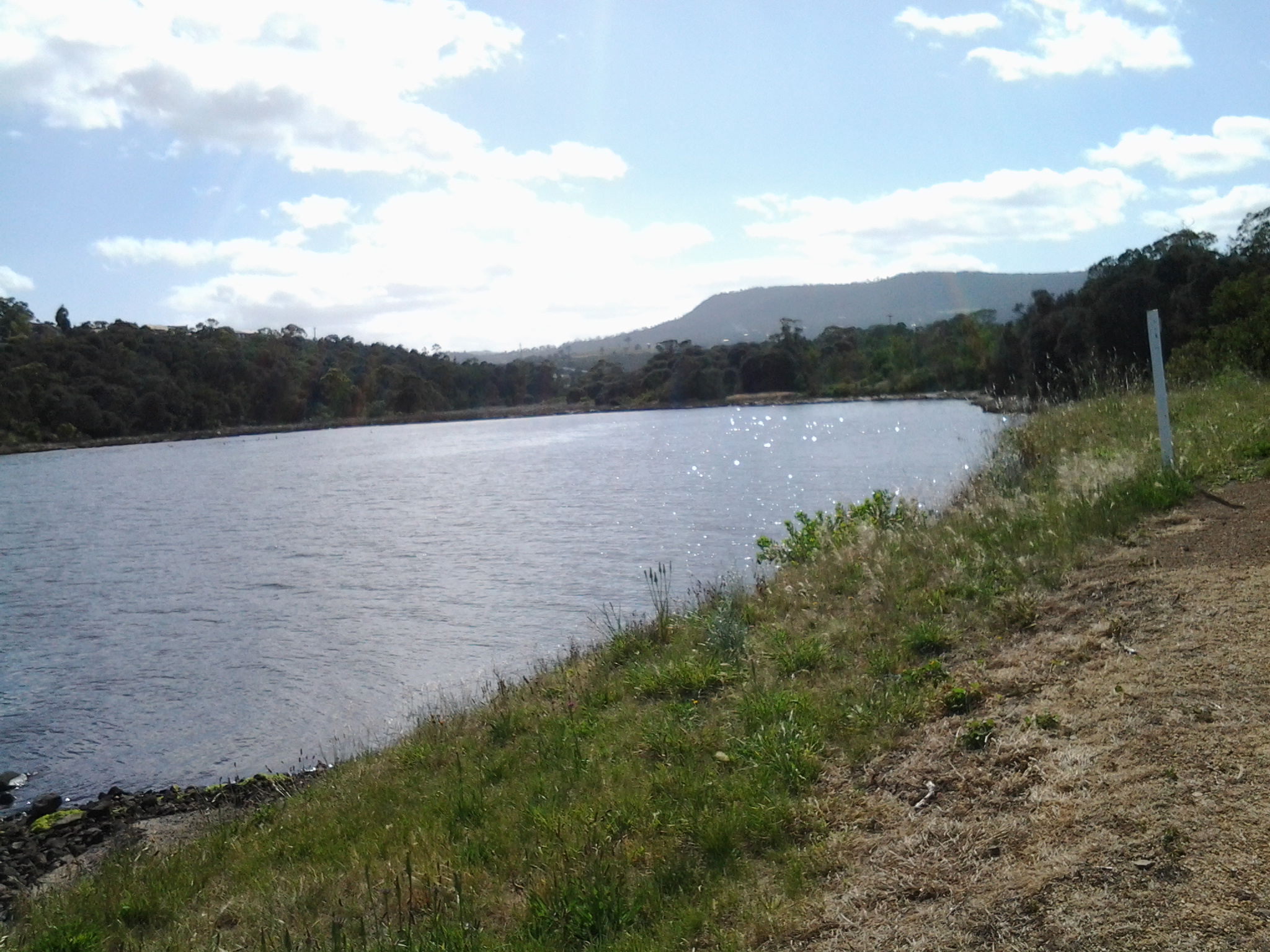
My favourite photo of the day was taken near the end of my walk, when I sat at the point where the southern end of Cameron Bay met the Derwent River (with MONA just over the hill). The water had been frothed by wind and I liked the lacy remnants floating by.  The intense colours are the result of the rich light quality caused by the heavy clouds overhead.

20141125_153054

Granton and Austins Ferry on the western shore of the Derwent River

On my 9th walk along the Derwent I will be passing through Granton South and Austins Ferry.

Granton is the northern-most suburb within the City of Glenorchy, part of the Greater Hobart Area.  I can find no records explaining how it came to be named. Granton and its Harbour in Edinburgh Scotland were not developed until the 1830s.  If the York Hotel in Tasmania’s Granton was built in 1849, possibly there may be a Scottish connection with the naming of the suburb.

Austins Ferry sits adjacent to and south of Granton within the City of Glenorchy.  Wikipedia informed me that this suburb was named after James Austin (1776-1831). Austin was transported to Australia as a convict and arrived in Tasmania in 1804. When he became a free man, the government granted him some land in this area. During the 1810s he had a profitable ferrying business across the Derwent River to the eastern shore. In 1821 the visiting Governor Lachlan Macquarie renamed the village Roseneath, but it has since reverted to its original name.’ James Austin’s original cottage is located (somewhere) in this suburb and maybe I will be fortunate enough to locate it when I walk.

According to http://profile.id.com.au/glenorchy/about?WebID=160, Granton is linked with the suburb of Austins ferry for statistical purposes. In 2011, the joint population was 3,329.  ‘Settlement of the area dates from the early 1800s. Some growth took place in the early 1900s, although significant development did not occur until the post-war years. Most of the houses were built in the late 1960s and early 1970s. Growth continued from the early 1990s, with the population doubling between 1991 and 2011, particularly in Austins Ferry, a result of large numbers of new dwellings being added to the area. Major features of the area include Goulds Lagoon Sanctuary, Poimena Reserve, Hestercombe Reserve, James Austin Park, Roseneath Park, Shoobridge Park, Weston Park and one school.’

According to http://www.homesales.com.au/location/granton-tas/, Granton has a population of 1519 with an average weekly income of $787. The median prices for houses are $375,000. The average house is rented for $610 a week. 94% of people live in houses as distinct from other types of residences. 36% of people fully own their houses/property. Almost 30% are under 30 years of age and only 10% are over 65 years of age. 92% of residents were born in Australia.  By contrast, Austins Ferry has a population of 2221 with an average weekly income of $721. The median prices for houses are $287,000. The average house is rented for $340 a week. 87% of people live in houses as distinct from other types of residences. 31% of people fully own their houses/property. 27% are under 30 years of age and 14% are over 65 years of age. 88% of residents were born in Australia.


Starting stage 8 of my walk along the Derwent River

My starting point was the jetty half way through Old Beach on the eastern shore, and to reach this from my home in Bellerive on the eastern shore of the Derwent River was not straightforward. There are no direct buses from Bellerive to Old Beach.

Instead, I left home at 6.45am (way too early for my liking but no other choice), passed three Black Cockatoos feasting on a native tree in a private home (one acted as a sentry high up while the others gorged themselves), walked to the Eastlands bus mall and caught the first bus through to the bus mall in Elizabeth St in Hobart’s CBD. At 7.17am the X1 express bus to Glenorchy in the northern suburbs of the Greater Hobart Area (and beyond) departed. This arrived at 7.35am at the Glenorchy bus mall and, anticipating public toilets would be non-existent for my walk, I walked over to the Northgate shopping centre to use their facilities. I was back at the bus mall in time to catch Metro bus 126 to Old Beach which departed at 8am. At 8.20am I stepped off the bus ready for the day.

The sky was overcast and I was wearing a thermal top over my T-shirt and topped with a fleece jacket.  Blowy. Hard air hitting my face.

Since there was no direct water access from the jetty northwards, I walked through the suburban streets staying on the hard concrete footpaths. Plovers and Blackbirds were my constant companions and extravagant blooming roses and wattles perfumed the air. It was rubbish removal day and the streets were lined with bulging large faded red wheelie bins and yellow lidded green bins. The wind had lifted many lids and these were thrown back as if saluting when on parade (a vision that friend Jo exclaimed he saw).

At 8.33am I reached the intersection with the East Derwent Highway and lost a footpath. I turned left and walked beside the highway where it was obvious a few other people had walked but there was no formal pathway. At this point I could see the water of the Derwent River but I was not close. It was clear that property owners had fenced and gated off any access to the River and I need to determine whether they had the right to do this in all cases.  I continued on the Highway noticing the signpost to the Bonorong Wildlife Park and Compton Agistment Centre marking the turn off from the highway away from the River.

Not much further along I saw a track between new houses on the left and followed it then through the grassy bushland but, as lovely as it was, it was impassable offering no easy way to the River and so I had to retrace my steps. At 8.54am I was back on the Highway walking to the left of the guard rails (so that I wasn’t directly on the Highway) on rolling gravel where a path was never intended.  Then the guard rail disappeared so I walked carefully as far off the road on the narrow verge as I could.  Sometimes I walked in the ditch. By 8.58am I was passing Compton Road and at 9.01 I reached Clarrie’s Creek. I began to disrobe as the morning and the exercise began to warm me: off came my thermal top.

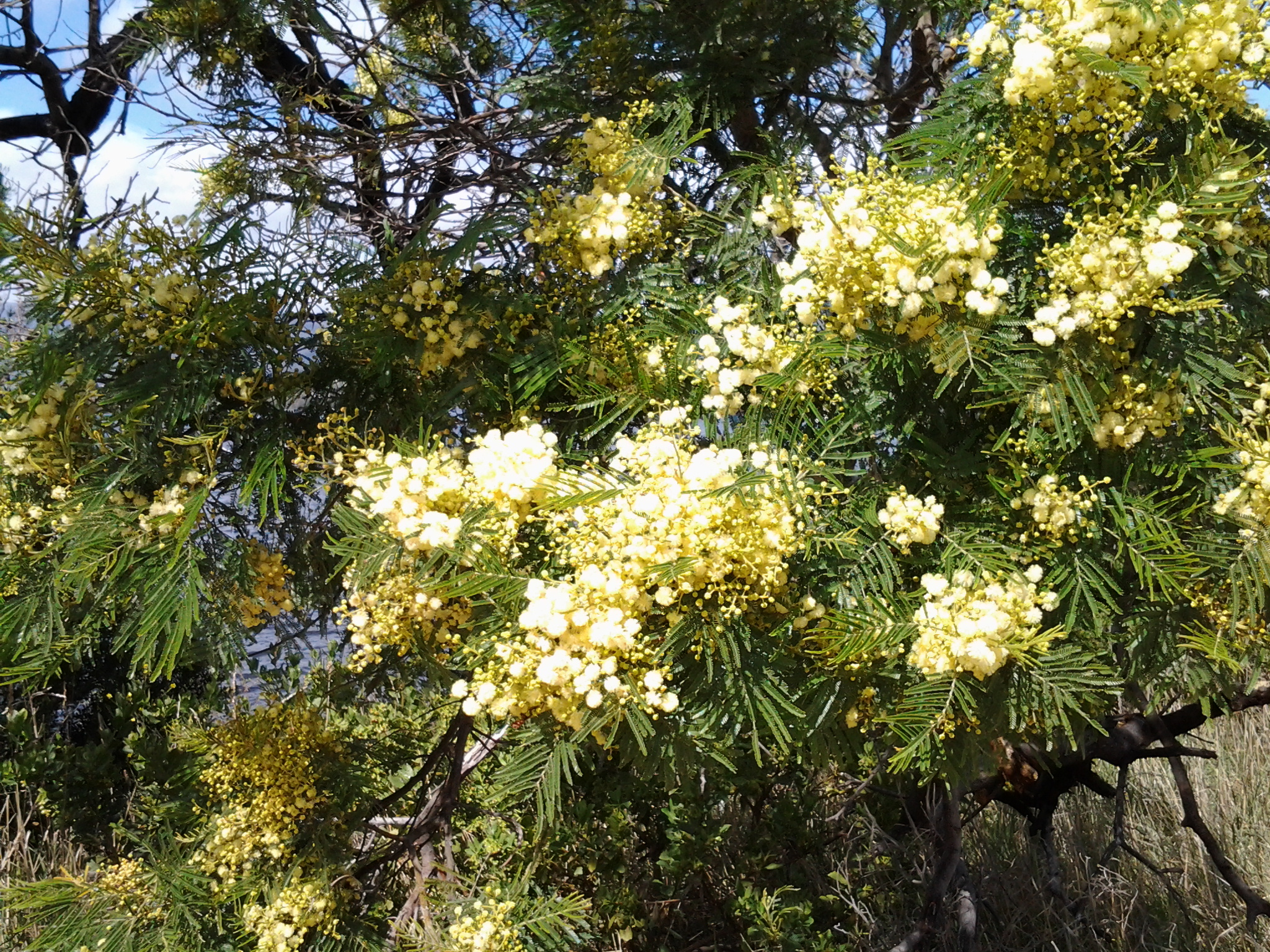
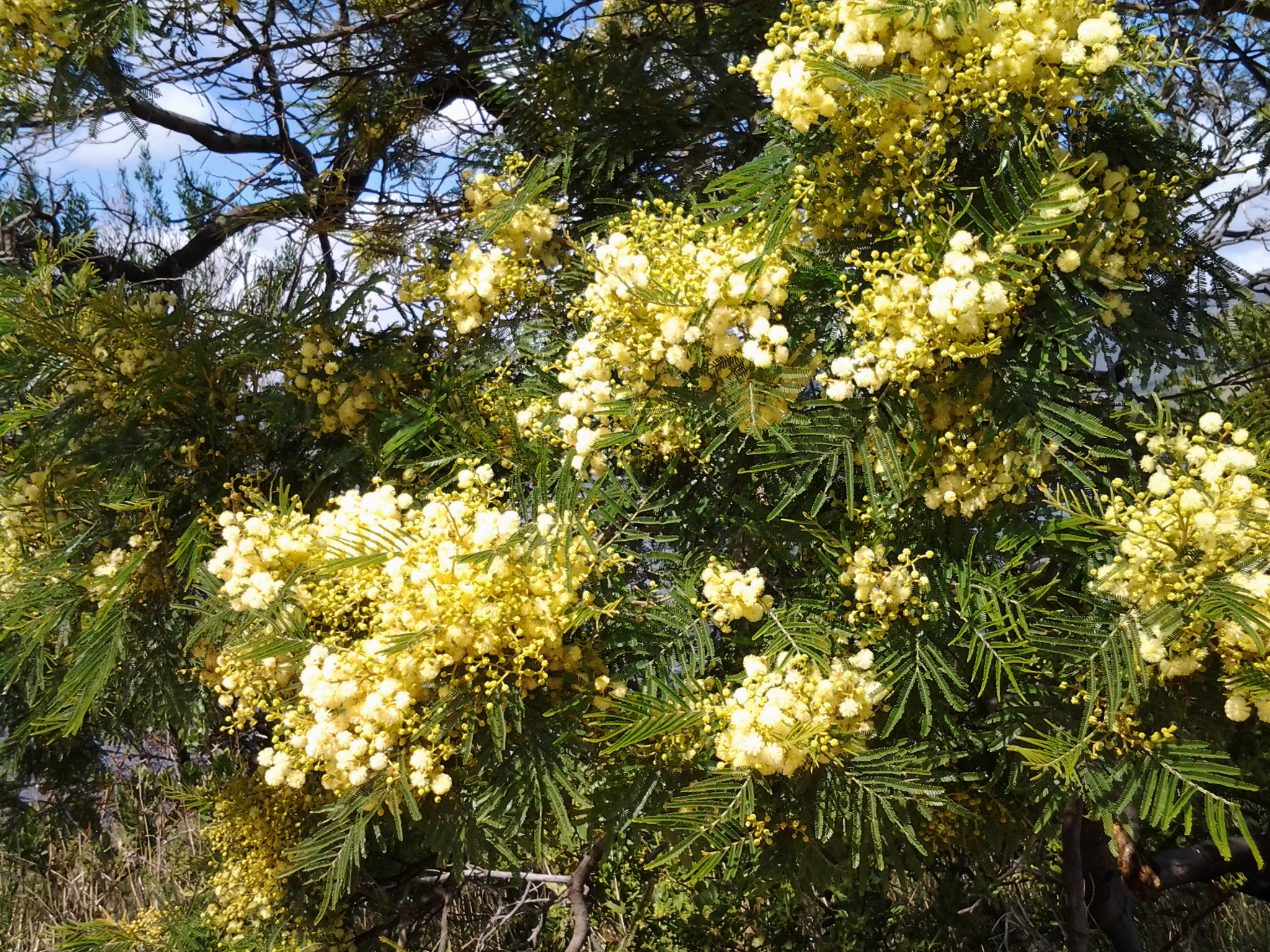
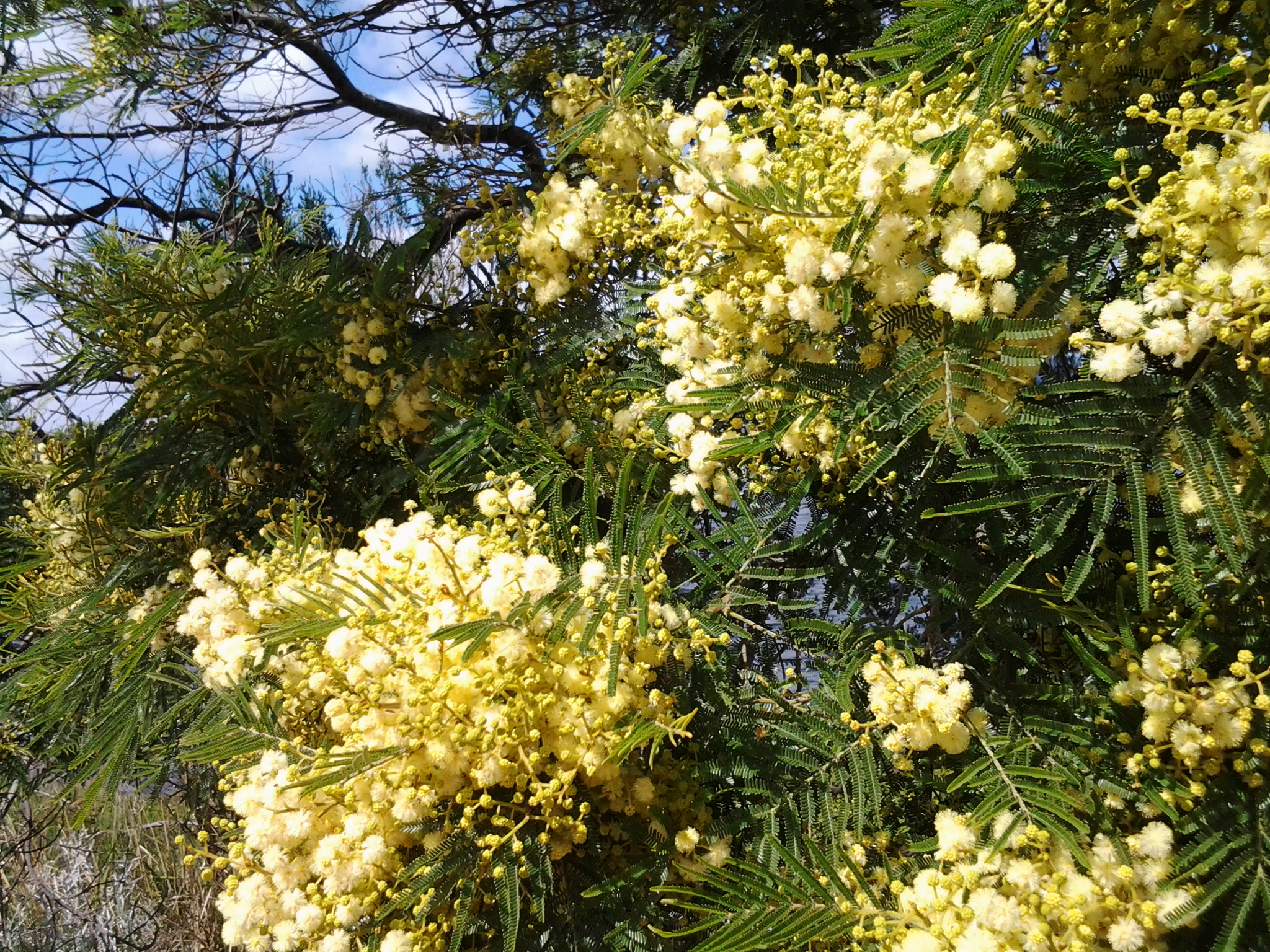
The perfume from the flowering wattle trees was invasive and pervasive in the nicest way.  Please feel free to use any of the photos below as a screen saver. I have.

20141111_103700 20141111_103704 20141111_103708 20141111_103711 20141111_103716

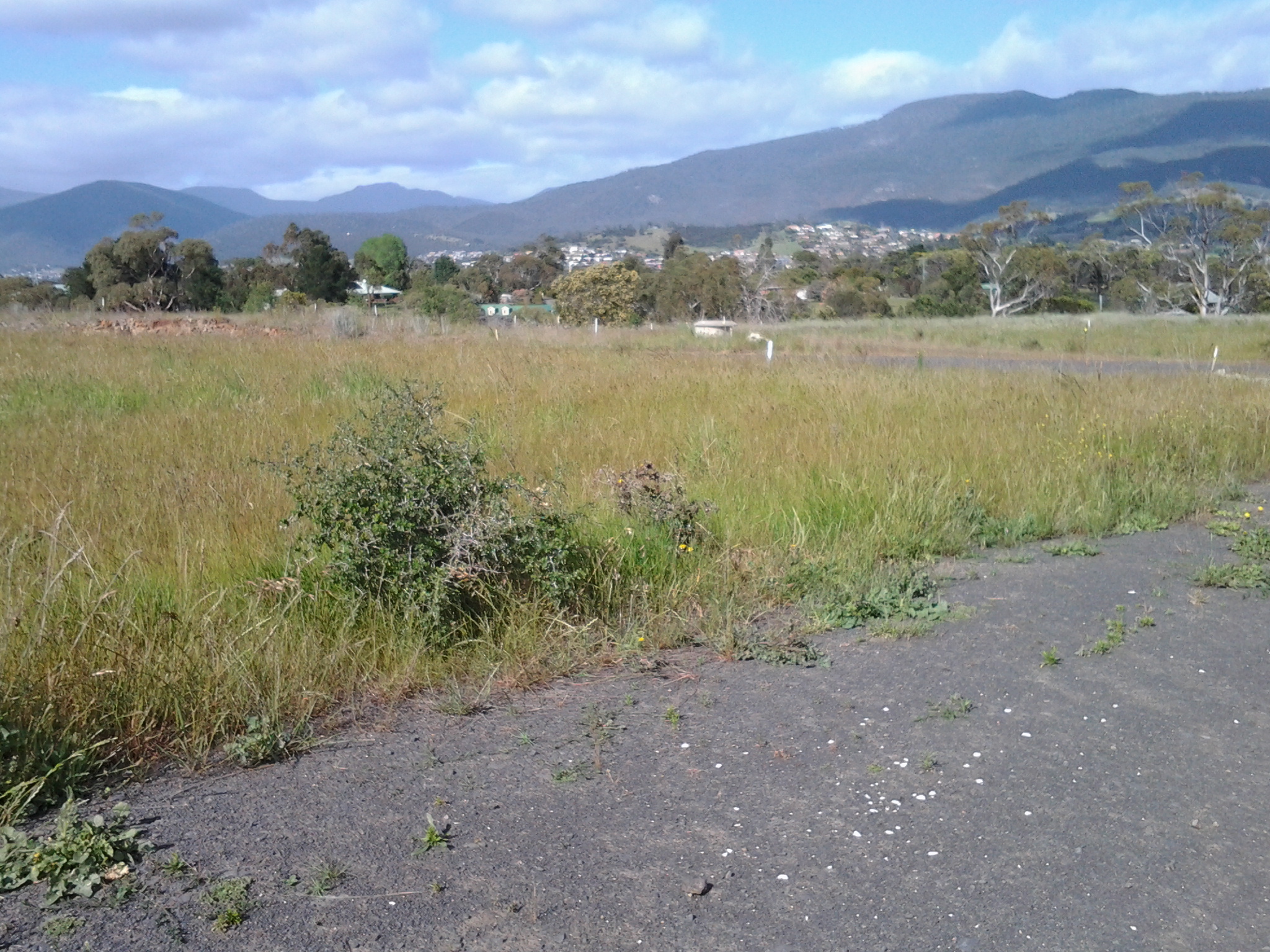
Continuing along the Highway, I walked up an incline until I could turn left on a bitumen roadway. This was blocked by a gate, but there was walking space around this, used by others. I had reached the newest part of Old Beach on its own rounded headland. Once past the gate I turned left towards the Verve Village site office signs and walked on. Through the mesh fence to my right I could see the Verve café, not open. The time was 9.10am.

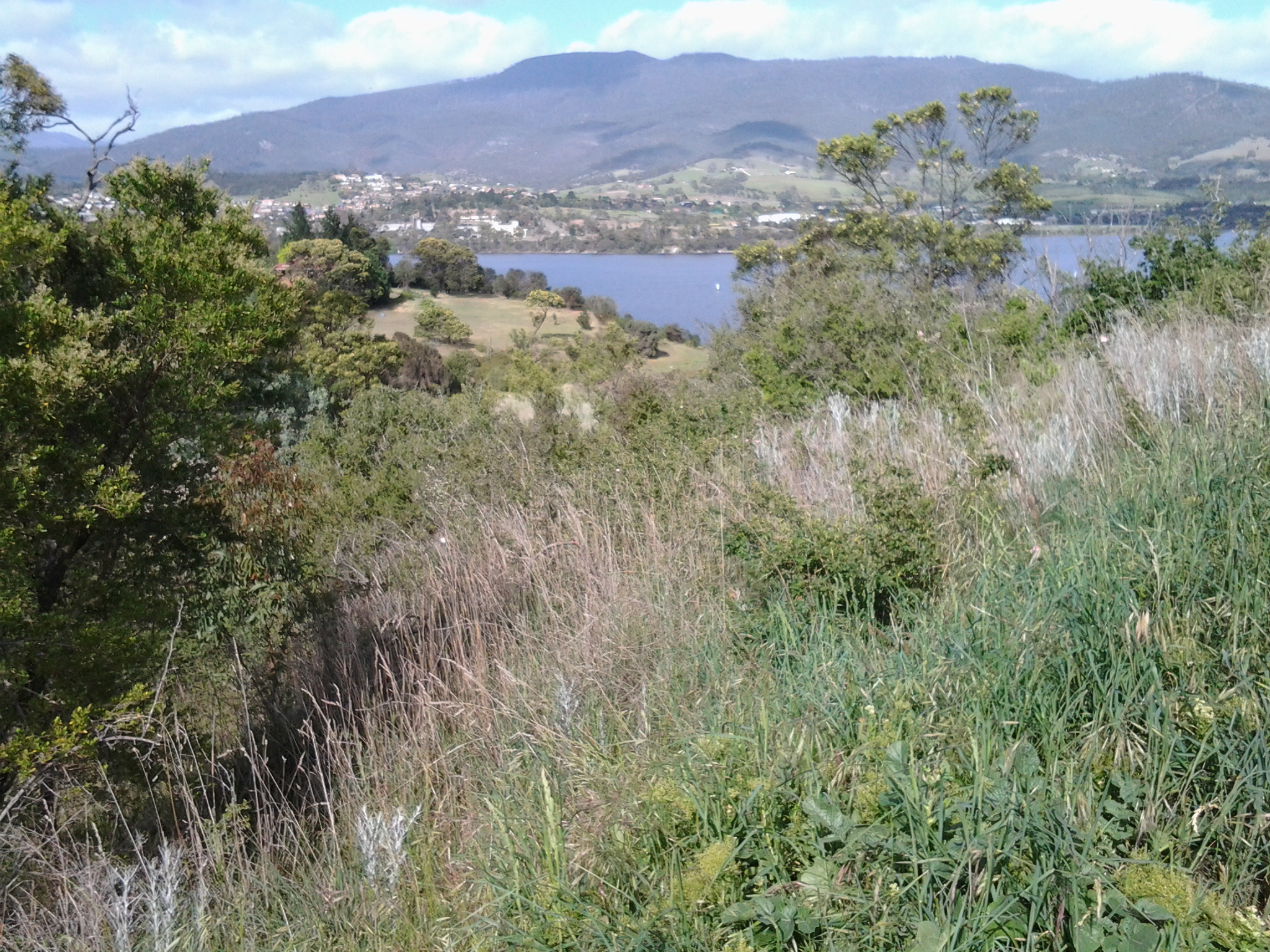
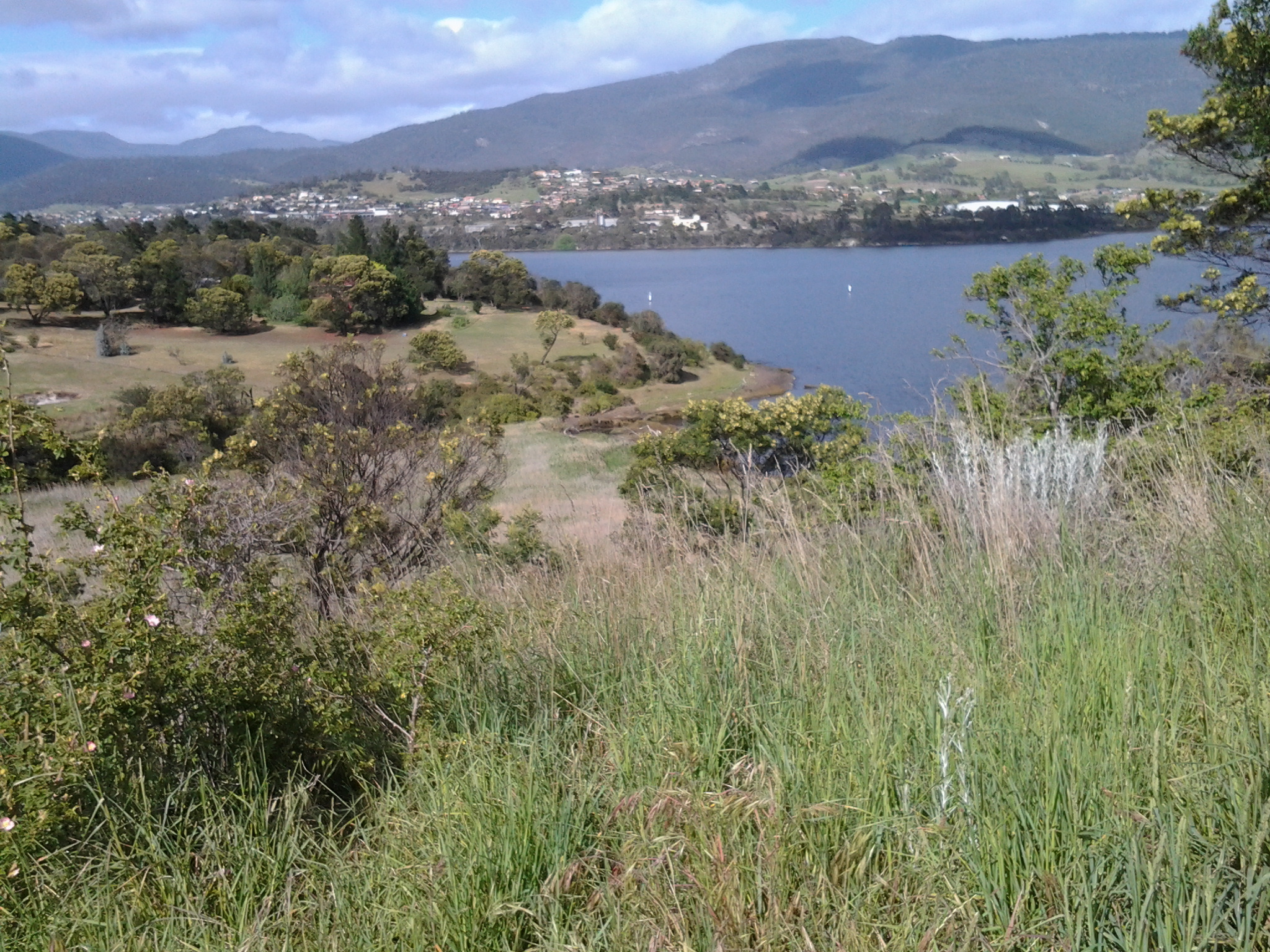
Not long afterwards I was snapping photos of the low mountains and hills across the Derwent River on the western shore. Grandly beautiful in a simple way.

20141111_091212  20141111_091128

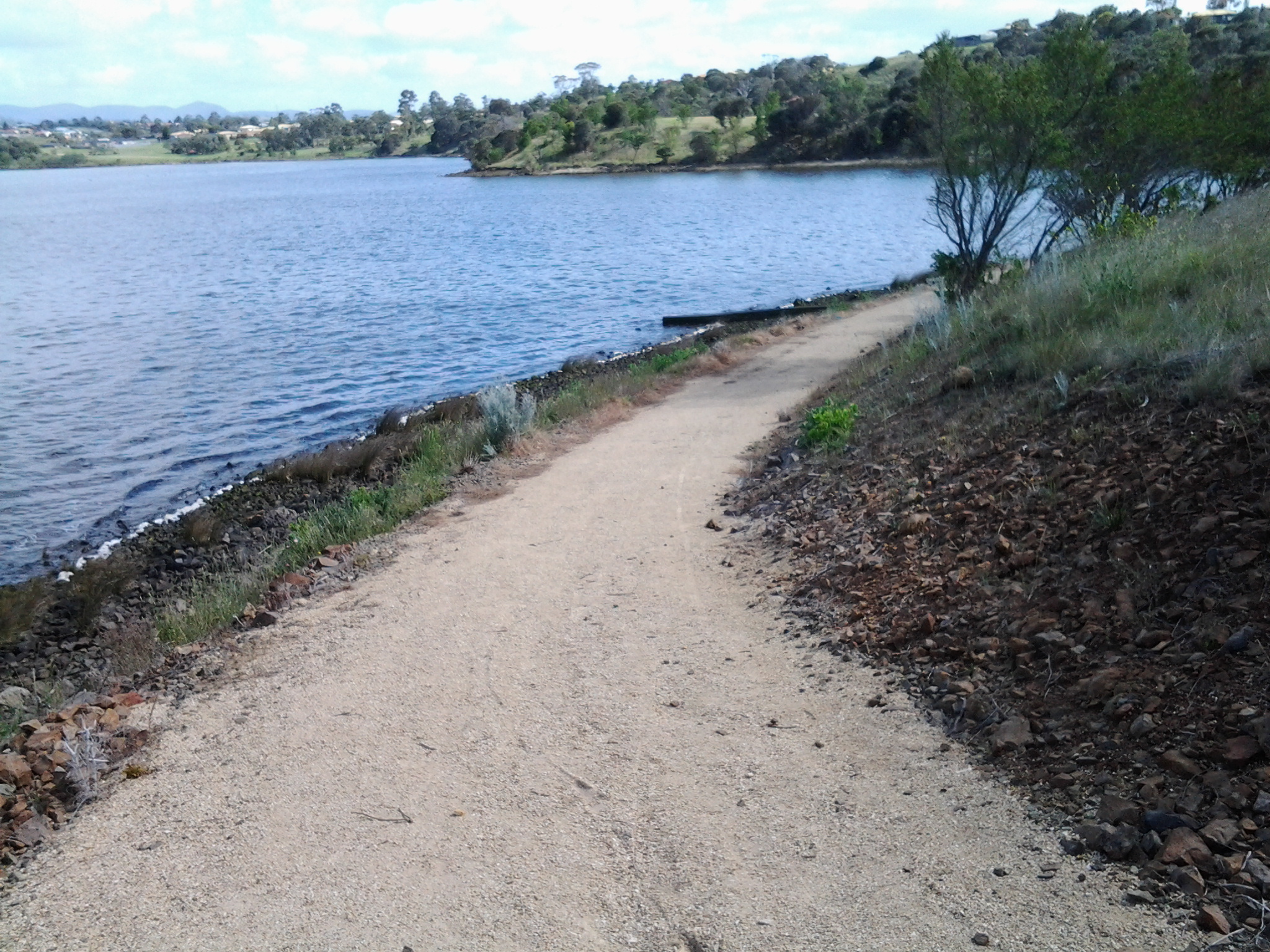
This ‘roadway’ eventually ended at a locked gate but again a regularly padded informal path was clearly visible around the obstacle.  I turned left and 100 metres along, a yellow gravel path appeared. The path had no sign but I hoped it was a foreshore trail and followed it. It was.  A trail with almost no signs of animal life except a massive black furry feral cat bounding away and a sole man out for exercise.  Crows carrhh carrhh carrhhed in the distance and overhead. Casuarina trees edged the path and through them the woodland was open and airy. Water lapped onto the shore. Mudstone rocks edged out of the soil on the banks. I enjoyed a flash of colour when I noticed yellow and orange flowering nasturtiums that had escaped from a suburban garden into the bush.

The photos below show a view southwards to the River from the first 100 metres of the path.

20141111_091838 20141111_091955  20141111_092155

The foreshore trail was easy to follow, wide and clear.

20141111_092752

At 9.36am I reached the point where the Derwent River and Gage Cove met.

20141111_093443

The trail curved into the Cove but not before a man-made construction, to the right of the path, seemed to flush deep below and then a dreadful stink followed. I tried not to think what was going on there.

20141111_093606

By 9.42am I was walking up into the suburb having enjoyed watching black swans floating around in the Cove, and a few minutes later I reached a gate which, as usual, I walked around.  I turned left and followed the road from the cul de sac amidst the noise of every neighbourhood dog barking to indicate a stranger was nearby.  Me.

At 9.45am I turned left at the T junction and by 9.48am I reached the intersection of Stanfield Drive with the East Derwent Highway.  Continuing on I could look down in Gage Cove with its coating of red algae or some other red plant.

20141111_100127

So far my morning had gone well and I was enjoying myself. Also, I was pleased that I had finished passing through all parts of the suburb of Old Beach and was ready for the next suburb.

Herdsmans Cove

On my walk northwards towards the Bridgewater Bridge, the next Brighton Municipality suburb that I will walk through as I continue along the Derwent River, will be Herdsmans Cove.  I hope I will be discovering this residential development tomorrow; the weather forecast is good.

According to http://www.yourinvestmentpropertymag.com.au/top-suburbs/tas-7030-herdsmans-cove.aspx, this northern suburb of the Greater Hobart Area has a population of 1134. The median weekly income is $675, the median age of residents is 25 years, with the median monthly house loan repayment is $879, 52% are not married and a further 20% are in a de facto relationship, 56% are not in the labour force and only 20% work full time.  Of those employed, 30% are labourers.  67% of people in Herdsmans Cove rent their accommodation. There is a sense from newspaper articles that this is a suburb suffering from a range of social problems including irregular school attendance, low educational achievement, unemployment and higher than average crime rates. Surely sitting next to the beautiful Derwent River with a stunning view of Mount Wellington in the distance and the Mount Faulkner Conservation Area across the way could be enough to lift people’s spirits.  But I guess that the superb natural features do not lift the bank accounts of local residents.

I will be most interested to see the natural features of this suburb tomorrow.

More music close to the Derwent River

One of my August blog postings extolled the magnificence of the Tasmanian Symphony Orchestra Chorus in a series of performances at MONA by the western shore of the Derwent River in the northern suburbs of the Greater Hobart Area.

Last night I travelled to another institution, the University of Tasmania, which has its lower boundary almost at Derwent River level on the western shore, south of the Hobart city centre. I was so pleased that to continue an annual visiting artist series, the Tasmanian Conservatorium of Music had joined forces with the Hobart Organ Society to bring world renowned pipe organist John O’Donnell to Hobart.

John O Donnell organist

In the University’s Stanley Burbury theatre, the only neoclassical pipe organ in Tasmania was on show for an appreciative audience. Served up was a 1 and a ¼ hour nonstop magical program: Georg Muffat Toccata Septima; Arcangelo Corelli Concerto in C minor, op. 6 no. 3, arr. Thomas Billington Largo/ Allegro/ Grave/ Vivace/ Allegro; Johann Pachelbel Wie schoen leuchtet der Morgenstern; Johann Sebastian Bach Wie schoen leuchtet der Morgenstern(BWV739); Johann Sebastian Bach Sonata no. 3 in D minor (BWV 527); Johann Sebastian Bach Fantasia sopra il Chorale Wo Gott der Herr nicht bei uns haelt (BWV1128); Johann Sebastian Bach Fantasia and Fugue in G minor (BWV542)

I have listened to pipe organs being played in various places around the world but last night’s performance exceeded all expectations. In the hands of a non-expert, the sounds from a pipe organ can sound muddily mixed and your ears can feel assaulted.  Or the playing can sound lack lustre, colourless, and dull. Or irregular pacing can make me, as a listener, believe the organist hasn’t practised well enough and isn’t able to keep to the time signature.  That he or she isn’t as familiar with the musical piece as they ought to be before they play for public entertainment and pleasure.  In those instances there is minimal or no pleasure. But last night, John O’Donnell was nimble of finger across the keyboards, agile with his hip and leg movements to control the multitude of foot pedals, and most importantly made music with his touch. This wasn’t sound it was music. Lyrical. Magical. He made the composer’s scores come alive.

Listening to such music through headphones as you walk along, or blasting from a sound system in your own home, is no substitute for hearing the sounds in an environment where the acoustics work and the nuances of the music embrace you.  The concert was intense.  Intensely rich and beautiful.

I wondered on the effects of significant rivers in the lives of the composers from last night’s concerts.

17th century composer Muffat spent 6 years in Paris near the Seine River before settling in Vienna next to the Fluviul Dunarea. Corelli lived for a time early in his life near the river Po in Italy and later when settled in Rome, he had access to the Fiume Tevere that winds its way through. Pachelbel started life in Nuremberg through which the Reglitz flows. Later he studied at Regensberg around the Fluviul Dunarea, before moving to Vienna also on the same river, then Stuttgart on the Neckar river before settling back in Nuremberg against the Reglitz river for the rest of his life. Johann Sebastian Bach moved as a teenager to Luneberg next to the Ilmenau River. During Bach’s time in Weimar he could have accessed a number of rivers which enter into or are nearby to this city. When he was in Mulhausen, the Unstrut river and a tributary were close at hand. A multitude of rivers and tributaries flow through Liepzig where Bach spent 27 years.

I don’t want to mislead any readers. The connections between composers and rivers is a geographical one and I do not believe the rivers that they lived near had direct musical relevance. But the advantage of this tiny research to me was that I was able to understand a little more of the world’s geography and the interconnectedness of so many things; history, people, musical development. As a result, the experience of my project to walk along the Derwent River is enriched.

Discovering the suburb of Old Beach – 7th stage of my walk along the Derwent River

At 12.40pm I reached the town sign for Old Beach at Cassidy’s Bay. The Bay was covered with ducks of every age.  Families of ducklings are always a pleasure to see. Seemed like a safe haven for them.  Tall grasses grew into the water but there was no beach.

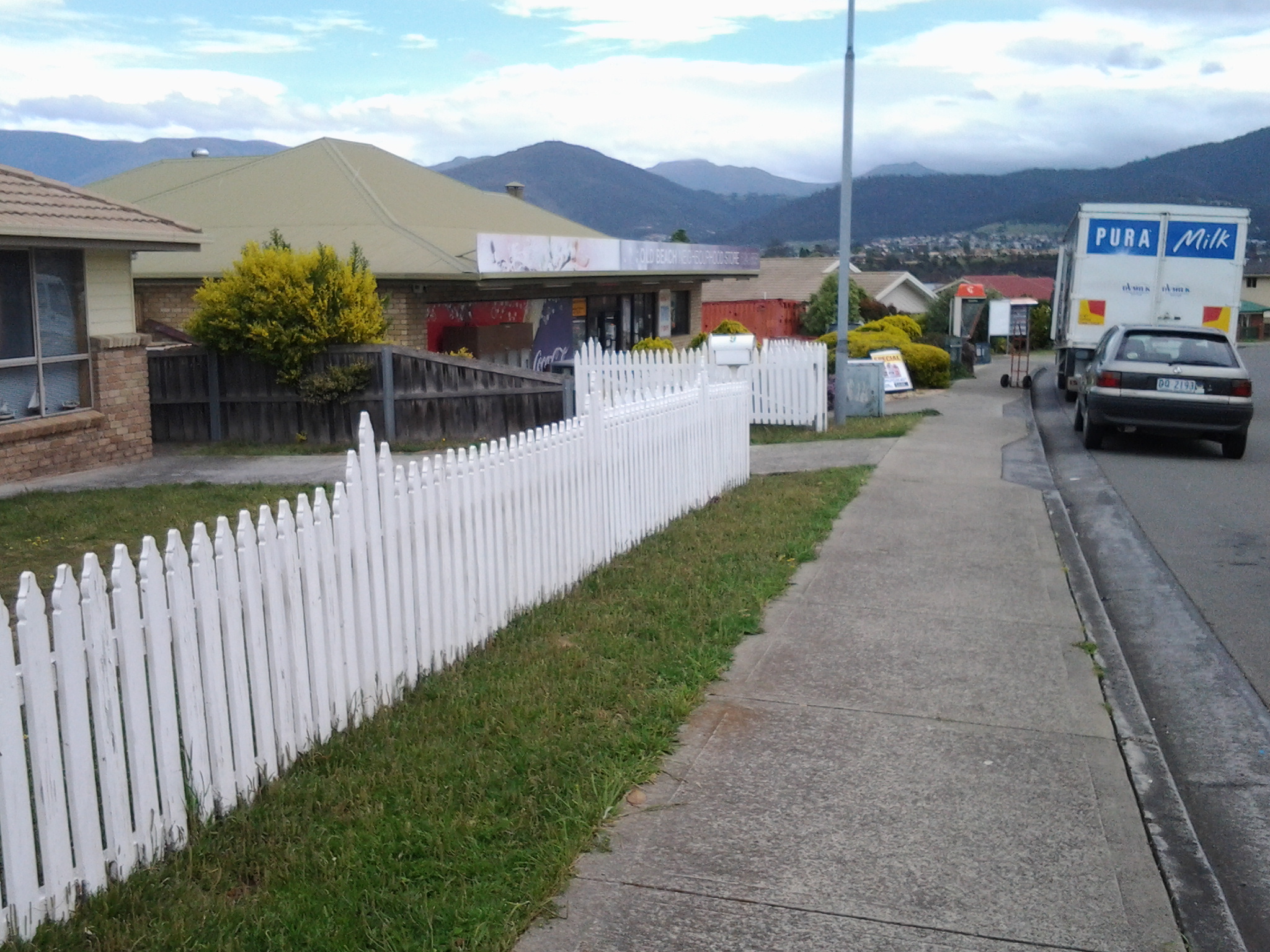
I continued walking along the highway, passed the turn off to the Baskerville raceway, and was eventually forced down into a clay sogged ditch almost until I reached the roundabout at 12.50pm.  At the roundabout, with the hilly section of Old Beach up on the right, the choice was to continue on to Bridgewater or turn left into Fouche Avenue. I turned left to the lowlands and walked through a reasonably affluent area. Back on proper footpaths. Just before 1pm I reached the Old Beach Neighbourhood Store claiming to serve hot food 7 days a week.  I didn’t enter to check.
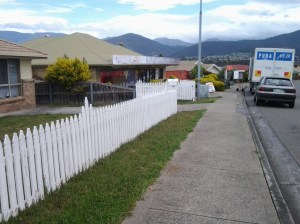
20141031_125642

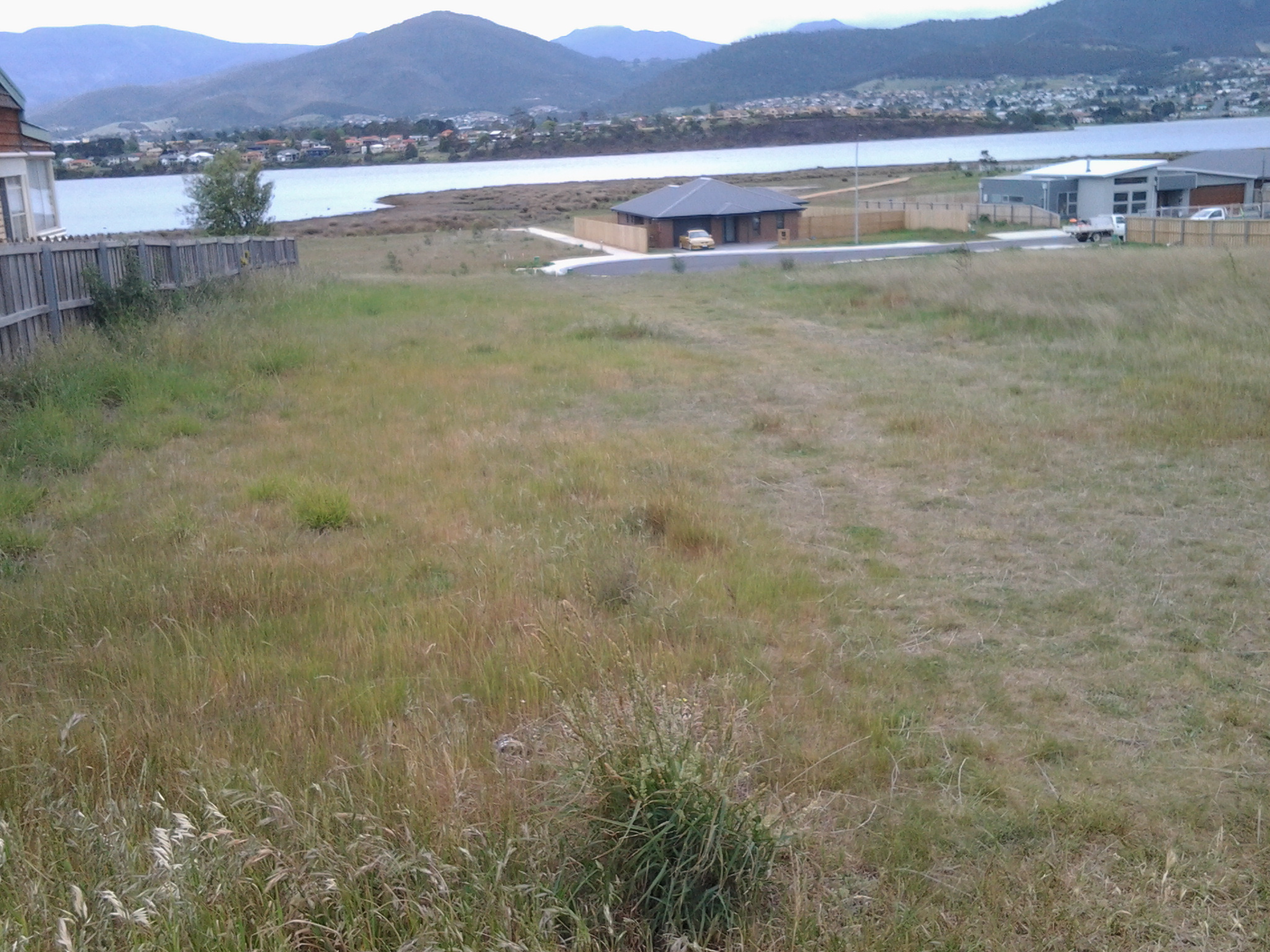
By 1.03pm, after passing a house outlandishly decorated for Halloween, I came to the end of the road.  It seems like one of those roads which will connect up with a street coming from the other direction at some other time. Everywhere I looked, new houses were being built so that I feel confident roads will connect sooner than later. I walked through the open paddock in the photo below in order to reach the ‘golden’ pathway in the distance which I assumed might lead me onwards next to the Derwent River.
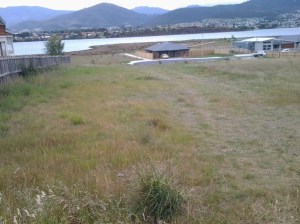
20141031_130307

At 1.06pm I reached the lower path, which was appropriately signposted as the Old Beach Foreshore Trail, and enjoyed seeing more black swans, swooping swallows, flocks of starlings, and the usual screaming plovers. Closer to the water the path divided.  To the left it returned to Cassidy’s Bay (although I saw no signs of a path when I was there), to the right the path would continue to the Jetty at Jetty Road.  The spot where I stood was named the ‘Calm Place’.

20141031_131028

The photo above faces south across the lowlands of Old Beach (which doesn’t seem to have a beach), and provides a view of Mount Direction in the distance.

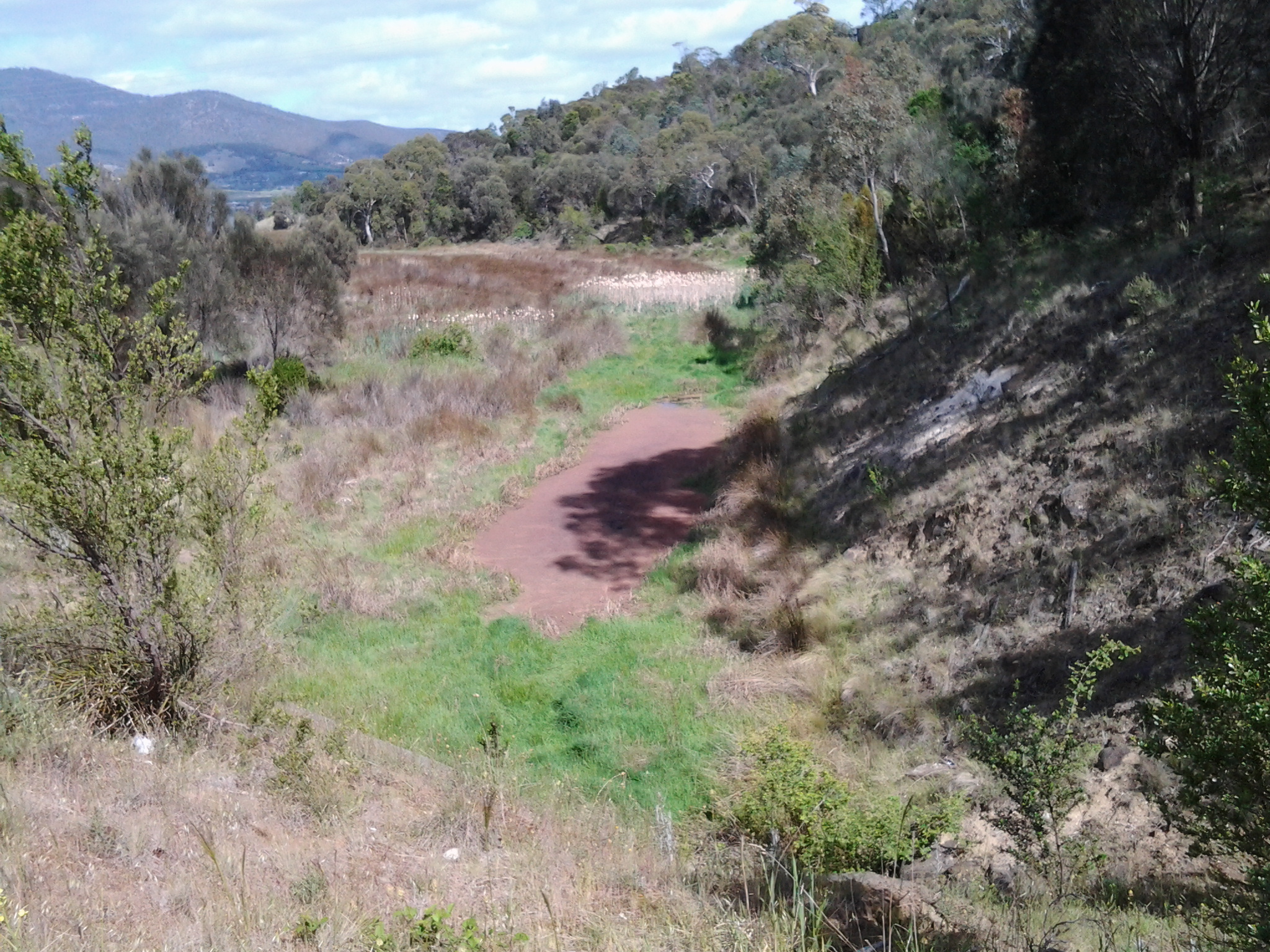
I headed north by taking the right hand trail. Not long after, on the right hand non River side of the path, I saw a tiny man-made lake, with its quota of swimming ducks and a rusting large sculptural tower on a central island with two Dominican Gulls on top (the expression ‘kings of the castle’ came to mind), amidst a stack of new houses and others being built. The sign on the fence worried me.

20141031_131049

I was concerned that because the land was so low and the lake depended on a levee to contain the water, any River flooding could be of great concern to the new property owners.  I wondered how much of that being built on was reclaimed land. I am surprised the local government allows new buildings here. With global warming increasing the sea level, these houses won’t be around in hundreds of years.

Blue skies opened above Mount Wellington in the distance but heavy clouds sat overhead.  Spits of rain persisted off and on for the rest of my time at Old Beach.  But it was time to have lunch. In the absence of any seats or rocks or other raised area, at 1.20pm I sat on the grass beside the Foreshore Trail, emptied my pack, and started munching as I absorbed the details of my low lying surroundings.  I could see heavy rain clouds that darkened the day travelling across the Derwent from the Mount Faulkner Conservation Area on the western shore.
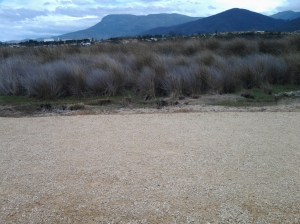
20141031_132509  20141031_132519

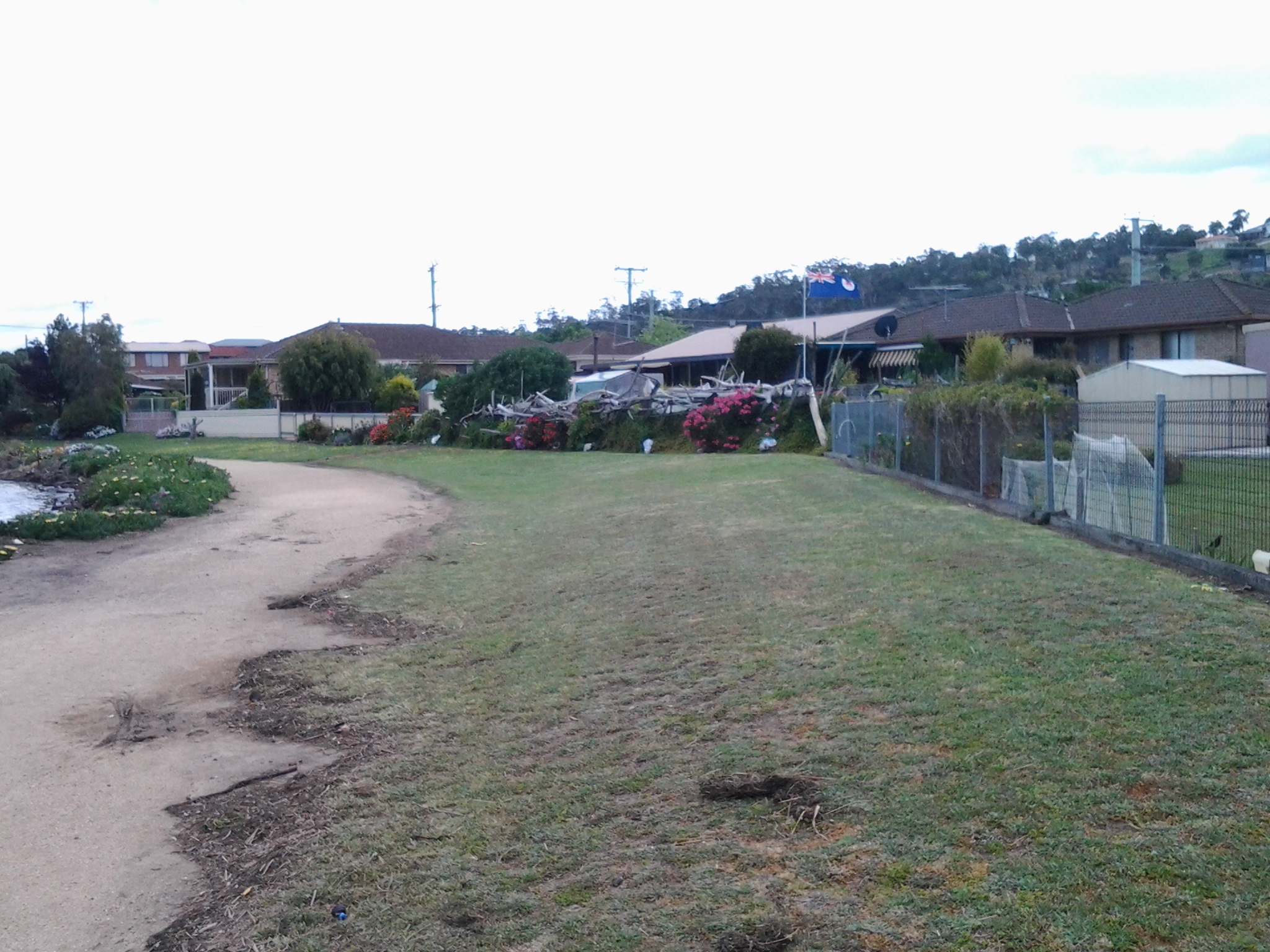
At 1.35pm I was on my feet and continuing along the path, passing an alternative walk to Sun Valley Drive, and spotting a pair of native hens pecking ahead on my path.  A private fence made from large pieces of driftwood festooned with creeping bright flowering geraniums, caught my attention.

20141031_134059

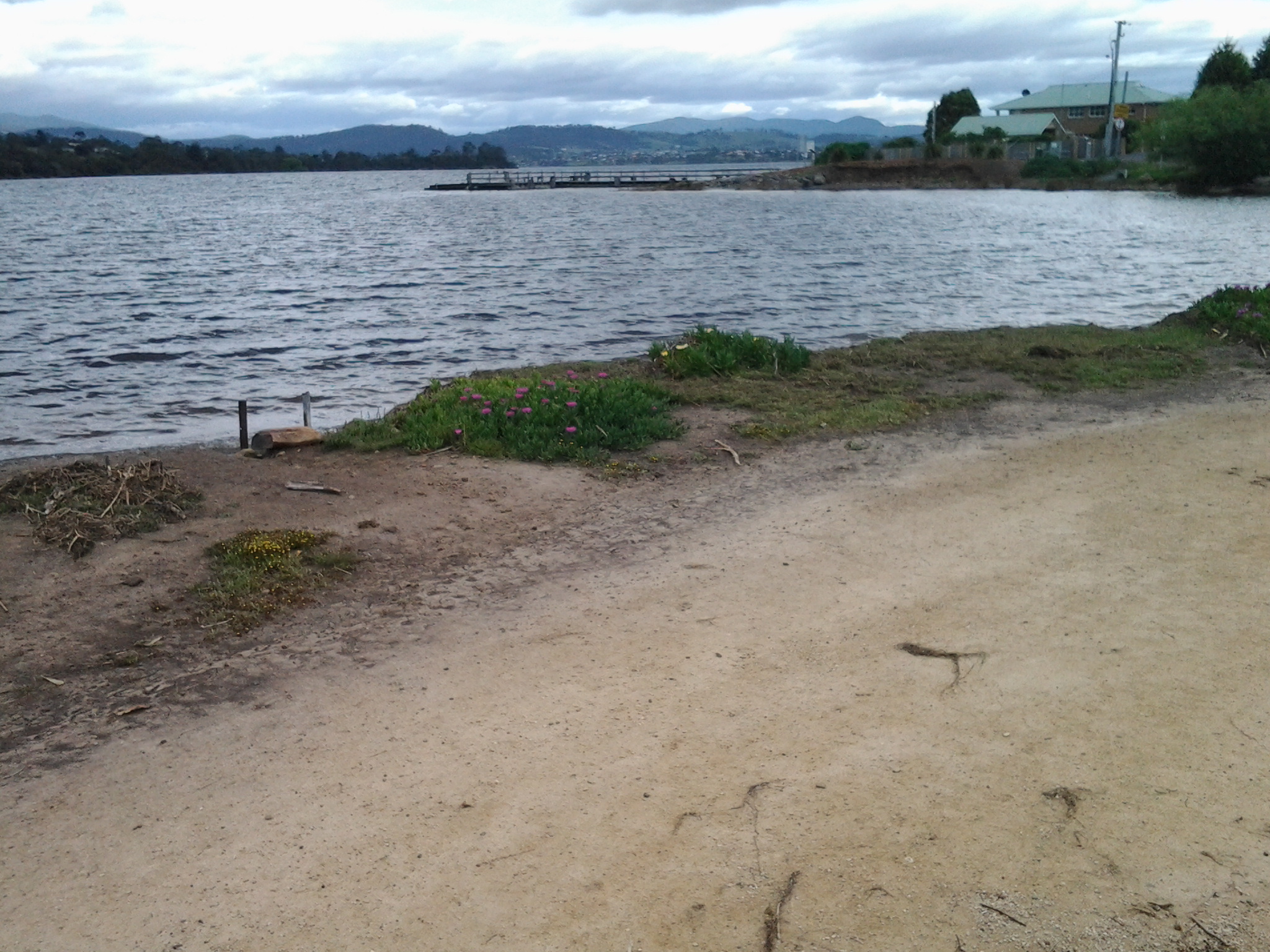
At 1.43pm I arrived at the Old Beach jetty

20141031_134047

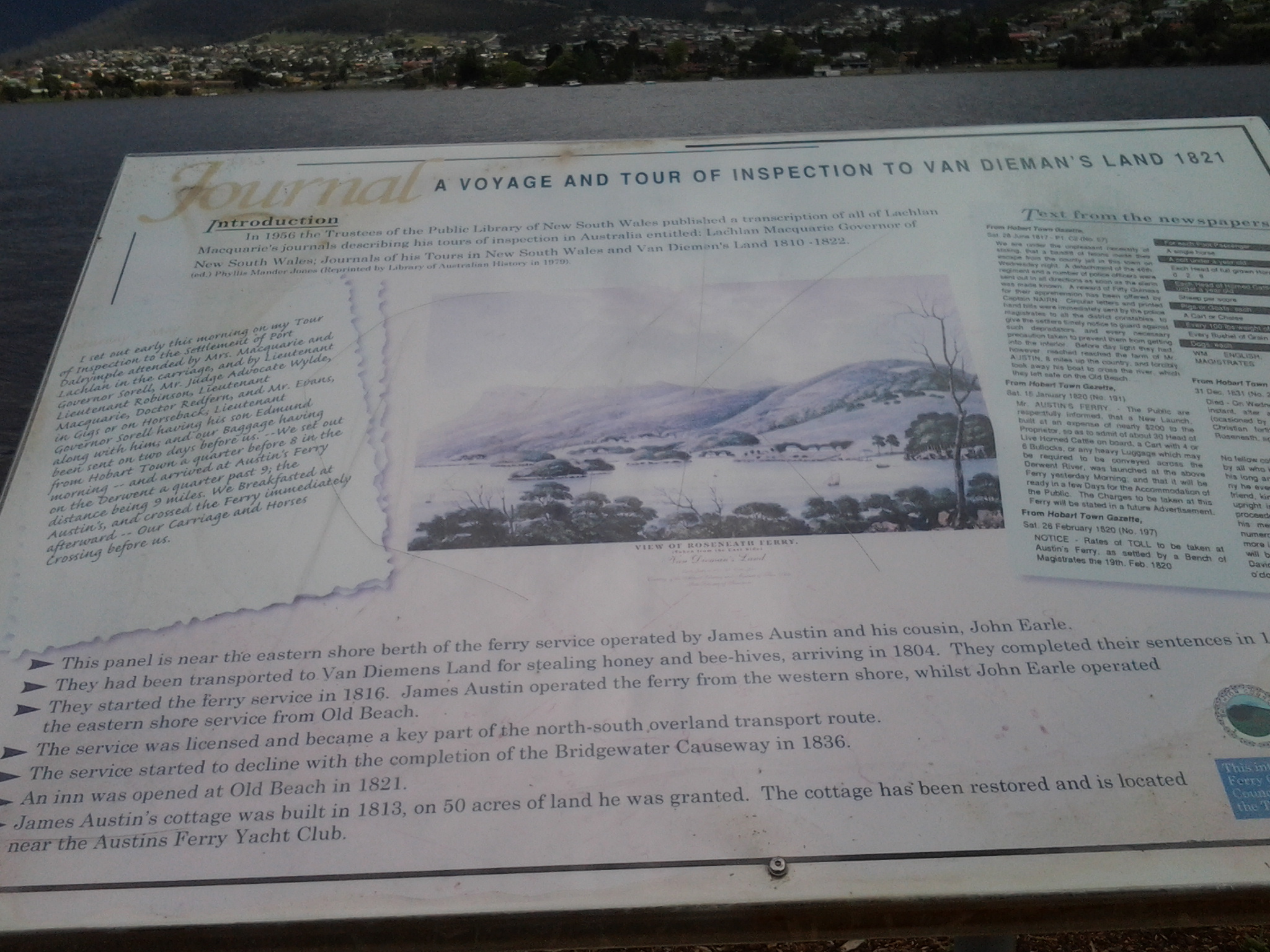
where I found an interpretative panel explaining some of the early 19th century history associated with the location of the jetty.
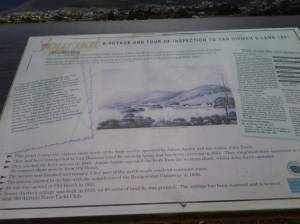
20141031_135134

As early as 1821, an Inn was established near the current jetty, and people would ferry across the Derwent from the western side of the River.

This 7th stage of my walk was coming to a quick close.  I knew a bus would be travelling along Jetty Road at 2pm, and that the next service would not be in the vicinity for another couple of hours. I had wanted to finish walking through all of Old Beach before I finished this stage, but the potential for a long wait for a bus inclined me to cut the anticipated walk short.  I walked along Jetty Road and waited at a bus stop.

Metro bus 114, destined for the Glenorchy Bus Mall on the western shore, picked me up.  I did not travel the entire way but if I had, I would have needed to catch a Hobart city bus to reach the CBD, then a bus to take me back to my home suburb of Bellerive on the eastern shore. A long way. A long time. From Old Beach there are no bus services travelling along the eastern shore.  All the buses travel to the northern city of the Greater Hobart Area of Glenorchy via the Bowen Bridge. Since I live in Bellerive on the eastern shore, I resolved to try Plan B. I proposed to catch a bus from Glenorchy to Hobart via the eastern shore and close to the Bellerive area. Once over the Bowen Bridge from Old Beach, I got off the bus at the first stop which was outside the Elwick racecourse at 2.15pm. I crossed the road and waited in a bus shelter for Metro bus 694. As the rain started to pour in earnest at 2.35pm, the bus arrived. Phew!

I loved the return trip. While again on the Bowen Bridge I looked northward and could see where I had walked earlier in the day. Ahead and looming over the land, was Mount Direction. Looking southward I could see the Cleburne Spit was empty of cars and people, the suburb of Risdon looked quiet, and a thick eddy of smoke rose from behind Risdon Cove. Closer to the area with the fire, a sweet wood smoke smell spread through the bus and reminded me of camping fires I have enjoyed in the past. That was a great conclusion. Memories of the immediate day and memories of the past coming together.

Now I am looking forward to preparing for and then walking the 8th stage of my walk along the Derwent River.  This next walk is likely to happen early next week, weather willing. Let the discoveries continue!

Bellerive

Last Friday/Saturday the fourth stage of my walk along the Derwent River finished in Bellerive. Being curious to know a little history of this Hobart suburb’s existence, I discovered it was first settled in the 1820s after years of people ferrying across the Derwent River from Hobart Town. Its first name was Kangaroo Point.  No prizes for guessing why.  Apparently the area abounded with native kangaroos (and/or perhaps the prolific Bennetts Wallaby which is often referred to as a kangaroo).

The name changed from Kangaroo Point to Bellerive around 1830, using the French language as inspiration: bel = ‘beautiful’ + rive = ‘bank’.

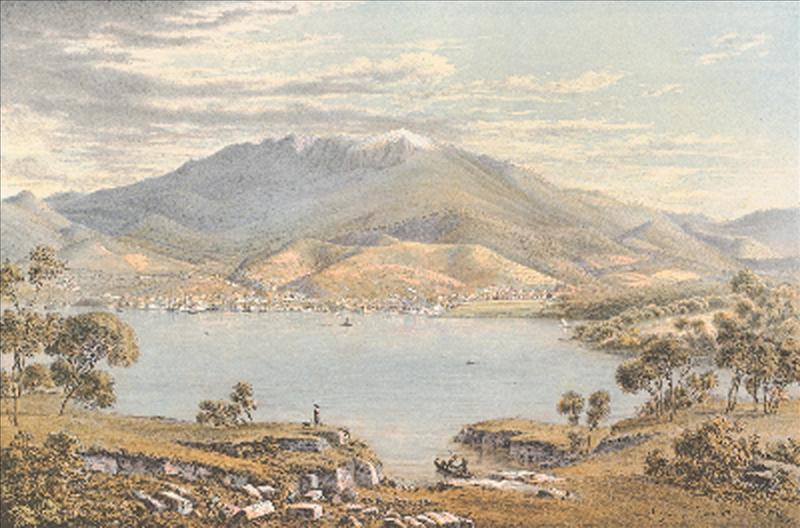
However, its original name seems to have been retained in common usage, because two eminent artists of the 19th century produced art work located from Kangaroo Point. The renowned English artist John Glover painted Mount Wellington and Hobart Town from Kangaroo Point in 1834, and the Austrian artist Eugene von Guerard, who was active in Australia in the middle of the 19th century, created a colour lithograph Hobart Town, from Kangaroo Point, Tasmania in the late 1860s.

The Glover painting is at home in the Tasmanian Museum and Art Gallery in Hobart.  This picture interests me because some of the original indigenous land owners, the Moomairremener people, have been depicted on the banks of Kangaroo Point, and there is very little sign of the ‘civilisation’ of Hobart Town on the other side of the Derwent River.  By contrast, 30 odd years later von Guerard’s print shows considerable build-up of Hobart Town beneath a snow capped Mount Wellington.

John Glover- from Kangaroo Point towards Mt W and Hbt Town

The von Guerard lithograph is at home in the National Gallery of Victoria in Melbourne.

Von Guerard Hbt Town from Kangaroo Point

These days, Bellerive is a suburb of the Greater Hobart Area completely covered with streets and houses of every vintage. With its easy access to excellent sandy beaches, a vibrant village shopping centre, the regular presentation of fantastic free public festivals, and safe marina, Bellerive is a great place to live or visit.

My route for Stage 4 walking along the Derwent River

Yesterday’s route took me from Tranmere to Bellerive on the Derwent River’s eastern shore of the Greater Hobart Area.

  1. I caught the Number 615 bus to Camelot Park and got off at bus stop 31 in Tranmere just before 9am. The bus continued onto it final stop 31, while I crossed the road to look down on the rocky foreshore, before striding out along the concreted Clarence Foreshore Trail (CFT) back towards the city.

20140926_085658

  1. When I reached bus stop 29, public toilets were located next to the Trail. I continued along the Trail to the left on a gravel path separating the rocks and water from the back yards of houses lining the river. Fifty odd minutes after leaving the bus, and after passing Punch’s Reef and Anulka Park, I arrived at a significant curve in the Trail. At that point it seemed to be returning up to the roadway for continuation on a concreted pathway next to Tranmere Road.
  2. Instead I walked on northwards, next to the river on a grassy terrace but was eventually forced down onto the rocks of Howrah Point. Fifty minutes later I arrived at the southern end of Little Howrah Beach where I sat and ate some of my lunch. I would not recommend followers take this route because when the tide is in, some rocks will be impassable. At other times some uncovered rocks will be slippery with moss. In addition, there are overhanging prickly bushes which will scratch if you follow this way. I suspect staying on the Clarence Foreshore Trail would have taken half an hour or more off my walk.

The photo below shows the tranquillity of Little Howrah Beach.

20140926_104107

  1. Half way along the road next to the Little Howrah Beach is bus stop 21. Close by are public toilets.
  2. It took 6 minutes to walk the length of this short beach, a minute to walk over a tiny rocky shoreline, and then 30 minutes to walk the long Howrah Beach. The photo below shows the Howrah Beach. Second Bluff is the treed area at the end of the beach.

20140926_105721

  1. From Howrah Beach, I walked up and around the Second Bluff headland on a well-marked path (the rocks below would be impossible to walk around) and arrived at the start of the Bellerive Beach approximately a quarter of an hour later. The leisurely stroll along Bellerive Beach took about 30 minutes. The photo below was clicked looking back along Bellerive Beach after my walk was completed.

20140926_121521

Near this end of the beach a large football and cricket ground is evident through the trees.  Between this ground and the beach you will find public toilets.

  1. I took the stairs at the northern end of Bellerive Beach up onto Victoria Esplanade, turned left and followed the road around Kangaroo Bluff to Bellerive Bluff where this fourth stage of my walk along the Derwent finished.

This Bluff marks the point where the small Kangaroo Bay opens off tto the east of the Derwent River. Northwards across the water I could see Rosny Point which will be the starting point for the next leg of this journey.

20140926_123316

On the other side of the river, the city centre featured prominently below Mount Wellington.

20140926_123103

A number 608 bus runs through this part of Bellerive and continues onto Hobart. Alternatively, if you continue walking along the edge of Kangaroo Bay, then through the Bellerive Village onto Cambridge Road, buses can be hailed to stop at Bus Stop 8 for travel into Hobart city.

How much of the Derwent River have I walked?

I strolled very slowly for almost five hours. If followers choose to stay on the Clarence Foreshore Trail and are not as engaged as I was in making notes and taking photographs, I believe this walk will take a comfortable 3 and a half hours including snack breaks. In total, I probably walked about 10 kilometres because of the convoluted nature of the Howrah Point rocks and other non-Clarence Foreshore Trail pathways which I followed from time to time.  In relation to meeting my goal to walk the 249 kilometre length of the Derwent River, I gained another 4 kms; the total distance covered so far is now 19.5 kilometres.

Howrah

My walk today  (my fourth walk) along the Derwent River must pass through Howrah, an eastern shore suburb adjacent to Tranmere in the City of Clarence (part of the Greater Hobart Area).

The Clarence City Council records that Howrah was named after Howrah House (or Howrah Farm, an alternative source suggests), a property established in the 1830s on Clarence Plains by a retired Indian Army officer Captain James Fielder. According to the Asiatic Journal of the times, when Fielder was a branch pilot in Calcutta (which in our recent times has been renamed Kolkata), his wife had a son in Kolkata on 3 March 1830 so travel to Tasmania occurred sometime after that. On 25 March 1835, ‘the lady of Captain James Fielder’ gave birth to a daughter at Clarence Plains. Fielder arrived in Hobart at least a year earlier if the information in http://vdlworldimmigrants.wordpress.com/stories-of-immigrants-pre-1900 is correct.  “A newspaper notice by James Fielder of Howrah Farm, Clarence Plains, dated 17 November 1834 reads: Run Away On Friday the 14th instant, my apprentice boy, named Charles Connor, a native of India, between 16 and 17 years of age. I therefore warn all persons against harbouring him. He has on a narrow blue striped shirt, under a blue baize shirt, duck trowsers, lace shoes, and a tarpaulin hat. A reward of ten shillings will be given by the Undersigned to any constable who may take him up.”

Captain James Fielder took the name Howrah from a place of the same name near Kolkata. Clarence Plains is now known as Rokeby, a suburb I passed through on route to my first two walking stages on the South Arm peninsula. Rokeby is located over the hill from Howrah.

I found another historical connection when I recalled that Lieutenant John Hayes, who named our Derwent River, sailed from Kolkata in 1793.

With a little online research, I found that Howrah is the twin city to Kolkata in the state of Bengal in India, separated only by the Hoogly River. Back when Hayes was in the India, Kolkata was the capital of India during the British Raj so I imagine a bustling, active and expanding city.

On 11 October 1760, the Indian Howrah district came under control of the East India Company (EIC) – a massive trading company with ships travelling the world.  In 1823, when Bishop Reginald Heber described Howrah as the place “chiefly inhabited by shipbuilders”, it confirmed that location as a significant base for the 27 year old Hayes before he took leave of the EIC, acquired a couple of merchant sponsors who built him two ships, and sailed to Tasmania.  In addition to the shipbuilding industry, I have been pleased to learn that the British created a balance in the landscape by establishing the Indian Botanical Gardens in 1786. Perhaps Hayes experienced this maturing garden before he left in 1793. When he sailed into the Derwent River the Rokeby Hills would have been heavily forested (not cleared or edged with suburbs as they are today) and might have seemed similar to a botanical garden – a place with unusual vegetation.

Is there any chance Lieutenant John Hayes looked at our trees and remembered the Indian Botanical Garden?