Category Archives: Derwent River

The complex that makes up Wayatinah – posting 6 of 7

Wayatinah Dam

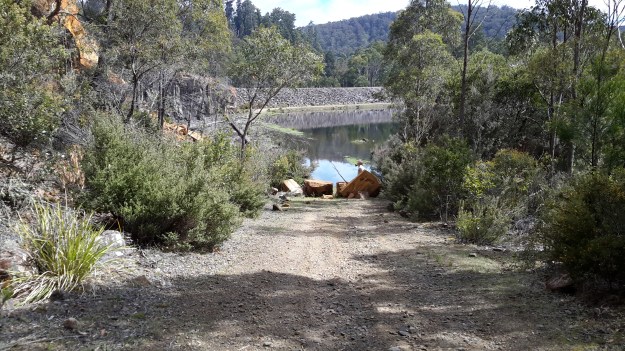
Instead of driving back to the Lyell Highway straight away, Andrew and I took a detour left off Long Spur Road and arrived at an impasse with the Wayatinah Dam ahead.  I had hoped we could drive across but this wasn’t to be.

20151029_111237.jpg

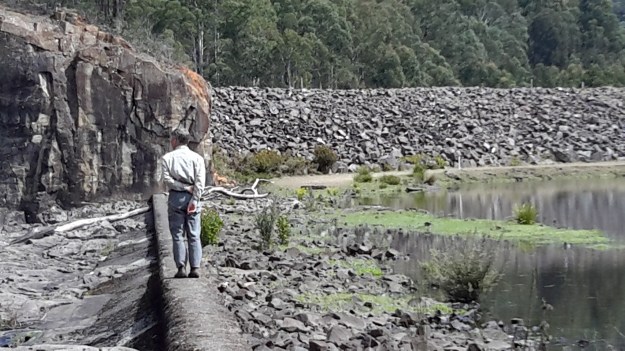
Nevertheless the water level was low and it was easy to walk across and connect with the road from Wayatinah township a few kilometres away.

20151029_111352.jpg

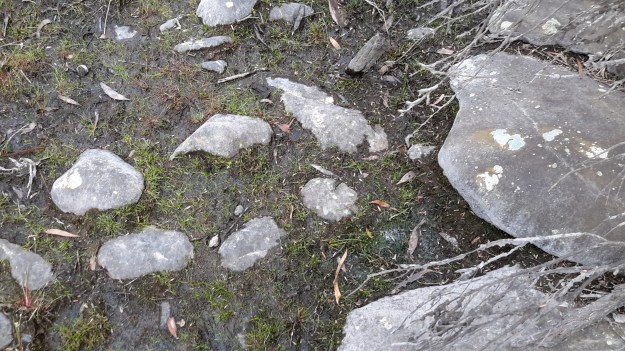
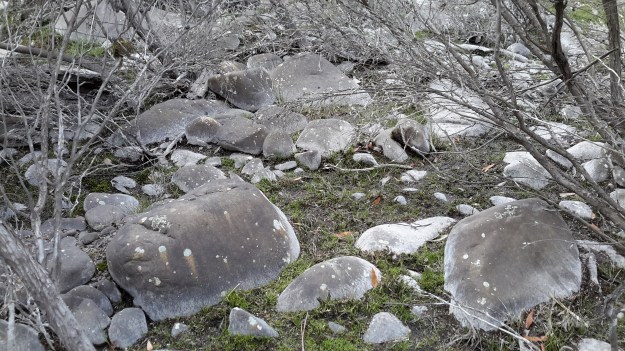
Decades ago thousands of tonnes of rock had been blasted to create a slipway beyond the Dam and the Lagoon. The scale of that effort was very impressive.  Clearly huge volumes of water had passed over the Dam in the past; these hard volcanic rocks were somewhat smooth.

20151029_111453.jpg Dam slipway.jpg

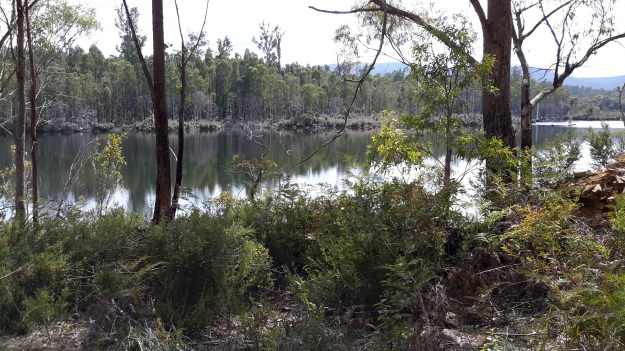
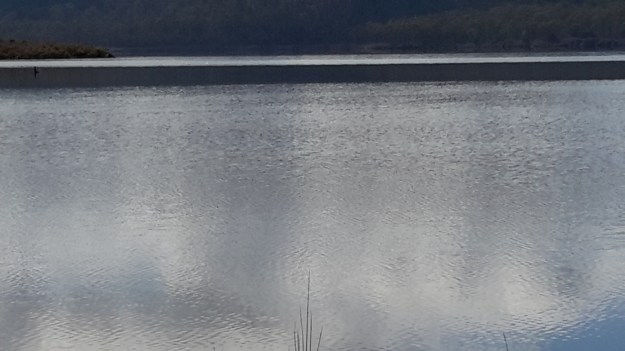
Wayatinah Lagoon backed up to the dam wall.

20151029_111239.jpg 20151029_111241.jpg

Looking across the Lagoon gave me an immense sense of calm.

20151029_111527.jpg

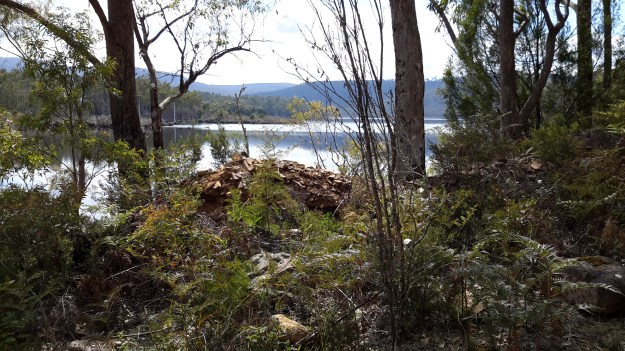
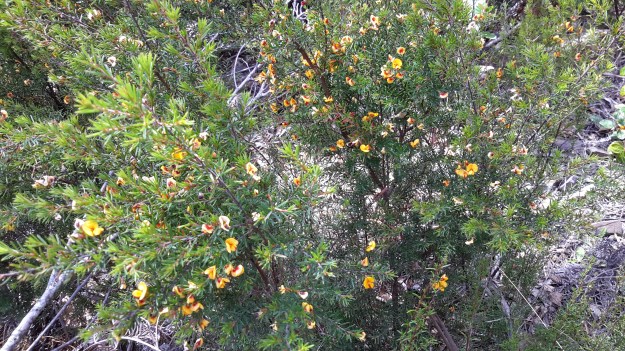
Examples of the flowering vegetation:

20151029_111842.jpg

20151029_111849.jpg

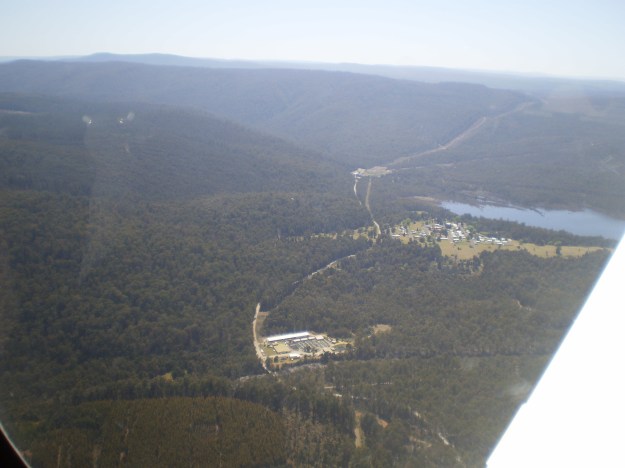
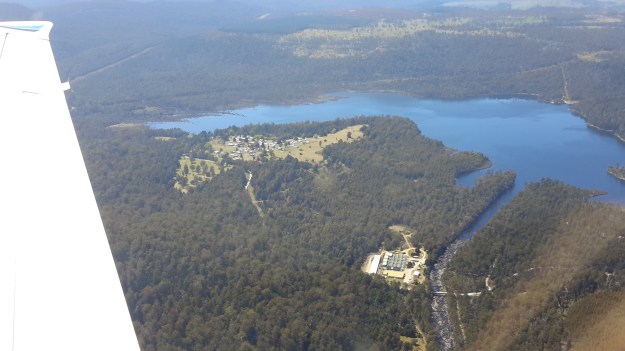
Later we drove through the Wayatinah township.  Michelle’s aerial photo shows the town on a cleared hill with some of the Wayatinah Lagoon visible.

PA280097Wayatinah township.JPG

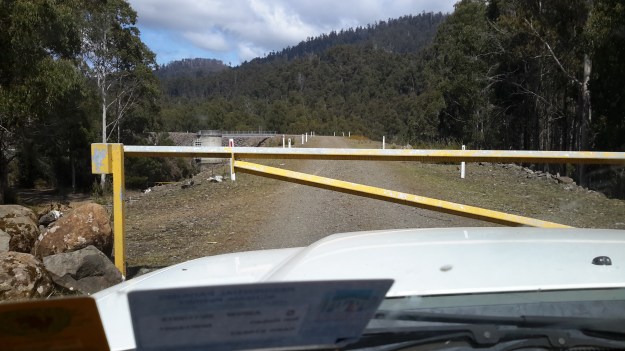
After passing through the town, we proceeded down to the dam wall and were met with locked gates.

20151029_114511.jpg

A sense of the scale of the town in relation to the Lagoon in relation to the Dam can be seen in my aerial photograph.

20151028_115428.jpg

The complex that makes up Wayatinah – posting 5 of 7

The Florentine River flows into the Derwent River.

Westwards from the Wayatinah Power Station, Andrew and I covered some kilometres of bush, clambering over fallen trees and through a mesh of understorey vegetation.  The marks of mankind were clear despite the absence of tracks; various weeds were flourishing.

20151029_091112.jpg

And through the bush in two different locations a well secured lidded white box sat alone with a surname and phone number written on top.  These were not bee hives and we could not determine their function.

20151029_093657.jpg

Once we had walked further westwards past the meeting of the Florentine River with the Derwent River, the Derwent presented with a low water level and stony river base.

20151029_094042.jpg

20151029_094127.jpg

However there were sections containing more water.

20151029_094048.jpg

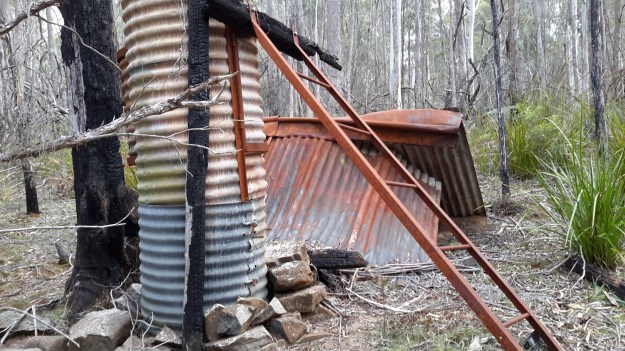
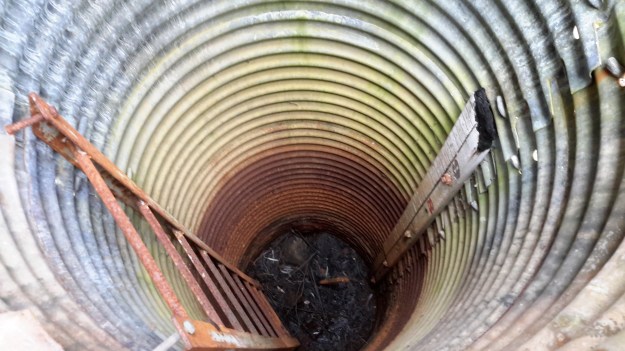
Along the way we discovered the remains of an old shed and an ancient water level monitoring system, through which a bush fire had passed.

20151029_101015.jpg 20151029_101039.jpg

20151029_100953.jpg

20151029_101649.jpg

Bits of iron and steel were scattered through the cleared surrounds.

20151029_100936.jpg

20151029_100939.jpg

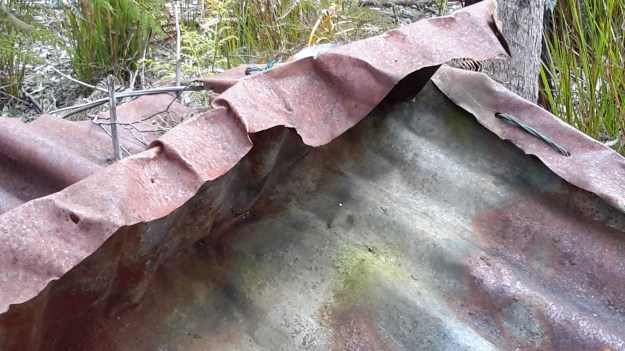
I loved the way the corrugated iron had been ‘stitched’ with wire to create the building. Very enterprising.

20151029_102240

20151029_102243

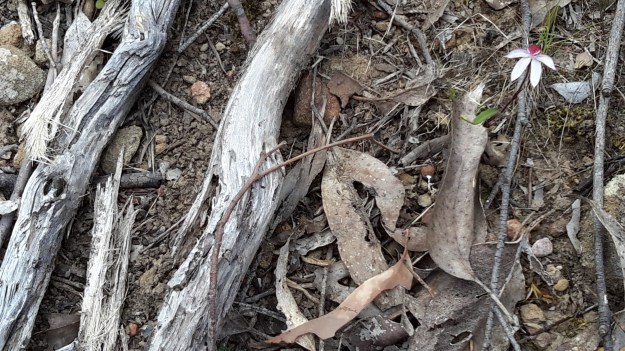
Amidst this debris a lone native orchid bloomed.

20151029_103015.jpg

Down next to the river bed, a water level height gauge was marked in imperial measurements, therefore indicating a date before the mid-1960s.

20151029_101155.jpg

20151029_101151.jpg

20151029_101548.jpg

20151029_100933.jpg

20151029_101745.jpg

We wondered what sort of electronic or satellite related devices and measurement tools were used these days.

I found this trackless walk to be very hard going (at the pace Andrew set) because negotiating the bush took thought and time.  I reflected on the challenges this section would pose if I had been carrying a full backpack.

Michelle’s aerial view gives an idea of the dense bush on the top side of the River where we walked.

PA280093Florentine & derwent intersection.JPG

The complex that makes up Wayatinah – posting 4 of 7

North west end of Lake Catagunya.

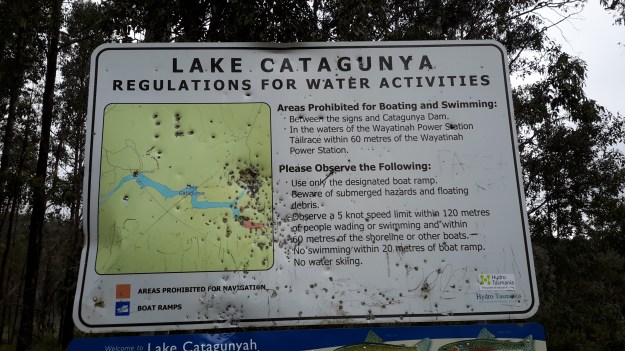
A side track from the Wayatinah Power Station took us to Lake Catagunya where the sign shows evidence of being used for target practice.

20151029_090228.jpg

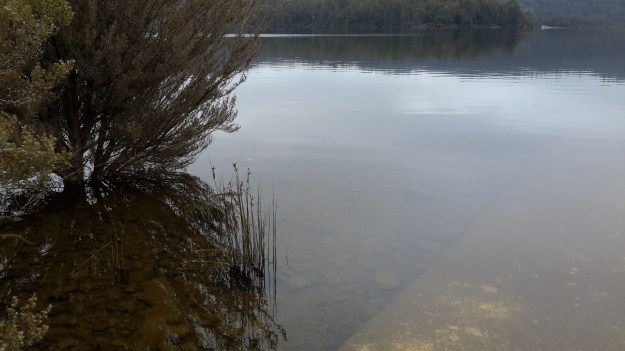
The Lake was still.

20151029_090233.jpg

Tiny white butterflies flitted at the water’s edge in the tall grasses.  Watch this short video.

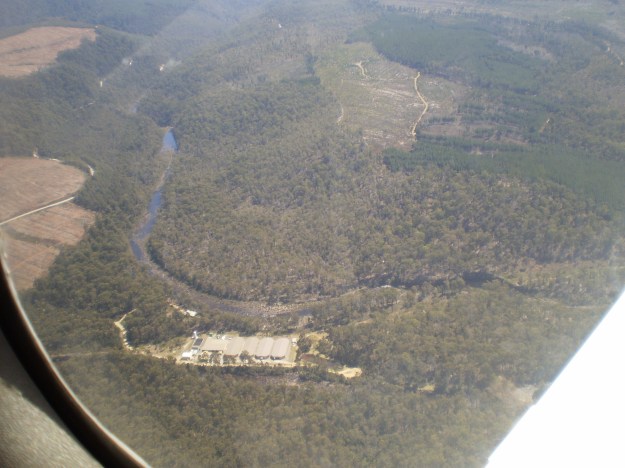
An aerial shot by Michelle below indicates the size of the Lake Catagunya. Note the comparatively tiny power station in the centre of the photograph.

PA280092 Lake Catagunya with Wayatinah PS.JPG

The complex that makes up Wayatinah – posting 3 of 7

Wayatinah Power Station

On Thursday 29 October 2015, Andrew drove me off the Lyell Highway and down Long Spur Road to Wayatinah Power Station. An underground pipeline from Wayatinah Lagoon fills penstocks which fall down steep hills to the Power Station.  The water exiting the Station empties into Lake Catagunya, through which the Derwent River flows.

20151029_090827.jpg

Watch the video.

20151029_091538.jpg 20151029_091554.jpg


The complex that makes up Wayatinah – posting 2 of 7

Wayatinah Lagoon

Having taken a turn off Long Spur Road, Andrew and I were the only visitors to this misted expanse of water on the 29 October 2015, the characteristics of which were almost total silence and an immense sense of quiet peacefulness.  I felt privileged to stand in such a serene environment, and smell the clean fresh air.

20151029_084702 Liapootah PS on hill in distance.jpg 20151029_084713.jpg 20151029_084742.jpg 20151029_084845.jpg

Watch the video.

A boat ramp, away from the infrastructure that accepts the water to be transported to the Wayatinah Power Station, ensures the safety of anglers from any unexpected water level changes.

20151029_084906.jpg 20151029_084829.jpg

Michelle’s aerial photo below gives some indication of the size of this Lagoon, and the way the river bed snakes away from it amidst dense vegetation heading towards Hobart.

PA280095 Wayatinah Lagoon.JPG

The complex that makes up Wayatinah – posting 1 of 7

As an introduction to the widely spread features of Wayatinah, the Derwent River runs in a south easterly direction past many acres of State Forest before flowing into the expansive Wayatinah Lagoon, a waterstore located five or so kilometres north of the Wayatinah Power Station. The Lagoon’s water is piped to the Station first underground and then overground in massive white pipes.

Excess water from the Lagoon seeps, dribbles or spills back into the Derwent River at the Wayatinah Dam, which isn’t far from the Wayatinah township. Then the low water level of the river trickles over a rocky base until it catches the flow of the  Florentine River before continuing on to become part of Lake Catagunya.  The western most reaches of the Lake have already formed before the river reaches the Wayatinah Power Station.

Out on the Farm

On the last day of October 2015, I walked along the river edge (part of Meadowbank Lake) and mostly on the property of Curringa Farm.  I am most appreciative for Tim and Jane Parsons allowing me to walk there.

Their Farm is home to thousands of sheep.

20151031_111536

While I walked along approximately 4km of the river’s edge towards where the Clyde River entering the Lake, my friend Alex waited. As she sat in the car reading newspapers and drinking tea from her thermos, the wonderful view down to the ‘river’ as shown below was hers to savour.  In fact this waterway is one part of the very long Meadowbank Lake through which the Derwent River flows. One of Alex’s photos is shown below.

20151031_121223 Curringa Farm

While I walked, the Lake was busy with jet boats and water skiers. Watch this video.

As usual, the water and the river’s edge landscape enthralled me.

20151031_113507 20151031_114212.jpg 20151031_114403.jpg 20151031_115053.jpg

When I walk alone I hear and see things which are not usually available if I walk with another. That is, the talking or the crashing through the bush disturbs birds and animals and they disappear.  During this walk, when a Rufus wallaby was suddenly standing before me a few metres away, we were both surprised. The bush was so quiet and I must have been making foot noises which sounded like normal bush rustlings so that s/he wasn’t immediately aware of my presence.  Eventually s/he hopped off to watch me from some bushes in the distance. I hadn’t moved a muscle since we first eyeballed each other.  But after its bounce away, my eyes swivelled to focus on a movement on the hill above. Down hopped a small wallaby and on the crest his/her mother appeared.  The following video shows them almost camouflaged in the environment. I feel sure you will not find the smaller baby wallaby until it moves again.

Watch this video.

Through the undergrowth, many well ‘walked’ tiny tracks were visible but on closer inspection they seemed to be wallaby highways.

20151031_114746.jpg Clever animals – they had been able to gradually force up fences in order to continue moving through paddocks. If you study the photograph below, on the lower right hand side you can see the wire mesh fence has been raised by rounding it up from the ground.

20151031_115247.jpg

Substantial sandstone/mudstone rocks intruded at the water’s edge and as cliffs formed hillsides and cave-type overhangs.  I wonder if the original inhabitants of the land rested in some of these places.

20151031_114531.jpg 20151031_115236.jpg 20151031_120846.jpg 20151031_120907.jpg

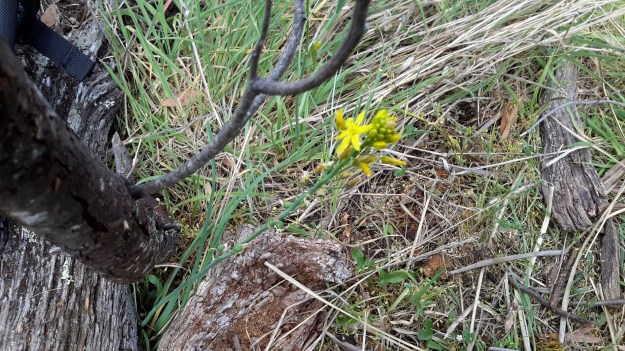
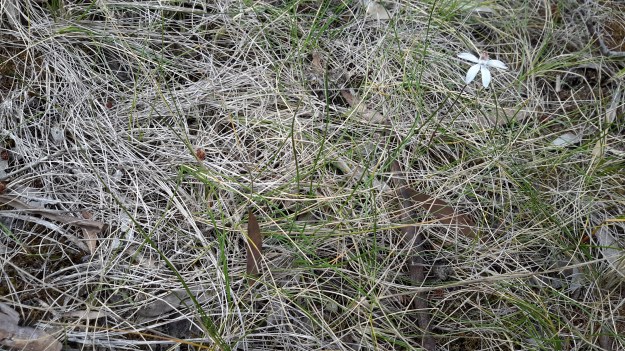
The next selection of photos shows a couple of examples of the profusion of bush flowers seen during this walk: I cannot identify the first but the second is a tiny native orchid.

20151031_120549.jpg

20151031_115144.jpg

Generally the bush was extremely dry, so much so that the lichen growing on rocks was shrivelled and seemingly dead.

20151031_120755.jpg

Parts of the Derwent Valley have received so little rain over winter that there is insufficient vegetation coverage for the cattle and sheep to eat in the coming months.  Apparently many farmers will be selling their sheep soon before the animals lose their good condition.  It is so challenging to work on the land.  It will be so challenging for city dwellers wanting to eat lamb in a few months’ time – a few gold ingots might be needed to make a purchase.

Nevertheless, it is a beautiful part of the world.

20151031_120901.jpg 20151031_123826.jpg

Meditation and peacefulness

I find that listening and looking from within the natural environment revives my soul and lifts my spirits. Partly this comes from the rhythm of taking each step, the regular intake and exhaling of breath, and then the quality of the fresh air touching all parts of me.

Here are a couple of small videos I made when skirting around Reids Fruits property.  These are the sounds that most relax me.

Two videos while on Reids property: https://vimeo.com/140869887  and https://vimeo.com/140865664

I kept walking and  soon found the railway line was fenced off close by. As I looked back over the route I had taken, unfamiliar parts of Mount Wellington could be spotted on the horizon.

Take away the fences and the place would be truly idyllic.

A change in plan due to the expected large volume of future information

In a blog post written a few weeks ago, I said I would not post a record for any walk on a section of the Derwent River unless it fell into the continuous sequence; that is the next post describing the walk should be from Gretna (the location of the end of the last stage of my walk- Stage 15) westwards.

From now on I will walk sections (yes blow the knee problem, I will continue)  that fit with friends dropping me off at starting points or collecting me from destinations, or that fit with the Tassie Link bus timetable.  In any given week I could be located at any point between Gretna and the source of the river as it leaves St Clair Lagoon. Therefore, in any week, my blog posts will be about where I have been walking and the experiences gained along the route.

The reason for my change of heart is that from the reconnaissance and short walking trips that I have taken in the past few weeks, I can see that there will be simply too much information to dump into the blog once I finish the walk.  Therefore, despite the chance of confusing blog followers, I will write up and post as I complete sections regardless of whether they fit into a seamless sequence.

Another advantage of this approach is that there will be less Derwent River related posts, and more actual walk related posts.

Where is the source of the Derwent River?

This question was on the minds of the new settlers to Van Diemens Land in the early 1800s.

In 1835 George Frankland, Surveyor General to the government of the time, organised a ‘search’ party to locate the source. After the expedition he wrote a report for despatch to the ‘mother country’, England.  The brief text has been published as The Narrative of an Expedition to the Head of the Derwent and to the Countries bordering the Huon in 1835.  The small book was reprinted by Nags Head Press for the publisher Sullivan’s Cove in 1983.

No description exists of how Frankland and his party travelled inland until they reached a property or area then known then as Marlborough (now known as Bronte) in the Lake country, located west of Lake Echo and directly east of Lake St Clair by over 30 kilometres. Marlborough was a probation station for North American prisoners in the 1830s/40s.

Map of probation stations including Marlborough

The map above can be seen in the story: ‘They left Jefferson County forever…’

The Marlborough district was discovered by Surveyor Sharland who also found Lake St Clair, in 1832, only three years before Frankland felt compelled to find the source of the Derwent.  It seems Sharland did not realise it was the Derwent River that flowed from the southern end of Lake St Clair. Further information can be read in G. H. Stancombe’s paper Notes on the History of The Central Plateau.

The Lyell Highway, according to the Highland Lakes Settlement Strategy has been known as the Marlborough Road where it runs westwards of Ouse and towards the area around Bronte.

Information, which is totally irrelevant to my writings about the Derwent but nevertheless interesting, concerns an earthquake near Marlborough that was recorded in The Courier, a Hobart newspaper on 25 April 1854. Thomas Bellinger reported ‘I beg to inform you of a very strange occurrence on the evening of the 24th of March last. A shock like that of an earthquake was felt in almost every part of the Marlborough District. Two shepherds were gathering sheep the other day and discovered the cause of it.  I went to the place yesterday: there has been some fearful volcanic eruption, rocks of enormous size have been driven about, the face of the earth appears to have been hoisted in the air and pitched surface downwards. I cannot describe to you the appearance, but if you will come up I am sure you will be highly gratified – the distance is about ten miles from this.’  I have no information about where Thomas Bellinger was writing from but I am curious to hunt out the location of this upheaval.

After that information detour, let’s go back to the expedition to find the source of the Derwent River.

Following a ‘difficult journey from the settled Districts’, all members of George Frankland’s party assembled at Marlborough on the 7 February 1835.  The record shows that George Frankland did not follow the edges of the Derwent, rather he crossed the Nive River (which empties into the Derwent River much further south), then travelled north-westwards. Initially densely forested hills stymied progress with horses, and then the boggy plains ahead slowed him down.  He continued generally in a westward direction and after almost five days, found Lake St Clair; ‘we suddenly found ourselves on the edge of a beautiful Lake in the heart of Scenery of the most picturesque Character’.  After further walking around parts of the lake, Frankland reports ‘It was a fine summers day and the Air was so serene that the surface of the Water was scarcely ruffled but the sandy beaches bore evidence of the Lake being at times as rough as the Sea. I will not here dilate on the extreme beauty of this scenery as it might be considered out of place in an official report, but … I feel it difficult to avoid expressing the impressions of delight which were inspired by first discovering of such a romantic Country…’

On the 14th February, Frankland despatched two of his party to return to the source of the Derwent and follow it downstream on the left bank while he set out to explore the country on the right bank.  Both parties walked across open plains where Lake King William now fills the area.  They reunited the next day.  One of the party, a Mister Calder was despatched to continue along the edge of the river until he met the entrance of the Nive, which he successfully achieved (although details are absent).  Meanwhile Frankland tried to continue following after Calder but was only able to proceed for 3 miles. ‘At that point we plainly perceived that the Country had … become such a thick forest that to take the horses any further was out of the question.’  The result was that Frankland split the party further with the horses taking an easier route to Marlborough.

On their first day trying to walk the edge of the Derwent, Frankland recorded ‘This day was consumed by a laborious march of two miles through a most obstinate scrub – and we bivouacked on the steep edge of the Derwent after wading for a considerable distance through the torrent, up to the middle, as the easiest mode of travelling.’  The forest is as dense in 2015 as it was then, so regular blog followers can appreciate why walking some sections of the rest of the way to Lake St Clair concerns me.

At this point Frankland was for giving up. ‘On the 18th February I determined on leaving the Derwent and accordingly struck away to the N.E. The forests continued depressingly thick – but by dint of labour we accomplished about four miles this day’.  Only four miles in a day for strong men!  What chance do I have of walking this part quickly or easily?

A couple of days later Frankland reached Marlborough and from there he set off to cross the Derwent River and explore the Huon River area further south.

Thank you Andrew for alerting me to this report and for the loan of the book.

The best laid plans of mice and men …

Other people have sore knees or knees that can’t walk downhill without discomfort or pain. Not me.  That is, until a week or two after my walk to Gretna.  For the first time in my life, I noticed my knees.

On a couple of occasions since that walk, a shooter of a pain in one of my knees left me staring wide eyed and grunting. During a visit to my GP, she listened to both knees and (they didn’t speak to her but …) she heard them grinding away.  Subtle noises, of course.  Noises not available to the common ear.  Now, after X-rays and ultrasounds, the verdict is clear. I have little to no cartilage left between my knee bones.  Yes, you guessed it. Walking is not advisable.

I whined … ‘but the source of the Derwent River is still a long way off.’  My GP looked at me purposefully, ‘it’s going to take you a long long time to finish that walk. You can add ice or heat treatments, compression knee bandages, and walk with two poles to help, but you shouldn’t walk too far, too often or on uneven ground.’  I pursed my lips. I knew cartilage does not regenerate and I realised that a lifetime of walking has gradually taken its toll on my knees. A number of expletive deletives passed through my mind.

Can I let such a ‘little’ thing get me down? What’s my plan for the future?

I have some day walks planned along the upper Derwent with friends who are ferrying me to and collecting me from various locations. I plan to walk those. If my knees fail me then I will crawl or slither back to cars or buses. No probs!  But I feel that scenario is unlikely.  I suspect I will get through a shortish day walk just fine. Nevertheless the remaining cartilage is a finite quantity and I have to think about how much I want to aggravate the situation.

Many of my blog posts have mentioned my sore feet and how by concentrating on taking one step at a time, I can continue for hours with that focus.  Each walk in the future will continue on this basis until my knees indicate it is unwise to go on.

What else can I do to achieve something like the original goal?

Thinking laterally – here’s the first idea which comes to mind and that therefore is not necessarily one to be converted into action: so far I have covered about 90 kms of the 215 km length of the Derwent River.  If, during the future planned walks I cover another 20 or 30 kms of the river (which I expect requires lots more actual walking kms to achieve those few), I am now considering the idea that whatever kilometre gap remains, I might swim that length, not in the cold Derwent but in a heated Olympic-sized swimming pool located next to the Derwent. One kilometre at a time. Maybe swimming two or three times a week.  One of my original motivations for the Derwent River walk was my need to create a personal physical challenge; the goal of swimming 100 or so kilometres would give me something major to pursue (one armstroke at a time – until the shoulders fail . Hmm perhaps I shouldn’t tempt fate by making such jokes.). Watch this space for the continuation of this idea – or a new one.

The Derwent River is 215 km long – the authoritative answer!

I am so excited.

Blog followers know I have been frustrated in my attempt to discover the official length of the Derwent River. Now I have found the answer in Australia’s most reliable source of information.  Today I found that the Australian Bureau of Statistics gives the length as 215 km.  I feel vindicated.  Previously, using an Opisometer on 1:25,000 Tasmanian maps, I had calculated the length of the River at 214 km – all the time knowing that some inaccuracy was possible with this device. You can read my earlier post here.  Now all I have to do is to persuade Google to change their information!  What chance do I have?

Fires above the Derwent River

On too many nights last week the sky was dense with a rosy fire haze across my suburb.  The smoke slipped through crevices in my house so that, through each evening, I felt like I inhaled a camp fire.  Back then I checked the Tas Fire Alert website and learned the closest fire was in Quarry Road less than half a kilometre away. Today I went off to see what the burn looked like.

I chose to walk through the bushland of Waverley Flora Park first and then descend down Quarry Road.

2015-11-09 09.37.10

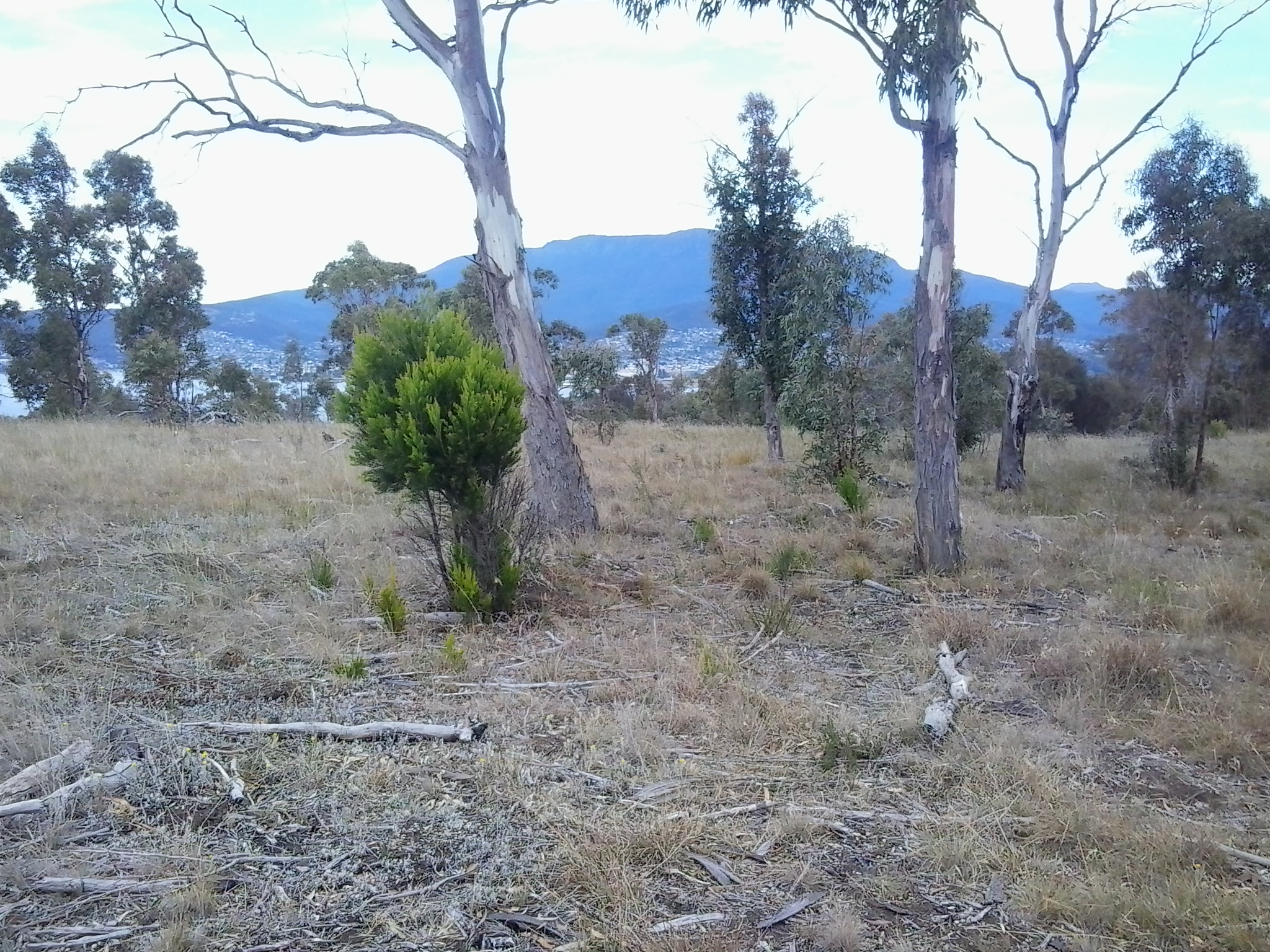
From the top of one of the Park’s walking tracks, I looked through stands of gum trees towards the mouth of the Derwent River.

2015-11-09 09.22.36 2015-11-09 09.22.51

In the other direction Mount Wellington loomed large over the Hobart CBD and the Derwent Harbour.

2015-11-09 09.24.47

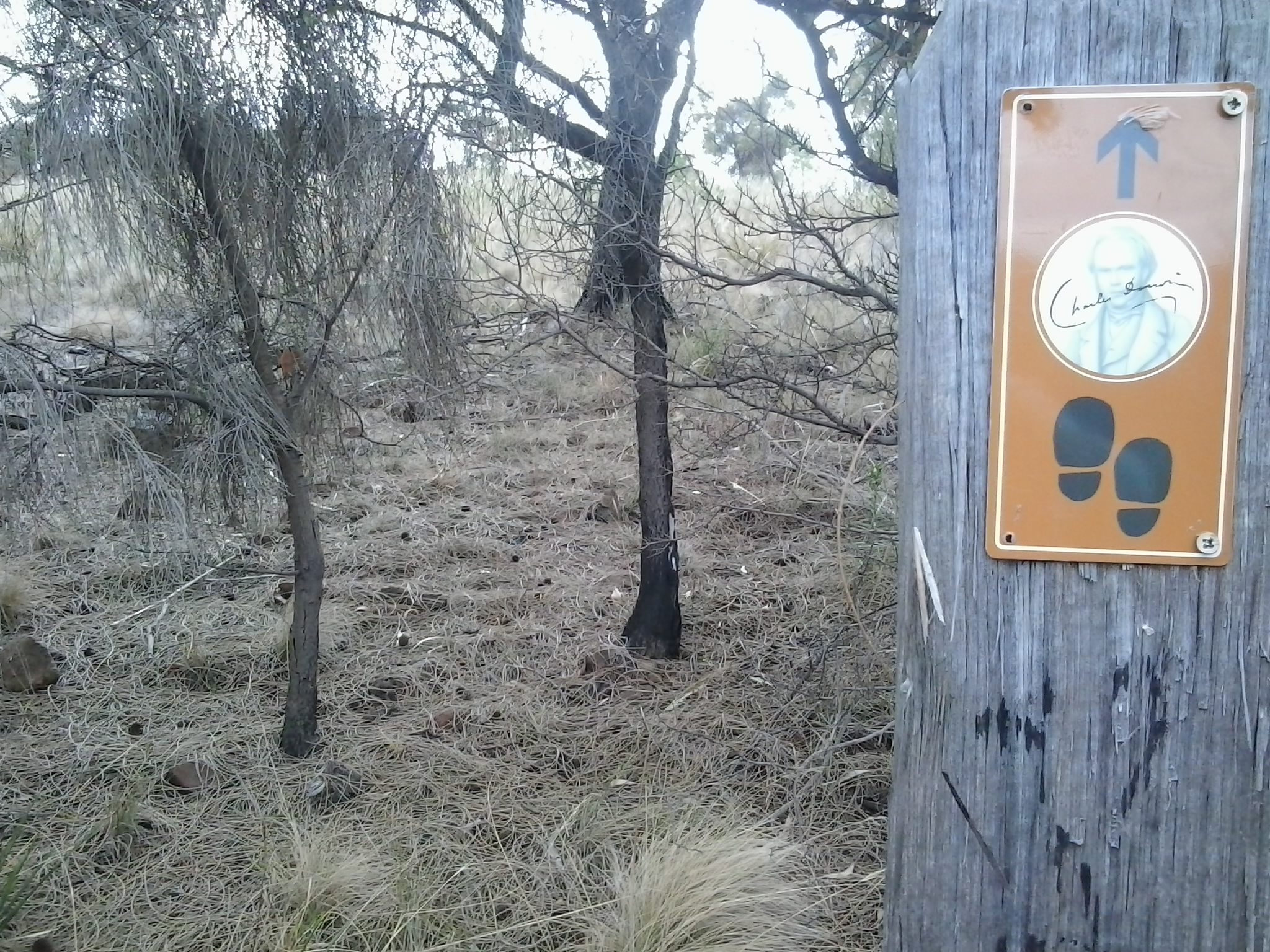
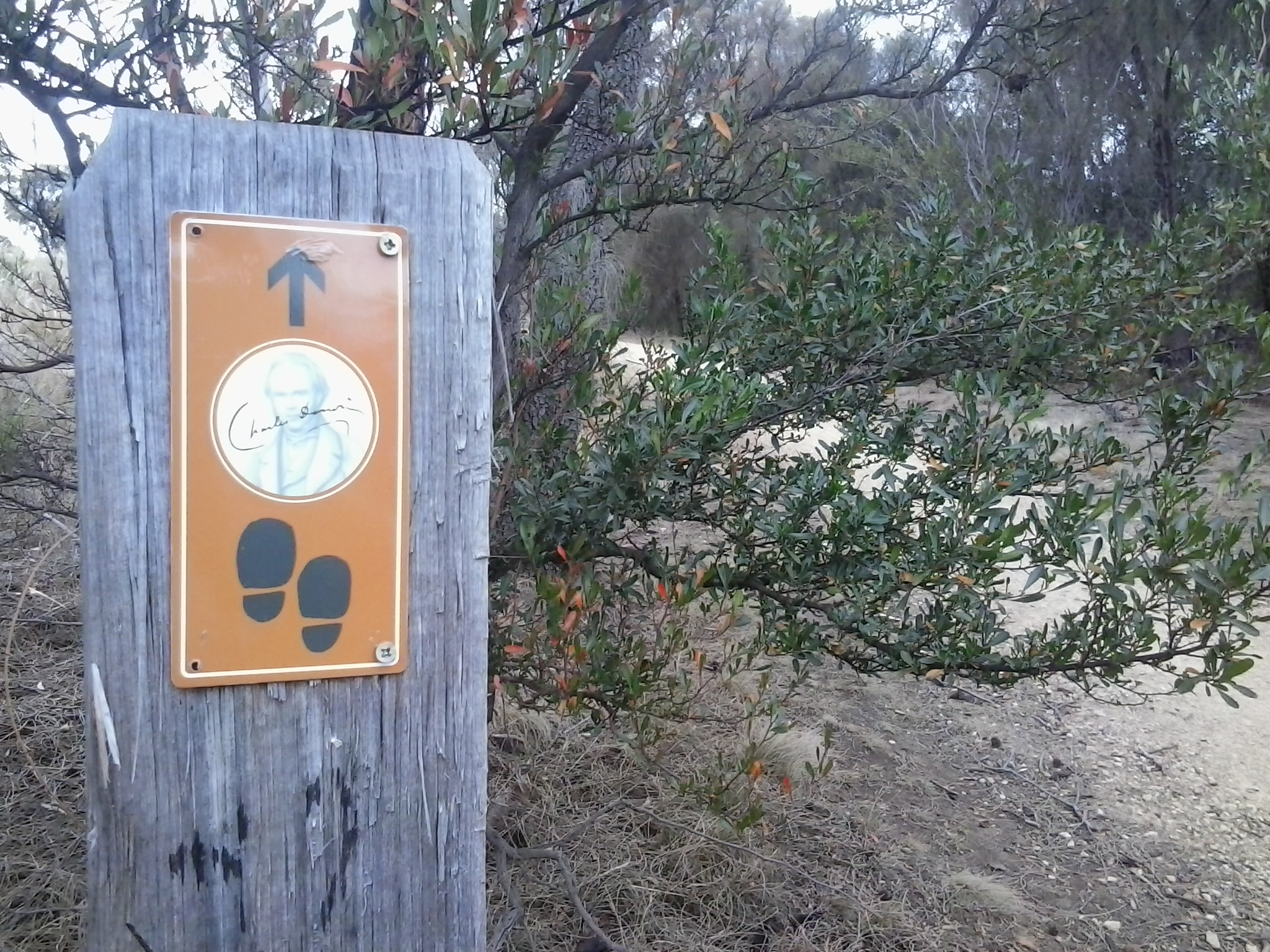
I followed in the footsteps of Charles Darwin, ‘father’ of the theory of evolution, who walked around Hobart in 1836. At some time during that visit he crossed to the eastern shore and wandered around the Bellerive suburb and beyond.

2015-11-09 09.22.59 2015-11-09 09.20.23 2015-11-09 09.20.15

I saw unfamiliar medium-sized birds collecting nesting material and insect food morsels (who flitted away far too fast for me to take a photograph): one was dressed in silvery greys with a long strand floating after its tail, and another with a rich olive green coat. None of my bird books help me to identify either of these birds – any locals with bird knowledge?

A profusion of native spring flowers carpeted parts of the Park, or stood as single colourful spikes amidst the dull dry green grasses.

2015-11-09 09.32.36 2015-11-09 09.25.26

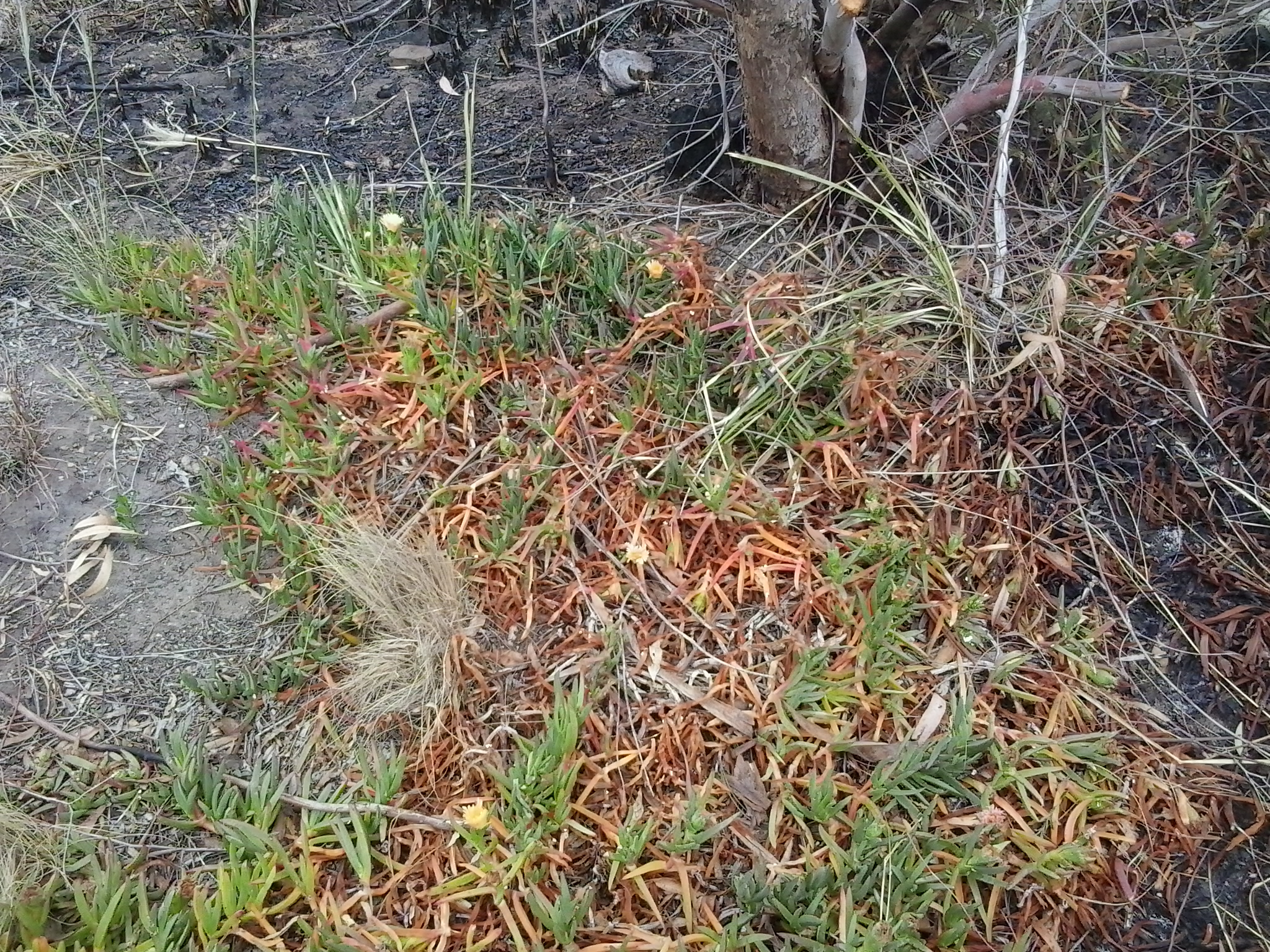
It soon became clear that lots of burned vegetation and scorched earth passages were scattered next to the walking track and beyond.

2015-11-09 09.29.05 2015-11-09 09.28.19

Later when I walked down Quarry Road with not a burn mark in sight, I realised that for bureaucratic purposes the Tas Fire Alert site had to indicate the best road for fire trucks to follow.  It had been parts of the Waverley Flora Park that suffered fire damage.

As I continued downhill, I heard the siren sounds of a fire truck and watched it whip past the intersection below.  When I turned the corner, the truck was parked askew with hefty yellow clad guys preparing their gear.  The screams of other sirens were closing in. I watched wisps of smoke escaping from all manner of slits and slots and dirty brown smoke puffing from the front door of the house below.  I saw an approaching ambulance and guessed this wasn’t someone’s best day.

Our Hops hop it to international markets

You may recall my earlier posts after my walks in the Bushy Park area and its hop fields. You may also recall reading that new paddocks were being set up for growing more hops.  Perhaps this article is related. For more information read Tassie hops make their way into US craft brews.

Derwent River: time-lapse photographic display

The Derwent Project’s website contains engaging images from cameras located at various points along the edge of the Derwent River.

There is a great deal of viewing to be done across this site including the page with the time-lapse videos.

Because of the imagery on this site, I find it possible to appreciate the environment and weather changes in a simpler way.  I feel sure that if you can’t walk or drive along the Derwent River, watching these videos should give some sense of the pleasure that is possible.