Author Archives: Tasmanian traveller

Unknown's avatar

About Tasmanian traveller

Through travel, I have experienced the eccentricities of people and their environments around the world. At the same time, I love where I live. So, for people who cannot travel to discover the wonders of my home town, this blog is an attempt to introduce its exoticness. My goal was to walk along both sides of Hobart's Derwent River from the mouth to New Norfolk, and to walk on one or alternating sides of the River between New Norfolk and the source of the River at the southern end of Lake St Clair. The walk was undertaken in stages around my other commitments of my life. Almost all stages of the walk connected with Tasmanian public transport - my intentions was to inspire people, who do not have access to a vehicle, to feel they can replicate the walks. This blog reports on each stage in the hope it will encourage people to either follow in my steps or to create their own walking project where-ever they live. Please note: The blog background and headliner image of 'Hobart from Mt Wellington' is the work of Tourism Tasmania and Garry Moore. It is a free image with unrestricted copyright and available from http://www.tassietrade.com.au/visual_library

Bloggers associating with mainstream media

After blog reader Jo became aware of various discussions by people interested in blogging in association with mainstream media, he forwarded a link to me.

Friends know that I can talk the leg off a table about my walking and related research projects. Therefore, if an opportunity was presented to me to talk about what I am doing on radio, television or write for the print media, I would welcome this.  But at the moment I am not interested in being proactive and engineering such opportunities; I am simply enjoying myself too much with the research and walks.  Yet because I do hope to inspire others to get out and make their own life projects large or small, not necessarily along a river like the Derwent and not necessarily walking, then perhaps I should make the time to broadcast more widely using mainstream media. Have any of my followers thought through this and, of so, what have you decided or done?  What have been the outcomes?

My blog is already directly connected to social media. It has its own Facebook and Twitter sites, and is connected to LinkedIn. I like the fact that these manage themselves and require minimal action from me, thereby releasing me for further research. But is this enough?

In the online article, “Ms Perera said working with mainstream media helped boost her credibility as writer and her social media followers. ‘It helped me in terms of going forward with my blog… having being published in places like Fairfax just makes your work seem more substantial,’ she said.”  Until reading this, it had not occurred to me that some people believe a hierarchy of media types exists and that bloggers are somehow less credible than writers in the mainstream media.  What do other bloggers think about this, I wonder?

Carly Jacobs in the online article said ‘she knew other bloggers who had been burned by their interactions with traditional media. “I’ve got lots of blogging friends that have had very, very negative experiences in working with mainstream media. Particularly personal bloggers. A lot of the time they’ve been misquoted, or they haven’t really understood the relationship…. I think bloggers are a little bit more sensitive to other people’s privacy, whereas mainstream journalists are trained to get ‘the good story’ out of people.”’  I wonder if my followers have any experiences they wish to share on this point.

What about bloggers seeking financial gain?

I imagine all blog writers would love a dribble if not a rush of income from their regular reports. This is perfectly understandable for those writing with the commercial motivation to sell a product or a service. However, I believe there are thousands of us who simply love what we do and what we write about, and we will continue to do so without expectation of dollars floating into our bank accounts.  I will be interested in the viewpoint of those of my regular blog followers who have their own blog.  Are you already attracting or trying to attract sponsoring advertisers to bring you some income?

Golden acacias

In our Tasmanian bush and in the suburbs Spring is evidenced by the budding and blooming of the early flowering native acacias. Last year, I included photographs of a few different varieties of these trees, commonly known as wattles, in various blog posts. Over the weekend during a suburban ramble, I was delighted to come across the early awakenings of a couple of wattle trees.

In my photo below, on the lower left of the image you can see some ‘open’ flower balls. As yet I have not been able to identify this acacia tree: it looked something like an Acacia Riceana otherwise known as the Arching Wattle, but it was not a prickly bush so this means it is another variety of the 950 species of acacias.

 2015-08-08 10.01.54

Wattles have been known and used by Australia’s indigenous population for thousands of years as an excellent food source. According to WildSeed Tasmania  , the Acacia mearnsii ‘Black Wattle’ is one of a number of local wattle trees which have edible seeds suitable for flour production and for medicinal uses of its bark. More information can be read at Bush Tucker Edible Acacias. The Australian Native Food Industry says the edible parts are ‘Seed – the seed is harvested, then roasted and can be ground or sold whole. The flowers (without stalks) can also be used, typically in pancakes, scones and scrambled eggs or omelettes.’ This website also contains information about the nutritional value: wattle seed is a high energy source, contains a wide range of minerals and provides valuable fibre to the diet. The seed pods appear in the first part of the year so, when I am walking along the Derwent in the first three months of 2016, I will remember this readily available food source.

Finding cooked produce containing wattle seed in cafes or restaurants is not unusual. Native Tastes of Australia lists many recipes for mouthwatering cakes, pies, meat dishes and much more.

Tasmania’s native purple berries

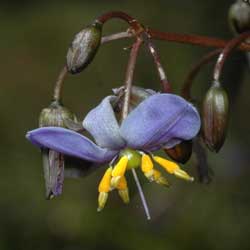
Blog reader Ma reminded me of the Flax Lily, a native plant well known to indigenous Australians – the Tasmanian Flax Lily is the Dianella tasmanica.  The purple flower petals spread around glowing yellow stamens and are very distinctive when you come across them in the bush. The resulting fruit are glossy purple berries.  The photos below come from https://www.anbg.gov.au/gnp/interns-2009/dianella-tasmanica.html

dianella-tasmanica-flower dianella-tasmanica-berries

Apparently the berries of mainland Australia’s varieties are edible and taste something like grapes, and can be made into jam.  When walking, I have simply admired their colourful occasional presence in native bushland whenever I have seen them.

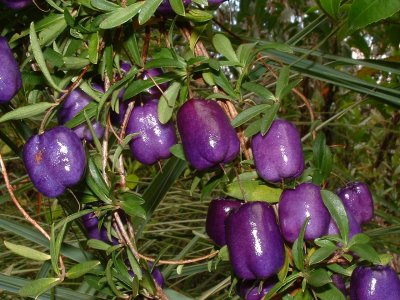
Tasmania has an additional plant with brilliant purple berries.  It is the Billardiera Longiflora otherwise known as the Mountain Blue Berry or Mountain Berry. The photo below is taken from http://www.wildseedtasmania.com.au/climber.php

 Mountain Blue Berry

The same site indicates these berries are edible. I have passed these berries many times when walking in the bush but I have never picked or eaten any.  I rather like the idea of leaving the bush as I find it.

The Outlaw Gardener at http://outlawgarden.blogspot.com.au/2013/08/billardiera-longiflora-my-favorite.html presents a range of stunning photos of the Mountain Berry.

Food for the walk – part 2

Recently my post Food for the Walk (https://walkingthederwent.com/2015/07/31/food-for-the-walk/) explained my process for creating a soupy stew from a variety of dried vegetables and dried minced turkey. This tasted heavenly and was extremely nutritious. I have now repeated the recipe but substituted dried strips of chicken leg meat for the turkey.

20150805_133946

I soaked and cooked the collection of ingredients for the same length of time given for the first experiment – but this time, despite the flavours being richly tasty, the chicken remained tough, stringy and dry.  My guess is that mincemeat is the preferable food for drying so I will try minced chicken for the next experiment.  I have now soaked and cooked the remainder of the previously dried chicken for hours; but it never became deliciously nor softly edible.  One failed experiment.  Ah well – a new learning.

Yam Daisies

Thanks to information and photographs supplied by blog follower, Ma from Melbourne, I will be more alert for the plant and flower Microseris scapigera or Microseris lanceolata known by indigenous Australians as Yam daisy or Murnong. Ma told me these plants would provide nourishment as I walked.

Yam daisy Microseris-scapigera-2-226x226

The photo above is located on http://www.victoriannativeseed.com.au/?product=yam-daisy . As the flower continues to open, the similarity with our common dandelion becomes obvious, and a number of websites suggest the dandelion head is similar to the seed head of the Yam Daisy.  It seems perfectly understandable that this plant may be referred to as the native dandelion and it explains why, when walking in our bushland affected by the intrusion of exotic plants, the possibility of misidentification exists. From Wikipedia I have learned that ‘the Tasmanian form is markedly smaller than the mainland Australian form’.

According to http://www.anbg.gov.au/gardens/visiting/exploring/aboriginal-trail  ‘This small perennial plant … has a radish-shaped tuber, which is renewed each year. In the spring the plant forms a yellow flower-head like a dandelion, and in the summer the leaves die off and the tuber becomes dormant. The tubers were cooked in baskets in an earth oven, producing a dark sweet juice which was much liked.’

The Yam Daisy has offered a traditional source of food for indigenous Australians. Wikipedia claims the tubers were ‘prepared by roasting or pit baking; the taste is described as “sweet with a flavour of coconut’.  Sounds yummy to me! The website http://www.parksaustralia.gov.au/botanic-gardens/pubs/aboriginal-plantuse.pdf tells us that the ‘Yam Daisy was a most important staple food. Women dug the roots with digging sticks and then roasted them in baskets in an earth oven. Digging for roots turned over the soil and thinned out the root clumps, two ways of encouraging plant production. Aboriginal people didn’t take the lot or there’d be none left for next time! Aboriginal people believed that the roots of ‘murnong’ should not be collected before the plants flowered. This was probably because during the drier winter period before springtime flowering, the roots would not be fully developed.’

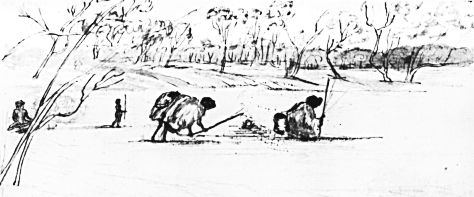
Women digging roots of yam daist State LIb of Vic

The drawing above by J.H. Wedge (1835), showing women digging roots of the Yam Daisy, is held in the collection of the State Library of Victoria. You can see a detailed drawing of a digging stick at https://www.anbg.gov.au/aborig.s.e.aust/roots.bulbs.html.

According to https://tasmanica.wordpress.com/tag/yam-daisy/ ‘… the Yam Daisy (Microseris lanceolata) or ‘Murnong’ as it is known by tuber hunting aborigines on the mainland, has a convoluted history. This makes it a subject of ecological and evolutionary interest to biologists. Its closest relatives are found in western North America. Based on morphological and chromosome studies, the Yam Daisy probably came about by the hybridization of two American species followed by long distance dispersal – quite a distance I might add. So it goes that aborigines were eating foods of American origin way back. This marvellous feat of intercontinental dispersal has been confirmed more recently by studies using DNA extracted from the chloroplasts (cpDNA) of American and the Australian/New Zealand species of Microseris (Vijverberg et al. 1999).’

In my walks along the Derwent River, I have seen these Yam Daisy flowers from time to time. Of course, next time I will look at the plants more closely.

Australian stamping grounds

Blog reader, Ju, surprised me with an unexpected gift; a freshly minted set of postal stamps.  Recently Australia Post released the set noting 4 Great Australian Walks: The National Pass in New South Wales, the Cape to Cape Track in Western Australia, the Larapinta Trail in the Northern Territory, and the Overland Track in Tasmania.

20150804_173448

On each of the four gloriously coloured stamps, a photograph of an iconic landscape represents each Walk. On the edge of each stamp, a white featureless body with a pack-on-the-back shape represents one or more people walking. Mentally you can pop yourself into the body and become that walker.

20150804_173629

The image for Tasmania’s Overland Track is Cradle Mountain. This marks the commencement in northern Tasmania for the 60km walk which winds southwards and ends at Lake St Clair (regular blog readers know the southern end of that Lake is where the Derwent River commences its life).  I walked the Overland Track in 2006 and strongly recommend it to others; leisurely – over 6 days with walks off the main path and plenty of time to soak in the atmosphere.  I remember that when I saw some of the mountains on the west coast of Tasmania way in the distance, I realised Tasmania was not so large. I thought it would be possible to walk across this state from the east to the west but I have not pursued that idea. Yet.

20150804_174429

Looking across to Cradle Mountain and beyond, and at its reflection in the pristine Dove Lake at its feet, I can see a light powdering of snow.  Currently, snow is very topical.

Over the past few days, Hobart and the rest of Tasmania have received loads of snow the likes of which hasn’t been seen here for 30 years.  News and social media are brimming with sensational photos many showing the thrill of this unusual flurry: for example, http://www.abc.net.au/news/2015-08-03/snow-across-tasmania-forces-many-key-road-closures/6666838 and http://www.news.com.au/national/tasmania/cold-brings-warnings-and-snow-wonder/story-fnn32rbc-1227467164313.

Most appropriate for this blog about Walking the Derwent, is the photo I found of The Hungry Wombat Café at Derwent Bridge (the township at the southern end of Lake St Clair to which I will walk sooner or later). When you look at the photo below (taken from the website above), you will understand why I am not walking inland at the moment.

Snow at The Hungry Wombat Cafe Derwent Bridge 030815

Wild West with Ray Mears

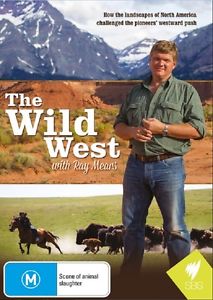
Blog reader, Be, alerted me to the third in a BBC program series, ‘Wild West with Ray Mears’. This episode focused on mountains and followed Mears travelling through the Appalachians, the Rockies and the Sierra Nevada to evaluate the landscape and its effect on the early European settlers as they moved west in North America.  Be indicated there was river edge walking and this reminded her of my quest to walk along the Derwent River in Tasmania – so I was eager to watch the documentary.

Ray Mears and Wild West DVD cover

I found that Ray Mears did access various rivers and streams to emphasize parts of his story, but direct connections to my walking project were slight. However, I found his story to be important because it has prompted me to ask new questions about the Derwent River and its most recent European settler history.  Hopefully others have already conducted research and can supply me with some answers – any leads will be welcome.

  • After initial settlement in Van Diemen’s Land at Risdon on the Derwent River in 1803, what was the nature of the westward push along the Derwent River by European settlers? Do we have names of the people and families of those who moved west? What are the dates associated with these movements?  What are their stories?
  • Why did they move along the River? Did they stop and set up camp, house or agricultural property? Do those buildings or farming properties still exist?  Is the land now in private or organisational hands or is it Crown Land? Or were people only passing through?  If so, what was their intended destination? Did people moving inland along the Derwent find some parts of the wilderness edging the River made their further progress impossible so that they moved away from the River? What are the movement stories?
  • To what extent was the River used for transport between Lake St Clair and New Norfolk? Where and when? What was transported on the River? Can anyone name ships/boats that were used? Were there recognised ferries across the River above New Norfolk?  I know the Derwent River has a series of rapids further towards the source.  Did these inhibit river travel?
  • In the rivers of the United States’ Rockies mountains, the ‘mountain men’ trapped beavers for their fur. Their fur was used to create a strong felt which could be used for those increasingly tall hats that were fashionable in the 18th century. What was the nature of any trade in possum skins and those of other animals that might have persuaded hunters to walk the Derwent River?  What are their stories?
  • Massive removal and usage of natural resources supported the westward movement of European settlers across America. When did forestry operations and logging commence west of Hobart in the Derwent Valley and how was the Derwent River used to support those operations? What mining expeditions and investigations were made along the Derwent River? When and by whom?  What were the outcomes of these searches and trials and finds?

Ray Mears met with a muleteer who explained why he loved being in the wilderness: ‘I leave no trace as I pass and just move through like a shadow’.  I hope that is how I walk.

Shelter for the walk

In future months I will be sleeping out on a few nights when I head off from New Norfolk towards Lake St Clair trudging beside the Derwent River. In the past few days I have outlaid outlandish sums of money when I purchased the lightest sleeping bag and tent.  Collectively they weigh 1.99kg.  We all have our priorities and mine is clearly to walk to Lake St Clair with the minimum of discomfort.  For others who might follow in my footsteps and expect to seek the lightest gear, as an example here is what I bought.

  1. The tent, a Marmot Force 1P, has a bright lime green shell supported by slim ‘Featherlite’ steel rods. In this one person tent I will be able to sit up (head zone is 91cm high), load the contents of my backpack at my feet (length less than 2 metres), and sit my backpack outside in the triangular vestibule.  It has a full coverage fly. The documentation with the tent indicates the package weighs 1.06kg.

20150802_173401 20150802_173814

Yes this is the tent set up in the comfort of my loungeroom!  It was a trial installation; first the tent and then the fly.

  1. The sleeping bag is a Mountain Design Ultra Tek 470 with a black 20 Denier shell, a vivacious orange coloured zip defining one edge and the inside of the bag is aflame with more brilliant orange fabric. Pertex Quantum is the windproof fabric used to reduce the weight without sacrificing strength and abrasion resistance. IApparently the fabric’s softness allows insulation in the sleeping bag to have more loft. A special feature is the water repellence of the 750 Duck Down Tek fill. The sleeping bag, including the stuff sack, weighs a mere 0.93kg.

Sleeping bags are temperature rated in 3 different measurements:

  • Comfort (C) is based on a standard adult woman having a comfortable night’s sleep
  • Limit (L) is based on the lowest temperature at which a standard adult male is deemed to be able to have a comfortable night’s sleep
  • Extreme (E) is a survival only rating for a standard adult woman

The temperature rating guide for my sleeping bag is C=1, L = -4, and E = -21 degrees.

20150802_171904

I still need to obtain one further comfort item; an inflatable mattress which weighs next to nothing.  More research required.

Food for the walk

I have been planning for overnight camps, which I will need to make when I continue walking into the wilderness along the Derwent River.  On many occasions, the highway, byways and back roads will be far distant from the River making it necessary to pack shelter and supplies for one and two overnight stops. I know I won’t be able to carry much weight and so all things feather light are being researched and sought.

As part of my preparation, recently I purchased an Ezidri food drier.

Ezidri Ezidri mesh layer Ezidri ordinary layerDried food

Over time I have sliced spring onions, carrots, beetroot, capsicum, garlic, leaves of silver beet and mushrooms, and reduced them to tiny dry twigs and flakes. In addition, I have dried pulled slivers of precooked chicken legs and turkey mince.  During the process four bananas were sliced and dried. Can you identify all the shrivelled remains in the glass jars above?

Yesterday I experimented with reconstituting some of these foods and making a meal – albeit on my kitchen stove top.

Firstly, I added a small portion of all the vegetables plus a small quantity of the turkey mince into a small zip lock bag.  Then I sprinkled a little cayenne pepper, ground a few fresh back pepper corns and sea salt crystals, and added a small teaspoon of chicken flavoured powdered stock into the zip lock bag.  After closing the bag I shook it to mix the ingredients.  Into my billy I poured these dry contents and then added a 600ml bottle of cold water.

I was curious to learn how long it would take for the meat and vegetables to swell and soften.  After 15 minutes I could see that full reconstitution had not occurred. However, I was bored with waiting and I imagined that in the bush I would be ravenously hungry.  For the sake of the home experiment, I decanted the ingredients into a normal saucepan and cooked the meal on my kitchen stove top for 10 minutes.

I am delighted to say this was one of the best tasting meals I have had in a long time.  The liquid was gloriously coloured by the beetroot and despite many of the vegetables not being fully reconstituted, all the food was soft and full of original flavour.

When still in the zip top bag before cooking, I weighed the meal: only 100grams.  This low weight is very encouraging. My next experiment will be to cook a meal using the dried chicken. I can only imagine that should be equally successful.  But more research required.

Searching for aboriginal history along the Derwent River; rethinking my approach

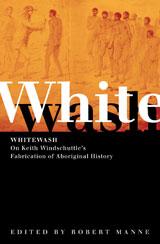
Thanks to the clarity of writing in Greg Lehman’s chapter ‘Telling us True’ (Manne, R Ed. 2003 Whitewash On Keith Windshuttle’s Fabrication of Aboriginal History, Black Inc. Agenda, Melbourne), I am rethinking my approach to ‘discovering’ and reporting on the ‘true story’ of aborigines living along the Derwent River prior to European settlement.

Whitewash book cover

Greg explains “In Aboriginal English, the word ‘true’ has a very specific intent, but a rather elusive meaning. ‘Aw – true!?’ will be a familiar phrase to anyone who knows blackfellas. It is a question of authenticity and at the same time of an apprehension of reality. The phrase encompasses much of what it is to communicate within a cultural space inhabited by Aboriginal people. This is a space within which ‘fact’, ‘reality’ and ‘certainty’ are secondary considerations to the act of communication. ‘Having a yarn’ is more governed by the protocols of respect, trust and companionship than by the imperative to explore the veracity of a statement. Rather than listening with an expectation of photo-accurate observations of a subject, hearers of a ‘yarn’ listen for meaning, nuance and metaphor. And only by knowing the person speaking – or at least her family – are you likely to get more than a minimum of what is really being said. For us, the ‘truth’ is made up of countless, contradictory, ironic and provocative elements, woven together into an allegorical, sometimes fictive documentation of what it is to live our lives.”

One implication of this comment is that all ‘facts’ cannot be known nor understandings developed in one meeting. Talking with people takes time and, of course, further chats take more time.  So I feel encouraged to slow down the process of my investigation to allow for a bigger picture to emerge, when I reach the research stage of listening to oral histories.

In addition when I read this comment, I was reminded that depending on our personal backgrounds and experiences we always ‘know’ or believe something to be true and we often then say ‘it’s a fact, I saw it, smelt it, felt it’, etc.  However, experience with friends, colleagues, relatives and strangers let us know that any of our truths is likely to be different from another’s. For example, when police ask two eye witnesses at an accident or crime to detail what they saw, their true stories will be different, even if similar.  So I am left wondering what aspect of aboriginal history can I ‘discover’ and report on without making an interpretation.  Will such a job be possible?

When Lehman added “The historic event, which contains real acts; the archaeological site, containing real artefacts; the human life, containing real experience, are just snapshots in history.  They are in themselves meaningless.  Without an observer or an interpreter, they have no life, no implication for the present and no wisdom for the future. The space between these snapshots is a vacuum that necessarily fills …” I can see that weaving a story around any ‘facts’ in order to make connections will be problematic if I hope to present a ‘true story’.

Further along in his chapter, Lehman notes “…sources of ‘social understanding’ are usually referred to by sociologists as authority and tradition.  But it is an error to consider these as fixed or providing a constant benchmark of truth …” Earlier postings in this blog indicate the start for my research project is the printed and written word of Europeans. To rely on this ‘evidence’ alone would be to forget that any ideas and comments represent limited points of view, and that any ‘truths’ would necessarily be fashioned from particular experiences and the constraints of the colonial environment. Lehman’s comments remind me that caution is required.

Disbelief in a single, privileged truth is what frees us from the power of prejudice.”  I hope I can remember to question every idea that I read, and all those which come to mind. In addition, I hope I will always consider the impact of my written words.

Searching for my place in history

When I talk with strangers about my project to walk from the mouth to the source of the Derwent River, people often ask why. I trot out a range of reasons but, in truth, it is never clear to me at a deep level why I am making this walk.

My experiences over the past few days have given me new insights.

Earlier this year I began immersing myself in family history searches, with the view to knowing something of family members who were born and had died before me.

When I realised that the 150th anniversary of arrival in Melbourne Australia from England of the first family with my surname, from which I am a directly descended, will occur next year (2016), I decided to find and see where they lived in Victoria. Last Friday, I walked the Melbourne suburban streets of Carlton and the areas governed by the Boroondara City Council in Hawthorn of Glenferrie, Auburn, Deepdene, Kew and Camberwell.

I found all the streets in which my great great grandfather lived, however his houses have been replaced with various vintages of newer architecture. The landscape was changing while he lived in Melbourne when massive land sale and building booms wiped away acres of farmlands. And, of course, since he died in 1889 ‘development’ has progressed.  Nevertheless, because homes built in the 1880s still exist with their facades intact, I developed some understanding of what an original streetscape might have looked like during that decade.  Unfortunately late 1860s and 1870s buildings are no longer in evidence.

Throughout my-day long walk, I felt very much attached to the areas where he lived. A weird sense of belonging.  Albeit transient. And I was profoundly happy that in every street, one or more magpies warbled as they watched my progress.

My father’s family home, located in rural central Victoria, has always been special to me. It was during my early childhood visits that the music of the magpies perched on trees above nearby gold-mine slag-heaps, caught my attention. I have loved their intelligence and beauty ever since. Therefore, I should have not been surprised when I made a trip to the family home on Saturday and the wonderful sounds of magpies made me weep.  It seems the melodic notes of these black and white beauties provide me with a marker of family places, and also to other places where I gain so much pleasure.

Throughout my blog postings following the walking stages along the Derwent River, I have recorded my observation of magpies, and my delight in their song.  Rarely do magpies fly through my part of suburbia, so now I realise that part of my purpose for walking the Derwent is to hear the glorious communications of magpies. I guess it is my way of finding my place, as I make my own history – which becomes part of my family history.

A traveller – at the Salamanca Market set up by the Derwent River

Since April I have been waiting for the weather to warm up so I can continue my walk to the source of the Derwent River more comfortably. Between then and now my posts have connected with the Derwent River by various degrees. This posting is no different. Months ago I walked past historic Salamanca in Hobart as I walked the edge of the Derwent River and last Saturday, I headed back again to the area for the renowned Salamanca Market.

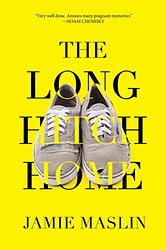
The big find was an Englishman who has relocated to live in Tasmania and had set up a stall to sell his book.  A few years ago his Tasmanian wife lured him here for a holiday and when she flew back to England, he decided to return by hitching his way half way around the world.  After starting from Hobart by accepting a lift on a Sydney to Hobart Yacht Race yacht returning to Sydney, his trek took 6 months via the countries north of the Himalayas.  Apparently it only took 800 rides, through 19 countries! Out of the adventure and experiences Jamie Maslin wrote his story: ‘The Long Hitch Home’.

The Long Hitch Home Jamie Maslin book cover

In more recent times, Jamie has relocated to Hobart for permanent residence.

Past posts have indicated my awe and amazement about the achievements of people who take on, what seem to me to be, herculean tasks – These always excite me to make yet another step.  Inspiring others to make the first step in their own backyard is one of the goals of this ongoing blog.

Where will I find authentic and reliable information about Tasmania’s aborigines prior to 1803?

This question has been asked because I am not concerned with researching European settlement or its impact on Tasmania’s indigenous population.

It seems that three categories of information sources might be used for my study:

  1. the written/printed word,
  2. material anthropology, and
  3. oral histories. Such histories might exist in association with the continuance of authentic movements such as dance and sound making.

As stated in an earlier post, the original settlers in Van Diemen’s Land, the descendants of non-indigenous peoples, and other non-indigenous people have left historical written/printed documentation. In addition, exploring visitors to this island before European settlement made written records. Each of these writers will have their own perspective, and so my challenge will be to remember what they write is not necessarily a fact. This means I will need supporting and corroborating evidence of other kinds; material artefacts and/or oral histories.  I do not expect to find any early 19th century documentation written by Tasmanian aborigines – but I would be very excited to read such records if I should find them.

James Joyce, in his essay “Fantasy Island” (Manne, 2003, Whitewash Black Inc. Agenda, Melbourne) refuted the evidence of Keith Windshuttle’s book (2002, Fabrication of Aboriginal History: Volume One, Van Diemen’s Land 1803-1847 Macleay Press, Sydney) when he declared ‘Windshuttle can impose his contemporary conclusions on Van Diemen’s Land history only by limiting the selection of sources …’.  Joyce’s position reminds me to stay focused and to explore broadly.

At the moment, I have started working through a mountain of freely available reference material seeking clues as to what I might need to follow up with careful research.  As yet, I have found very little that pertains to the Derwent River. These are early days during which I will come to an understanding of the limitations and challenges of my project.

The scope of my research into Tasmanian aboriginal history

My last post generated lots of interest so this post should clarify my intentions.

Principally, I plan to gather information about the aboriginals who frequented the area along the Derwent River, from the mouth to the source of the River. My research aims to collect and collate reliable and authentic information about the life of the indigenous communities prior to European settlement in Van Diemen’s Land/Tasmania.  In so doing, I hope to be able to understand the value of the River to early indigenous peoples, as well as the way the topography influenced their lives.

This study will not consider –

  • interactions with new settlers, convicts or any other non-indigenous person
  • the effect of European settlement on the lives and practices of the indigenous community
  • the history of mainland indigenous peoples

I suspect I may be challenged to present a ‘before and after 1803’ scenario of the situation for aboriginals.  Others have researched and written on this aspect generally although not specifically focused on the Derwent River, and I am seeking a fresh perspective which is not encumbered by conflict with European settlers in early Van Diemen’s Land.

The periods of history about which I want to collect information, are –

  1. before European settlement
  2. at the moment of European settlement in 1803
  3. some years after 1803 to later in the 19th century – this is deliberately loose to allow for non-indigenous people many decades later who have a first-hand experience, to contribute any information they have about any authentic aboriginal practices – but I will only be looking for those indigenous practices which do not seem to have been altered as a result of European settlement.

This quest will occur intermittently because it will compete with the priorities of my other projects and commitments.

Commencing research about the original aboriginal communities living and walking along the Derwent River

In earlier posts, I acknowledged the original aboriginal custodians of the land over which I have walked: refer to https://walkingthederwent.com/2014/08/21/acknowledgement-of-country-to-the-moomairremener-people/, and https://walkingthederwent.com/2014/11/10/the-paredarerme-people-the-original-indigenous-owners-of-the-land-along-the-derwent-river/.

My last blog posting referred to a book telling the story of a walk from the mouth to the source of the Yarra River in Victoria on mainland Australia.  Many steps of the author’s journey were associated with aboriginal stories past and present and this made me wonder what could be learnt here in Tasmania around the Derwent River. The history of aboriginals in Victoria and elsewhere on mainland Australia, is very different to that in the isolated island state of Tasmania.  Around 10,000 years ago, when the sea rose to form Bass Strait, Tasmanian aboriginals were cut off completely from their relatives on the mainland of Australia.

From the 1870s, for the next 100 years, the official Tasmanian government line was that the entire aboriginal population had been exterminated. No full blood descendants of the original indigenous peoples have survived however there is a sizeable minority of population in Tasmania now who proudly declare themselves as descendants from specific aboriginal ancestors.

During these cold winter days, I have started research seeking to understand the lives of indigenous bands and tribes which roamed the land from the mouth to the source of the Derwent River.  My starting point is my belief (which may be found to be incorrect) that, prior to European settlement in Van Diemen’s Land (later renamed Tasmania),

  • indigenous peoples had a significant history with activities, practices, laws, dress, property that are unique as a collection, although individual aspects may be common with mainland indigenous peoples.
  • indigenous peoples had a perfectly functioning tribal family system
  • indigenous peoples had a perfectly functioning interaction system with other tribes
  • indigenous peoples had a perfectly functioning communication system with other tribes
  • indigenous peoples were thriving

Most historians, anthropologists, sociologists, other researchers and various document writers have introduced ‘facts’ and conjecture about the nature and impact of events subsequent to European settlement, and I suspect this has been to the detriment of understanding the original situations of indigenous people.   As a result, I suspect at least some people who identify currently as having Tasmanian indigenous heritage, focus more with the outrages of the past 200 plus years than with the life of their ancestors, pre-European settlement. I wonder whether historians, anthropologists, sociologists, other researchers and various document writers (almost all of whom were original settlers in Van Diemen’s Land, are the descendants of the non-indigenous peoples, or are in some other way, non-indigenous) have presented a clear picture of the nature of the original indigenous peoples without the shadow of events post-settlement in 1803. Considering the political activism of some of the descendants of the original indigenous populations, their attempts to censor studies and dispute evidence, and their destruction of ancient artefacts, it may not be possible to create a clear picture, however I plan to try (and it may take time).